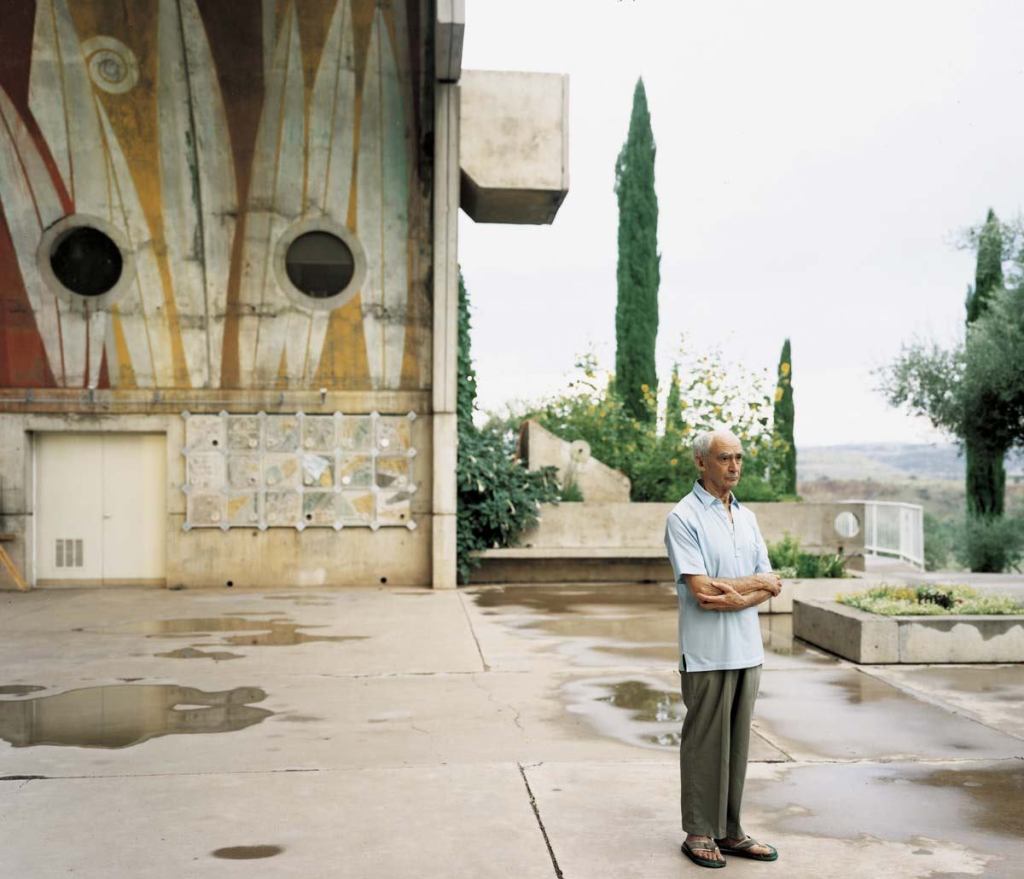
Paolo Soleri at Arcosanti

Cordes Junction, Arizona
August 2000

Throughout the 20th century, architects have been particularly ready to offer their visions of an idealized urban future. For Le Corbusier, a “Radiant City” would be appropriate to the machine age, providing a highly efficient and organized grid to facilitate modern life. For Frank Lloyd Wright, it was critical that everyone have their own patch of earth on which to realize their individuality: thus his “Broadacre City” not only necessitated personal land to live on, but a car to get there. The Italian-born architect Paolo Soleri is far less well-known to the public than Le Corbusier or Wright, but in the Arizona desert he is quietly building what is perhaps the world's only true prototype of a futurist city.

Paolo Soleri at Arcosanti, Cordes Junction, Ariz., August 2000

Paolo Soleri at Arcosanti, Cordes Junction, Ariz., August 2000

Credit: Joel Sternfeld

Arcosanti is an “Arcology,” a word used by Soleri to describe the harmonious marriage of architecture and ecology. Unlike Wright, with whom he studied, Soleri believes that it is the physical dispersal in the landscape permitted by the automobile that has led to moral and spiritual dispersal in society. By contrast, Arcosanti, planned for 5,000 inhabitants, will occupy only two percent of the land normally taken up by a suburban development. Residents work no more than a 10-minute walk from their homes, eliminating the need for cars within the city—consistent with Soleri's prophecy of the eventual extinction of the automobile. Reminiscent of the historic center of Italian cities, every aspect of Arcosanti's design, including numerous balconies, terraces, and piazzas, encourages a maximum of social interaction.

Soleri is also critical of excessive consumption of resources. To avoid wasting materials, gardens, solar heating, and natural cooling move the community toward self-sufficiency.

Arcosanti has been under construction for 35 years, self-funded by the sale of distinctive wind chimes and bells that are forged on site. It is being built by students and volunteers—progress is at once achingly slow and surprisingly fast. Visitors will find a substantial and unusual small community of about 50 permanent residents, and significant glimpses of a city that feels ancient and futuristic as it rises.

Ruins of Drop City

Trinidad, Colorado
August 1995

Ruins of Drop City, Trinidad, Colo., August 1995

Ruins of Drop City, Trinidad, Colo., August 1995

Credit: Joel Sternfeld


Three of the original founders of Drop City met as art students in Lawrence, Kan., in 1961. They referred to their practice of painting rocks and dropping them from a loft window onto the busy street below as “Drop Art.”

By 1965 the founders' desire to live rent free and create art without the distraction of employment led them to a six-acre goat pasture outside Trinidad, Colo., which they purchased for $450. Naming their community after their gravity-driven art was the easy part; building it a little harder. But having recently attended a lecture by Buckminster Fuller and now joined by a would-be dome builder from Albuquerque, N.M., they began with scrap materials and visionary optimism. Sheet metal was stripped off car roofs (for which they paid a nickel or a dime) and attached to the grid of a dome. These building materials not only provided shelter, but they also emblemized the group's refusal to participate in consumerist society. Money, clothing, and cars were shared, and they lived as quasi-dumpster divers.

Initially the community flourished. With a core group of 12, it functioned as the founders had intended, a hotbed of art-making. But a steady flow of publicity in underground and mainstream media, encouraged by resident Peter Rabbit, led to a torrent of guests. It has been reported that Bob Dylan, Timothy Leary, and Jim Morrison visited, but the historian's chestnut, the primary account, may be less than reliable when it comes to the 1960s. By the time the community decided to abandon its open-door policy, it was too late: The founding members had left, and conditions had taken hold that would bring about a final dissolution in 1973. In 1978 the site was sold; proceeds helped rent space in New York City for exhibitions of the group's work and to publish it in Crisscross magazine.

The domes sat on the land of A. Blasi and Sons Trucking Co. until recently, when they succumbed to gravity.

The Farm

Summertown, Tennessee
March 2003

The Farm, Summertown, Tenn., March 2003

The Farm, Summertown, Tenn., March 2003

Credit: Joel Sternfeld

When Stephen Gaskin, a charismatic philosopher from San Francisco, went on a speaking tour in 1970, his adherents followed him in buses and vans. After each engagement, a few more vehicles would follow along, until hundreds of people were in the caravan. Eventually, they bought 2,000 acres of land in Tennessee and began living communally as the Farm.

They lived according to “Agreements,” including a personal and collective dedication to “harmlessness, right livelihood, right thinking, etc., while maintaining a sense of humor.” All members agreed to a vegan diet, nonviolence, a shared purse, and voluntary poverty. Housing for the first several years consisted of used Army tents and the buses and vans in which they had traveled.

As the population steadily grew to 1,400, the Farm gained self-sufficiency in food production and took on the aspect of an at-once primitive and technically advanced small town, dedicated to humane enterprise. Soybean farming and research led to commercial sales of soy products such as tofu, tempeh, soy yogurt, and Ice Bean, an ice cream equivalent.

When an earthquake devastated Guatemala, the Farm sent its charitable arm, Plenty, with carpenters and workers to aid in rebuilding; an ongoing relationship with communities in Central America resulted. When municipal ambulance service in New York City's South Bronx became unconscionably inadequate, the Farm began its own voluntary ambulance corps there.

As the Farm grew, Plenty expanded, and satellite farms in 20 states and foreign countries were founded. To stay in touch, a group of ham radio operators living at the Farm developed innovative space-based communications and an electronics manufacturing center, which helped serve the Farm's broader environmental aims.

The Farm has developed solar hybrid vehicles, the doppler fetoscope (for amplifying the heartbeat of a young fetus), portable concentrating solar arrays, and numerous other inventions, but the one device that has remained constantly in production and a financial success is the Nukebuster, a pocketsized Geiger counter with a built-in alert system. After the Three Mile Island and Chernobyl disasters, sales of Nukebusters boomed. The resulting profits played a critical role in saving the Farm during a crisis in 1983, when crushing debt and a national recession nearly brought to an end one of the most important alternative communities of the modern era.

Sonora Cohousing

Tucson, Arizona
March 2005

Sonora Cohousing, Tucson, Ariz., March 2005

Sonora Cohousing, Tucson, Ariz., March 2005

Credit: Joel Sternfeld


In many ways Sonora Cohousing is typical of all cohousing—numerous environmentally sound practices are woven into the 36 homes and throughout the 4.7-acre site. Townhouses sit in groupings of three or four units around highly landscaped “placitas,” forming natural conversation points in the landscape. The “green-built” homes are energy efficient, with active and passive solar energy elements, and are structured to facilitate water harvesting. The community's 3,500-square-foot common house is built from straw bale. Sonora's social practices are also typical of cohousing: community, collaboration, conservation. But the most unusual aspect of the community is no longer visible to the eye: Sonora cohousing is intentionally built on an urban infill site.

“Infill development” refers to the practice of making use of underutilized or empty sites within urban areas. The founding members of Sonora wanted to avoid destroying untouched desert—“blading unbladed land”— or becoming part of the suburban sprawl that requires new roads, sewers, and schools every time a developer “leapfrogs” to build a community further out from the city center (developers are motivated to do so because the farther land may be less expensive—and offer better “access to nature”). The founders of Sonora not only made a choice for infill, they also adhered to the criteria that the site must be accessible by public transportation (in this case bus transportation) and that shopping must be within walking distance. What's more, they chose a neighborhood with a high crime rate by Tucson standards, and yet they refused to become a gated community. This has meant that bicycles, and charcoal grills and watermelons, are occasionally stolen—but it also allows for meaningful interactions with neighbors (the three nine-year-old girls who stole the watermelon came back and sought out its grower to apologize).

Something else invisible in this photograph: When the garden was being built, resident Don Arkin helped to create a compost area by building a wall around it. The much-disliked, stucco-like material he used was referred to as “doncrete.” An artist resident, Kendra Davies, created the mural that covers it without going through the community approval process. To date no one has objected.

An Earthship at Earthaven Ecovillage

Black Mountain, North Carolina
April 2005

An Earthship at Earthaven Ecovillage, Black Mountain, N.C., April 2005

An Earthship at Earthaven Ecovillage, Black Mountain, N.C., April 2005

Credit: Joel Sternfeld

Earthships, invented by American architect M. K. Reynolds, derive their name from his idea of them as “independent vessels to sail on the seas of tomorrow.” They are generally made from tires filled with rammed earth, though sometimes of bottles and cans. They are often configured to maximize the surface area on which solar panels can be placed and typically have rain catchments and a filtration system for water (the circular object seen at the corner of the building is a cistern). Not visible in this photograph is an all-glass south facing wall. In the winter when the sun is low in the sky, sunlight pours through it directly into the home. The warmth that results is retained by the high insulating coefficient of the three earthen walls enabling the house to be 68 degrees with minimal heating. In the summer, when the sun is overhead, the cool earthen walls maintain 68 with little or no additional cooling. This home is sited so that on Dec. 21 the sun is just over the horizon of the ridge to the east.

The house is one of numerous innovative structures that comprise Earthaven Ecovillage. Because Earthaven's 320 acres are mostly mountainous forest, all dwellings are built on slopes, leaving flat ground available to become agricultural fields. Though still under construction, Earthaven has been completely off the grid since its inception in 1994. The central village is powered by a micro-hydro system, and the water supply comes from a natural spring and is stored in a 10,000-gallon water tank. Homes in the community are built of natural or recycled materials, and the entire site has been planned as a model of permaculture design.

Members pay annual dues, share title to the land, and participate in a consensus decision-making process. Each community member is responsible for earning his or her own living. The village-scale economy includes numerous ecologically sound businesses, such as Red Moon Herbs and Permaculture Activist and Communities magazines.

The community doesn't have a single village-wide spiritual practice. “What many of us have in common is a reverence for the Earth and our land, and the belief that our land is alive and conscious and it's our sacred duty to honor and care for it.”

Heathcote Community

Freeland, Maryland
May 2005

Heathcote Community, Freeland, Md., May 2005

Heathcote Community, Freeland, Md., May 2005

Credit: Joel Sternfeld


When Ralph Borsodi founded the School of Living in the 1930s, the terms “permaculture” or “sustainability” did not exist. Borsodi was simply a philosophical man whose life led him to believe that a return to the land was the cure for all that ailed civilization.

His background might have predisposed him to think this way: His father had written the introduction to Bolton Hall's A Little Land and a Living, a book which led to the founding of Little Lander colonies in California. But the real impetus occurred in the early 1920s when the house in which he and his wife were living was sold, and they found themselves without a home. They moved to the country and began homesteading. As he acquired the skills necessary to live in the country with self-reliance, Borsodi began to work on his ideas, producing treatises such as This Ugly Civilization and Flight from the City. His writings influenced many, including Helen and Scott Nearing who moved to the country a few years later and whose own writings also encourage self-reliant, agricultural life.

The School of Living was founded to teach the pragmatics of small-scale subsistence farming and living, such as carpentry, organic gardening, and food storage. Self-sufficiency was at the core of his belief system, but he also considered the broader aspects of modern society and was particularly concerned about the overuse of nonrenewable resources—a topic of great importance today.

After World War II, Borsodi's mission was taken up by Mildred Loomis. In 1965, under her leadership, the School of Living purchased a 150-year-old gristmill in Maryland to serve as the center of a community where the pursuit of personal and spiritual growth could be interwoven with a lifestyle respectful of the land.

Heathcote, as it was named, has thrived, and in accordance with its communal belief that we live on a planet in crisis, it practices and teaches permaculture. A contraction of the words “permanent agriculture” and “permanent culture,” permaculture is a philosophy that informs an approach to planning, building, and maintaining sustainable systems, the ultimate expression of which is a sustainable community. Nature itself is the model for permaculture; close observation and working in concert with the natural world are at the heart of this thinking.

The long foreground of Heathcote—from Borsodi's personal transformation to Mildred Loomis's assumption of leadership; from Heathcote's formation as a 1960s commune to its present role as a center of permaculture—offers a model of communal evolution.

Prairie Crossing

Grayslake, Illinois
May 2005

Prairie Crossing, Grayslake, Ill., May 2005

Prairie Crossing, Grayslake, Ill., May 2005

Credit: Joel Sternfeld

Six weeks before this photograph was made the lawn was on fire—in a controlled burn. At Prairie Crossing, homeowners are encouraged to integrate native plantings and restored prairie into their landscaping and to recreate the true natural cycle of the prairie by burning it periodically.

Prairie Crossing is a privately funded community, founded by Vicky and George Ranney and Dorothy and Gaylord Donnelly when a large parcel of farmland threatened by high-density development became available for purchase. They decided to use the land in a manner that was consonant with the rural character of the area. Funds generated from the sale of homes in the community have gone toward restoring surrounding prairie: 60 percent of the 677-acre site is protected open space, including 165 acres of restored prairie and 20 acres of restored wetlands. Sixteen acres of old hedgerows—tough trees planted in columns to act as a wind block—have been preserved at Prairie Crossing, not only for their historic interest but also because they function as a wildlife corridor.

Hardier and more sustainable native plants require less water and maintenance than conventional flora, and serve an important function in cleansing storm water as it flows into local lakes. Prairie Crossing's Lake Aldo Leopold has water of such high quality that it was selected as a site for breeding endangered species of fish.

Besides its commitment to environmental protection and enhancement, many other aspects of the community's development plan—an on-site organic farm, a regional trail open to the public for hiking, biking, horseback riding, and cross-country skiing, and a policy favoring economic and racial diversity—serve to indicate that private development can not only be responsible, it can take a proactive role in saving and preserving endangered landscapes and promoting societal good. In the words of Vicky Ranney, “You couldn't save all the land you needed to if you depended on the government.”