A building’s structure is typically classified by one of three primary materials: steel, concrete, or wood. Architects routinely discuss these three options, and debates rage regarding the virtues and drawbacks of one material versus another. Yet, the reality is not so discrete.
Practically all contemporary buildings include some of all three materials. A reinforced concrete building incorporates significant amounts of steel, and buildings made of wood or steel almost always include concrete foundations. Even steel or concrete frame construction often incorporates wood elements, such as formwork or blocking. In other words, contemporary architecture is a hybrid construction in which the distinctions between materials are more nuanced and their relationships more interdependent than typically regarded.
In fact, material hybrids are becoming increasingly common, even within dedicated industries. (For example, at the American Institute of Steel Construction’s 2026 NASCC Steel Conference in Atlanta, steel-wood hybrid construction was a recurring topic.) Rather than juxtaposing individual materials as competing systems, a growing number of engineers and architects are exploring how different materials can complement one another, optimizing for each material’s strengths while minimizing their respective limitations.
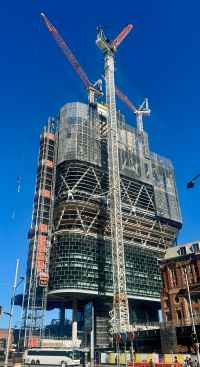
Atlassian Central, Sydney, is currently under construction and expected to be complete by 2026, when it is expected to reach a height of 182.6 meters and become the world’s tallest concrete-steel- timber hybrid building. Photo: SnowyRiver28, CC0, via Wikimedia Commons.
A notable example of contemporary hybrid construction is the Atlassian Central in Sydney. According to the design architect Shop, the project will be the world’s tallest commercial hybrid tower. The building consists of glulam columns and CLT floor systems integrated with steel exoskeleton components and concrete structural cores. This steel-and-concrete superstructure supports seven four-story-tall “habitat” modules, akin to individual timber buildings held within a larger frame.
These modules have direct access to interior landscapes and natural ventilation, and the building’s operable facade will reduce the need for air conditioning. The steel provides long-span capability and lateral stiffness, while the wood contributes warmth, carbon storage, and a lighter structural footprint. Meanwhile, the concrete offers rigidity and fire separation where required.
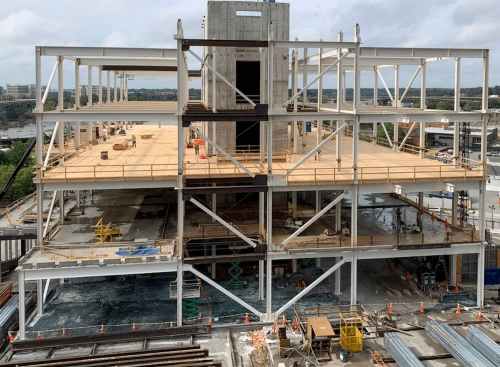
Pickard Chilton’s Foundry South, a 121-foot-tall amenity building in Richmond, Virginia, is another recent example. Engineered by Magnusson Klemencic Associates (MKA), the steel-and-timber hybrid structure is one of the first of its kind in the U.S. Serving as a corporate campus hub with an auditorium, cafeterias, and a gymnasium, the building required large, column-free spans suitable for steel construction.
However, the client aspired to incorporate wood in a significant way, despite timber’s relatively short spans. Not unlike Atlassian Central, the solution was to couple mass timber slabs with steel framing, thereby leveraging steel’s long-span capability and minimal physical footprint while leveraging CLT panels’ visual appeal and minimal carbon footprint.
While Foundry South uses discrete structural elements, the engineer WSP is developing hybrid components. The firm’s CLT-Steel Composite Floor (CSCF) consists of cross-laminated timber panels with integral steel beams. Developed with the University of Warwick School of Engineering as a low-carbon replacement for precast concrete floor slabs or composite steel decks, CSCF is composed of CLT floor panels with embedded transverse reinforcement that connect to steel beams via shear studs.
Concrete is used to fill panel notches and the joints between panels. Currently testing the system for commercialization, WSP and the University of Warwick estimate that the CLT hybrid floor plate represents a 60% reduction in embodied carbon—and a 60% to 80% reduction in the expected number of material deliveries—compared to concrete or steel flooring systems.
Novel hybrid systems not only represent material changes but also procedural ones. Focusing on construction sequencing, the engineering firm TYLin has developed RapidRise, a hybrid system that promises to reduce overall construction time, cost, and effort. Unlike most sequencing methods that take a bottom-up approach, RapidRise builds from the top-down. The process begins with the erection of a multistory, structural steel frame. A post-tensioned concrete slab is then poured as the uppermost floor. Once cured, this slab’s formwork is lowered to the level below, and the process is repeated until all floors are installed.
The construction of Foundry South also involved an uncommon sequencing approach. As with RapidRise, the erection of the steel frame advanced before the floor construction. In this case, however, the prefabricated CLT floors were installed in a bottom-up sequence, before the steel framing was complete. This interdependent sequencing required careful coordination with the construction crane operator, who installed both the steel and timber elements. It is, therefore, paramount that construction logistics be considered with any atypical hybrid system design.
As these examples demonstrate, monomaterial construction systems are not only rare but also increasingly uncommon, as novel hybrid configurations emerge that aim to maximize a given material’s strengths while minimizing its weaknesses. Certainly, these systems present their own challenges.
For example, fire propagation concerns at Foundry South led MKA to explore uncommon details, such as extending the steel beams’ intumescent coating by an extra 4 inches along the bottom surface of the CLT slabs. Despite the limitations, the improved environmental and aesthetic performance of hybrid systems can justify the additional time and effort required for such considerations.
Most importantly, these strategies suggest that technical innovation and environmental innovation are not separate agendas, as they are often regarded. Rather, the two aspirations converge on the same design problem: achieving optimal functionality in flexible, nimble, and resourceful ways.
The projects above point to a compelling future in which cities will grow and densify not through predictable raze-and-rebuild methods but through a variety of resource-conscious combinations of materials that form novel hybrids.