Fins and slats are not the skin disease plaguing buildings these days. Those thin metal lines attached in fanciful patters to office buildings and apartments alike to break up the scale and hide the bad design of big structures while supposedly mitigating sun exposure are a legacy of modernism. Now classicism is having a new revenge on the glass box: arches are spreading across facades around the world, hanging from curtain walls for dear life and hiding what should be tall and soaring things behind repetitive patterns. Mies van der Rohe must be turning in his already well-rotated grave.
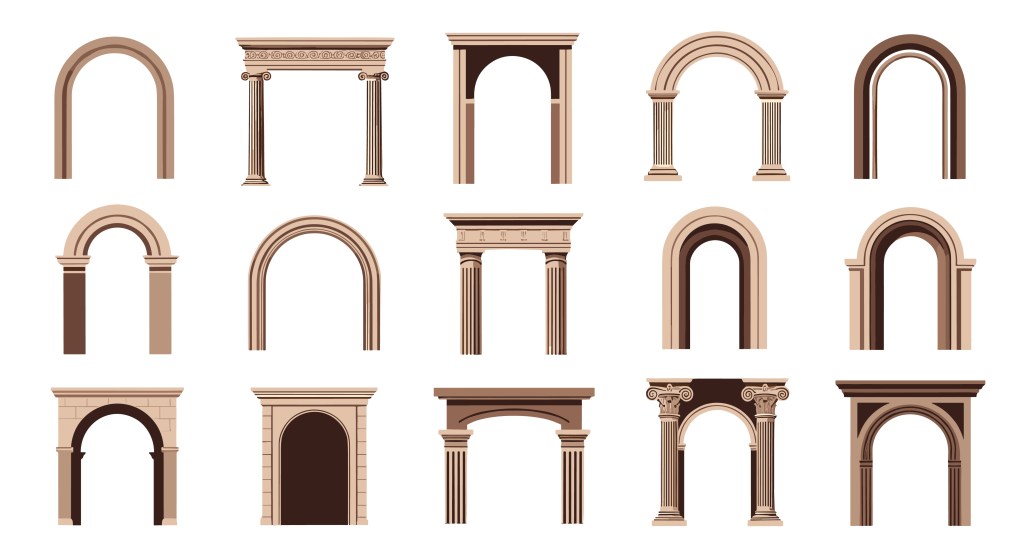
I am not talking here about the single, heroic arch, such as the Big Gulp-sized one Trump wants to erect to block the view of the Arlington Cemetery. It is bad in all kinds of other ways. I can, on the other hand, be persuaded by some of the low, leaping arches that even super-modernists BIG are using to ground or provide rhythm to their structures. I am talking about arches not as structural or foundational element, but as decorative pattern.
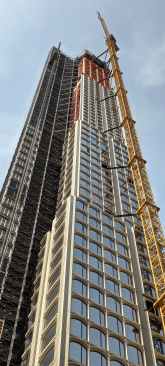
520 Fifth Avenue by KPF.
Exhibit A is 520 Fifth Avenue, the supertall recently completed in midtown Manhattan to a design by our most stylistically flexible corporate firm, KPF. Its entrance sports not just one, but three multi-story arched openings. They are layered inward, as if the designer couldn’t figure out exactly how big to make them. That is bad enough, but then, after a few lines of misaligned square-framed windows that I assume are meant to set off this grand base, the thousand-foot tower continues for eighty-eight floors with a field of shallow arches.
Each window set consists of a central, arched pane and two side panels framed in heavy bronze. Around these, the same kind of repetitive arches of fake stone fan out towards a square frame. One of these badly proportioned elements, unsure about its curve and breadth, would be bad enough, but hundreds of them is deadly. The effect is even worse because KPF divided the tower into cassettes of twenty-odd floors each that stack and stagger up to the skyscraper’s full height.
I am sure it is meant to be a scale thing, intended to break up what is a big structure. I assume it also is a design trick to make the owners of the obscenely expensive apartments behind all those curves feel as if they are in a slice of traditional mansion lifted miraculously above a less fashionable part of Fifth Avenue, but the effect is to make the tower much heavier and clunkier than it needs to be.
Sharif Khalje
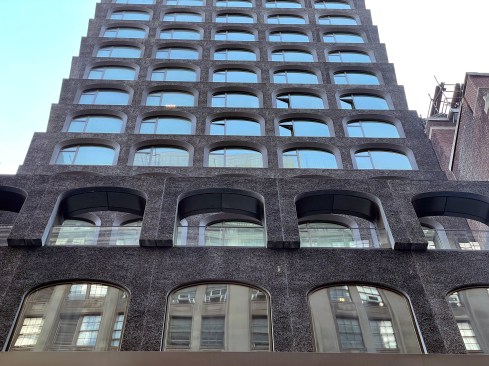
Podium, 130 Williams in New York by Adjaye Associates and architect of record Hill West Architects
The other big pile of arches in Manhattan is already a few years old: Sir David Adjaye’s 130 Williams Street. I mind this one less, mainly because it is much simpler and more abstract. Somewhat shorter than 520 Fifth Avenue at 880 feet, and with only sixty-six floors, it shows more as a monolith of black-tinted concrete.
Each window is just the arch (albeit with its glass divided into panes), and their proportion is taller, so that they contribute some to the tower’s sense of rising. There is also a surreal character to this –and many of Adjaye’s other work—that pulls it out of a relation to the buildings around it. The vibe is less McMansion and more De Chirico.
These towers are only the most visible set of buildings with an outbreak of arch-is. There are smaller office buildings and apartment buildings around the world where the repetition of arches hides whatever might be going on structurally and functionally.
You can find examples (to just name an arbitrary three) from Moscow (the Brodsky Building by Tsimailo Lyashenko and Partners) to Boulogne (an apartment building by Antonini Darmon) to another KPF-designed example, the better-proportioned 64 University Place.
In smaller and cheaper buildings, the arches also tend to become thinner and more pattern-like. I first noticed the disease in The Netherlands a few years ago, where the contrast to the high modernism for which that country became famous is even more extreme. Case in point is the replacement of an early, beautifully proportioned but maintenance-challenged OMA building for the Netherland Dans Theater in The Hague with a box for performances designed by a firm called NOAHH and covered with arches that seem squeezed out of toothpaste tube.
More recently, the firm ODA has pasted only the top of arches as decorative elements on a white grid that now overpowers Rotterdam’s adjacent City Hall and the remains of the city’s central post office (it’s grand hall is a glorious arched volume —that’s the excuse).
There is, of course, a history for the use of arches in modern buildings, and even a justification for them. Louis Sullivan himself, the author of that famous “tall and soaring thing” demand quoted above, used them with consummate skill and to great effect. Slowly, the logic of construction and the need for light and easy passage leeched them out of architecture until those architects who realized how alien modernism had become reintroduced them.
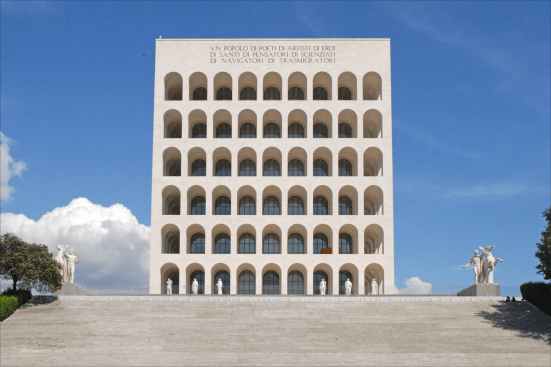
Palace of Civilization, Rome.
At times, as in Palace of Italian Civilization (Giovanni Guerrini, Ernesto La Padula, and Mario Romano) in Rome, they veered towards the uncanny, making us uncertain about where in time and place we were (and I assume Adjaye made a sideways glance at that block), but in most cases, especially in the Rococo Modern work of William Pereira, Edward Durrell Stone, Minoru Yamasaki, and the like, they became screens hiding the scale, repetitive nature, and sheer modernity of the underlying building. The funniest (if that is the right adjective) late example is Philip Johnson’s pile of Palladian windows in Boston.
We have long since given up the idea in thinking about the aesthetics of a building that it should look like what it does or how it is made, believing instead that responding to the context, whether physical or social, is much more important. That does not always mean answering in a polite way, as Foster’s overbearing new headquarters for JPMorgan Chase right up the street from KPF’s effort makes clear.
What I think we can demand is a little common sense and perhaps even, if I dare say it, good taste. Using arches, which, after all, are essentially a structural element at the core of architecture’s history, as a decorative pattern is, I believe, just silly. Divorcing them from the ground on which they have traditionally stood, whether physically or aesthetically, also removes a discipline that helps determine their proportion, scale, and shape.
The only good thing about all that arching around over acres of steel structure is that someday, when enough water has seeped into their seams and tastes have changed, they will be easy enough to replace with a more logical and beautiful set of façade elements.
Read more: The latest from columnist Aaron Betsky includes reviews of: Out There | The Shakers | The V&A Storehouse | Fins on Buildings | New Museum & The Studio Museum in Harlem | The Modern Museum | Monuments | Infrastructure | Interior Design | Viollet-le-Duc | Malibu High School | Architecture without Architects | Louis Kahn’s Fisher House | Meow Wolf | Generative AI | Frank Gerhy | Robert A.M. Stern | Lars Lerup | Princeton Art Museum | Victor Legorreta | Mexico City Underwater | On Vitruvius | On Olive Development | Calder Gardens | White House and Classical Architecture | Louis Kahn’s Esherick House | Ma Yansong’s Fenix Museum | The Cult of Emptiness | An Icon in Waiting | Osaka Expo | Teamlab | the Venice Biennale of Architecture | On Michael Graves | On Censorship or Caution? | Uniformity in Architecture | Book on Frank Israel | Legacy of Ric Scofidio| Fredrik Jonsson and Liam Young | DSR’s New Book | the Stupinigi Palace | Living in a Diagram | Bruce Goff | Biopartners 5 |Handshake Urbanism | the MONA | Elon Musk’s Space X | AMAA | DIGSAU | Art Biennales | B+ | William Morris’s Red House | Dhaka | Marlon Blackwell’s new mixed-use development | Eric Höweler’s social media posts,| Peter Braithwaite’s architecture in Nova Scotia,| Powerhouse Arts, | the Mercer Museum, | and MoMA’s Ed Ruscha exhibition.
Keep the conversation going—sign up to our newsletter for exclusive content and updates. Sign up for free.