Pick your analogy: Milky Way bars (but not Snickers), molasses, maple syrup, ice cream. Food is the handiest way Edward M. Kapura knows to explain the finer points of making glass—in his case, mass-producing the big sheets of glass that architects specify for the windows or walls of buildings.
Kapura is the senior engineer of manufacturing programs at PPG Industries' Works No. 6 factory near Carlisle, Pa. PPG is one of eight makers of flat or “float” glass (often imprecisely called “plate” glass) in North America; the company has six float-glass facilities in North America operating 10 glassmaking lines. The Carlisle plant alone makes 350 million square feet of float glass per year. A typical commercial building has about 10,000 square feet of float glass per floor, so Carlisle's yearly output is enough for 3,500 double-glazed, 10-story office buildings. (This article was reported from Carlisle. Owing to technical concerns, however, the photographs were taken at PPG's Works No. 4 in Wichita Falls, Texas, which has nearly identical processes.)
Glass first gave us the advantage of being able to see outside without feeling the elements. Today, with new low-emissivity coatings, it can help reduce a building's heat loss and gain, making it crucial for improving energy efficiency.
Glass is believed to have first been made by humans more than 4,000 years ago. The materials, their mixtures, and the types of labor evolved through the late 19th century, when mass-production techniques first took hold. In 1902, Emile Fourcault, a Belgian, patented a breakthrough machine for making flat glass by drawing a continuous sheet of it upward from a tank of molten material. A modified form of Fourcault's process, called the Pennvernon process, was introduced by PPG (then known as Pittsburgh Plate Glass) in the mid-1920s.
At Carlisle, that's all pretty much history. The float-glass process that PPG uses today is a modified form of the one invented by Sir Alistair Pilkington in Great Britain and patented in 1962.
Pilkington's process and others like it have proved to be something of a holy grail in making architectural glass because, as Kapura says, it is fast, continuous, and suitable for high-volume production. The huge, infernal tanks in which the glass is made are shut down only once every 10 to 12 years for major maintenance. “There is no off button,” Kapura explains. “No Christmas. No New Year's.”
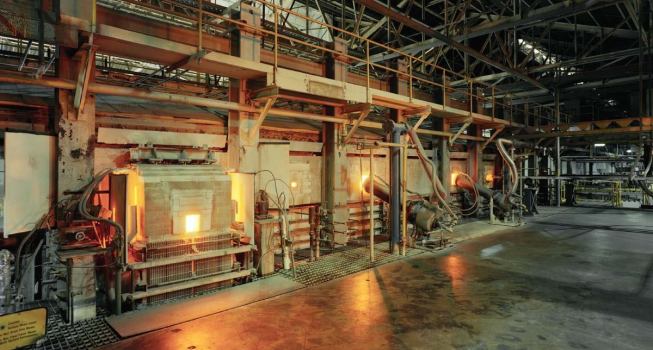
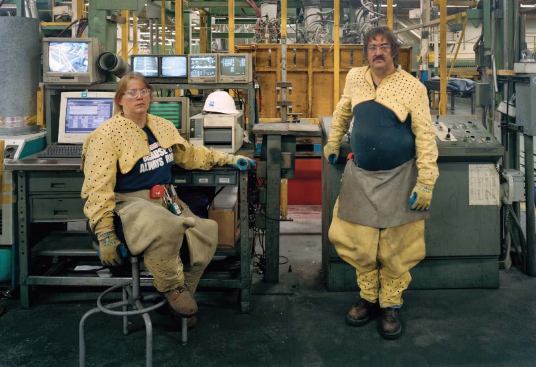
1) BatchingAt Carlisle, two identical glassmaking lines unfold side by side within the plant's enormous shed, which runs one-third of a mile long. Although the plant employs about 525 people, you don't see a lot of them standing around these lines, not least because, in some spots, the heat from the furnaces is so intense that you feel as if your face might peel off. For the most part, the human hand is at work inside air-conditioned control consoles, monitoring computer screens and closed-circuit cameras that track the flow of glass along an exquisitely automated path.
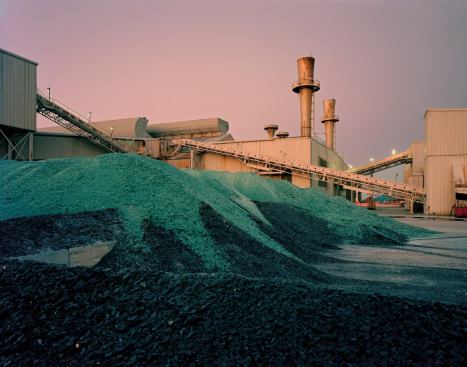
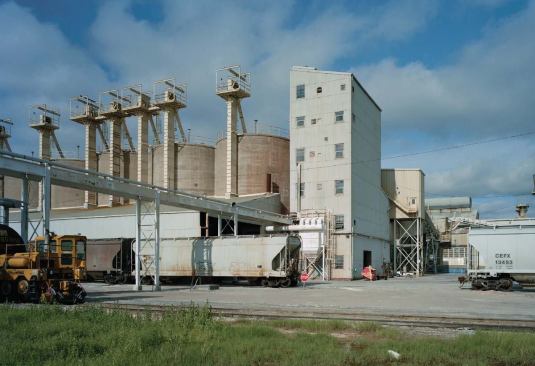
The first stage, batching, prepares the raw materials for melting in the furnace. A battery of six enormous concrete silos stands just outside the front end of the plant, filled with raw materials that arrive by truck or train: sand, dolomite, and a mixture of soda ash and salt cake. Often added to these ingredients are recyclable glass shards or “cullet,” much of which comes from the plant's finishing end.
Glass consists mostly of sand. At PPG it comprises about 70 percent Oriskany sand, an amazingly pure white substance quarried in northern Virginia and West Virginia. PPG prizes Oriskany sand for its low iron and chromium (iron, for one, gives glass a greenish hue) and high silica content, which makes for an exceedingly clear product.
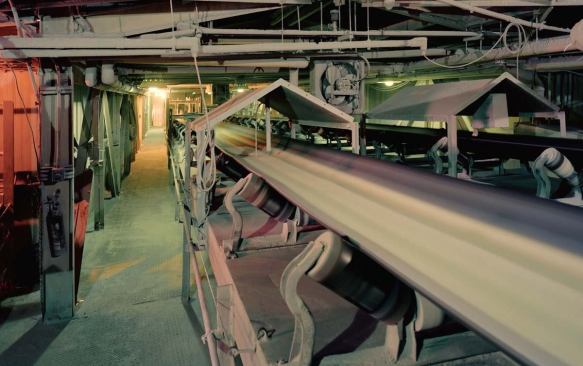
From the minute the materials arrive, they are in nearly constant motion. Inside the gray, dusty confines of the silo compound, a long, flat conveyor takes the materials in sequenced layers from their silos and sends them to a bucket elevator that carries them up to a scale to check their combined weight. They fall into a mixer that stirs them together “like an old ice cream bucket,” Kapura says. The mix is basically damp sand as it rolls across a high bridge conveyor to the main plant and into a hopper that feeds the furnace.
2) Melting and Fining
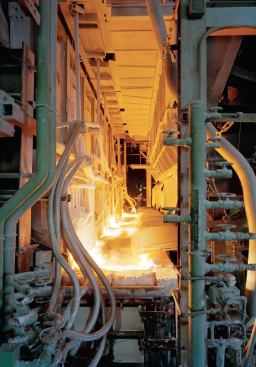
Two enormous melting furnaces stand side by side at the head of the plant, radiating prodigious amounts of heat. The yellow-painted iron handrails of a nearby stair are hot to the touch. Silica melts at about 3,000 degrees Fahrenheit—the peak temperature inside the furnace—although adding soda ash and salt cake helps lower the silica's melting point. Through the melter's open end, you can see the material mixture entering its white-hot confines.
The melter, properly known as a Siemens Side Port Regenerative Furnace, has a tank a couple of feet deep and 200 feet long to hold molten material. “You could swim in there,” Kapura says, “if you didn't burn up first.” The tank is surrounded by four sets, two on each side, of 36-foot-high regenerators, so called because they force hot air into the furnace and ignite a series of natural-gas flames over the top of the glowing melt, then take back the excess heat for reuse.
Once the mixture is melted into liquid glass, it travels to a second large tank, the refiner, for what is called fining. At this point, when chemical reactions among the batch materials are taking place, the glass is suffused with air bubbles, which are no good for glass. So more air bubbles are pumped in—to bind with the existing bubbles and force them out.
The refiner also serves to cool the glass to about 2,000 F to reach its correct viscosity before it is formed. Above that temperature, Kapura explains, the glass is too much like water for forming, and below that, it's like—what else?—molasses.
3) FormingThe process of forming the refined liquid glass into solid panels is one of mechanically manipulating the material around its natural propensity to be 0.271 inches (6.88 millimeters) thick. PPG's Carlisle plant makes glass in thicknesses between 0.08 inches (2 millimeters) and 0.75 inches (19 millimeters).
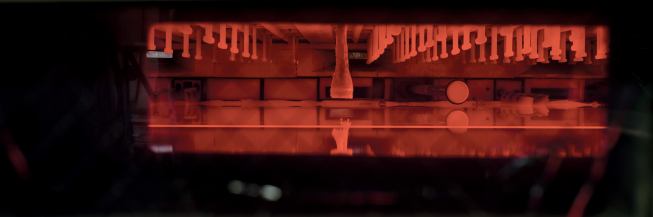
At the end of the refiner, the glass pours through an adjustable gate, called a “tweel,” that regulates its flow volume and depth to within 1/160th of an inch. It lands atop a bath of molten tin, on which it floats— hence the term “float” glass. The glass and tin don't react with each other but stay separated; their mutual resistance at the molecular level makes the glass perfectly smooth.
As the glass forms a thin layer of pale fire—called a “ribbon”—on the tin bath, a series of adjustable guide wheels on either side hem it in to determine its width, which determines its thickness. Ranks of glowing orange electrodes help to keep the glass hot from overhead, as if it were in a broiler.
The flow of the glass has to be perfect, like “syrup on pancakes,” Kapura says, when it passes through the tweel and over a specially sculpted flat spout, or lip, onto the tin. “It all has to do with the viscosity,” Kapura says, and, thus, the temperature.
Kapura asks me to take out the Milky Way bar he gave me at the start of our visit, unwrap it, and grip the ends in both fists (which is why my notebook now has chocolate stains). He has a Milky Way of his own, although his is chilled. He grips it at either end and pulls it apart. It snaps cleanly in half. He tells me to do the same with mine, which had been in my pocket. The gooey caramel stretches to a strand as it pulls apart.
“The glass has to have the right stretch,” Kapura says. He can't tell that story with a Snickers, he says, because the nuts in the candy would be like having flaws in the glass.
4) Annealing, Cutting, Packing
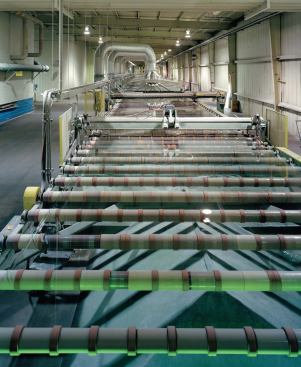
After the drama of melting and flowing, the glass remains mostly passive for the rest of the trip through the factory. As it forms and moves toward the “cold end” of the tin bath, a series of water pipes conduct heat away, taking the glass temperature down to about 1,150 F, at which point it enters a cooling oven known as a lehr.
The lehr is a rather long, enclosed passage in which the glass gradually cools down to about 300 F, a process known as annealing. A machine at the lehr's far end automatically does a first check for flaws such as stones or bubbles in the glass surface before a stain inhibitor is applied from overhead. The stain inhibitor protects the glass from corrosion, which can develop if it is stored for a long time before fabrication. (This coating is eventually washed off.)
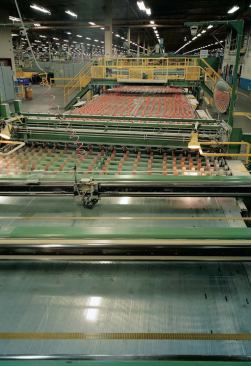
The solid sheets pass through the “slit-cut bridge,” a series of adjustable incisors that cut the panels into specified widths as it passes under them lengthwise. The panels then move beneath a second cutter called the “cross-cut bridge,” which scores them in the other direction, perpendicular to their path—though to make a straight cut while the glass is moving, the cutter is set at an angle. Directly afterward, they pass over a point called the “high roll snap,” which bumps the panels to separate them along the score lines.
Any pieces that are found flawed by the automatic inspection are discarded at the cullet drop, a kind of trap-door section of the roller line. Individual pieces are taken off the line to be inspected by the staff for any distortions. If the panels prove worthy, they flow forward for packing in one of two directions at the “mainline corner table,” which sends them either straight ahead or off to one side, depending on their size.
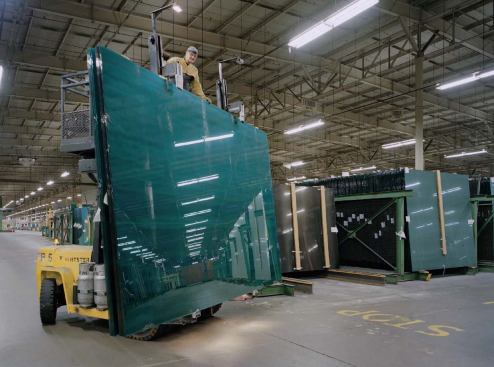
The edges are trimmed from the outer pieces and then inspected (the refuse is recycled as cullet), and the glass receives an application of a separating medium, a fine powder that allows the panels to stack without sticking together or scratching (saving on the tons of paper that used to be laid between them). An automatic packer picks the panels up by suction and stacks them in bulk.
Usually, the glass panels are sent to another line to be tempered by heat so that if they break, they crumble into small cubes that aren't sharp. They may also receive specialty coatings here that modulate heat and light transmission, though some coatings may be applied later at a customer's—i.e., a fabricator's—shop. When it's finished, the glass goes off, as white as water, to enclose homes, buildings, automobiles, and even aircraft.
Wherever it winds up, “the first person to touch the glass,” Kapura says, with a pause that suggests his continued amazement, “is the customer.”