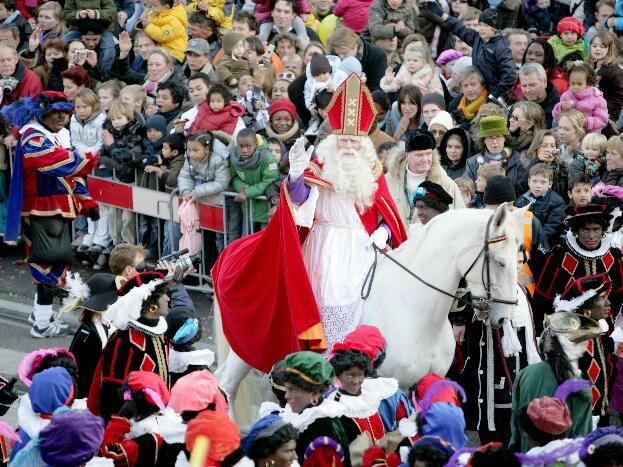
Last week was Sinterklaas. Unless you grew up in Northern Europe, as I did, that probably means very little to you. But when I was a kid, it was the biggest holiday of the year. We would put our shoes in front of the fireplace, expecting Saint Nicolas to leave us presents by the morning. We would gorge ourselves on special cookies and chocolate letters spelling out the first letters of our names.
Christmas was an afterthought. A few weeks before the “delicious date,” as a song called it, Saint Nicolas would arrive by boat from Spain. He would parade through each town and village on his white horse, followed by his retinue of politically very incorrect “black Petes” (remarkably and regrettably, that part of the condition continues, blackface and all).
Unlike Santa Claus, who somehow materializes from the nebulous regions of the North Pole and plunks himself down in the middle of every shopping mall, this Saint arrived from a specific space, on a boat, and then paraded through town, transforming a normal urban scene into a festive site. If you were good, you could expect presents from the burlap sacks the Petes carried around with them. If you were bad, you could expect the switch or, what was worse, the Petes would snatch you from you bed, stuff you into their now empty sacks, and carry you off with them to Saint Nicolas’s palace in Madrid, where you would be forced to make presents for the good children. There was a specificity to the whole operation. The Saint came from what was, in the earliest days I can remember, someplace we thought of as a rather backward country, though also one with mythical overtones. He took charge of our well-ordered and rather parsimonious environment and made it magical. If you were bad, he took you away from that place of order and continued you in that world of wonder, but in a horrible manner.
As I grew up, not only did I begin to doubt the story, but also Spain became the favorite vacation destination for sun-deprived Northerners. Suddenly, it did not seem like such a punishment to go to Madrid. If that is where your parents saved up to go, and from where your friends returned a few shades darker and happy, maybe it would pay to be bad? It was all very confusing.
These days, Saint Nicolas still arrives and parades, but his home is somewhat more nebulous—a bit like that of Santa, who by now, as a result of the globalization of all commerce and culture, has just about replaced him as the favorite dispenser of presents. Spain is no mysterious evil or sun-drenched place either, but rather a full member of the EU. The Dutch and Germans send presents in the form of financial support down there, and receive agricultural products and cars in return.
It is all part of the disappearance of both real spaces and spaces of wonder. The former are those places we make our own and know through rituals, whether of daily life or, in a heightened manner, at special occasions. These locations contain memory and guidelines for action. The latter are the mirror versions of these sites, existing in a place outside of measurement, while mirroring its contours. They are spaces that help us realize where we are in reality, while letting us dream of what might have once been, or what might be possible—in a good or a bad manner. As a grown-up trying to navigate through a landscape where the real and the imaginary, the physical and the projected, and the known and the unknown are so intertwined, I miss those spaces. Then again, don’t we all? And won’t we always miss the imagined spaces of our earliest coming into consciousness?
Aaron Betsky is a regularly featured columnist whose stories appear on this website each week. His views and conclusions are not necessarily those of ARCHITECT magazine nor of the American Institute of Architects.