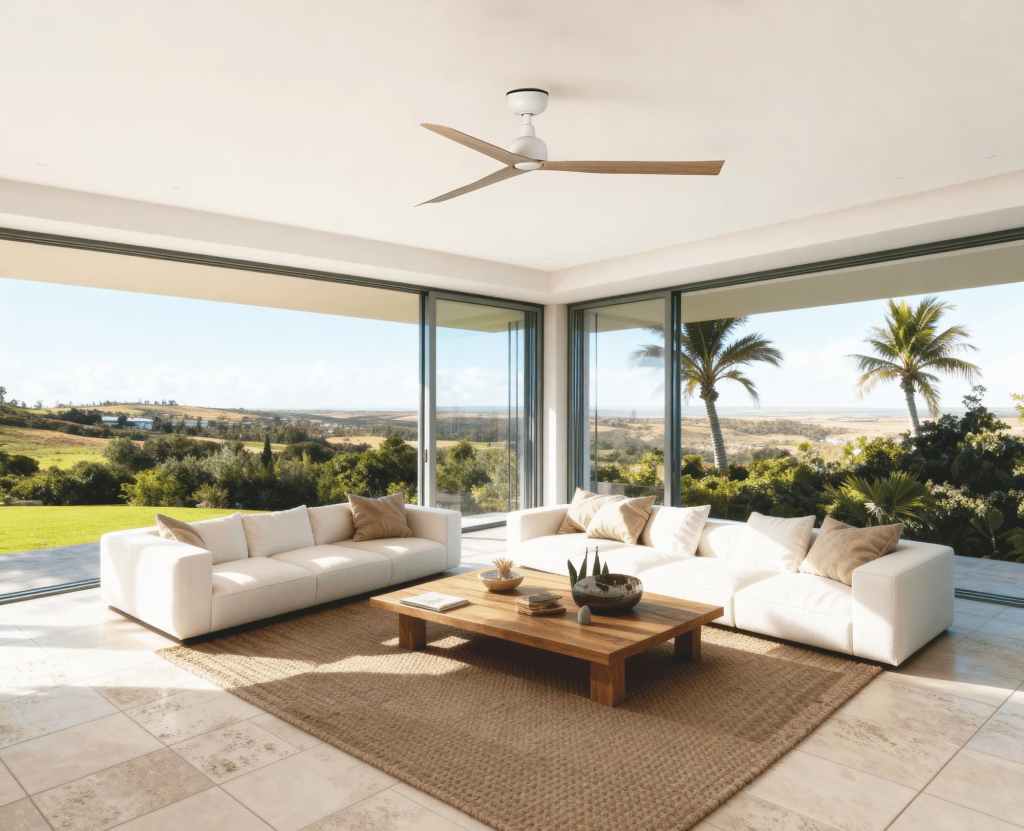
For decades, architects have lavished attention on outdoor spaces while largely ignoring one of the simplest devices capable of making them truly usable.
They specified expensive furniture, sculptural lighting, elaborate landscaping, and increasingly sophisticated outdoor kitchens. Yet when temperatures climbed and humidity rose, many of those carefully designed terraces, porches, and hospitality lounges became uncomfortable enough to drive people back indoors.
The problem wasn’t a lack of architecture. It was a lack of air.
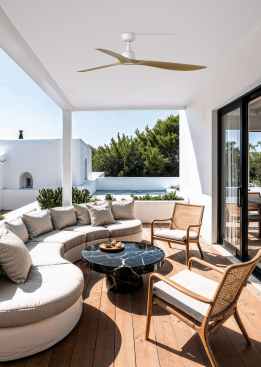
Faro Outwood Outdoor Ceiling Fan.
As outdoor living assumes a more prominent role in residential and hospitality design, a new generation of architects and designers is rediscovering a surprisingly humble technology: the ceiling fan.
Once regarded as a purely utilitarian object—and in some cases a visual nuisance—outdoor fans are undergoing something of a design renaissance. Better engineering, quieter motors, and more refined aesthetics have transformed them from mechanical necessities into architectural elements that can enhance both comfort and atmosphere.
In an era when sustainability and passive environmental strategies are becoming increasingly important, the outdoor fan may represent one of the industry’s most underrated tools.
Designing for Life Beyond the Walls
The pandemic accelerated a shift that had already been underway. Balconies, terraces, covered patios, pool decks, and open-air restaurants ceased to be seasonal amenities and became extensions of everyday life.
Hospitality designers began treating outdoor lounges as primary gathering spaces. Homeowners invested heavily in outdoor kitchens and dining rooms. Multifamily developers marketed terraces and rooftop amenities as key selling points.
Yet many of these spaces continue to rely heavily on mechanical cooling—or worse, remain underutilized during warmer months.
Air movement changes that equation.
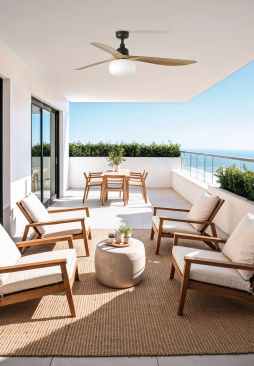
Faro Outwood Outdoor Ceiling Fan with Light.
A properly positioned ceiling fan can make temperatures feel several degrees cooler through evaporative cooling, improving comfort without the energy demands associated with air conditioning. Rather than sealing outdoor rooms behind glass or conditioning large volumes of air, designers can leverage movement itself as an environmental strategy.
In many climates, this approach aligns with a broader architectural shift toward passive comfort—using shade, orientation, natural ventilation, and air circulation to create more livable spaces while reducing energy consumption.
From Eyesore to Design Object
Ceiling fans have not always enjoyed the best reputation among designers.
For much of the twentieth century, they were viewed as functional compromises rather than objects worthy of aesthetic consideration. Bulky forms and uninspired finishes often made them feel disconnected from carefully curated interiors and outdoor environments.
That perception has changed.
“Whereas decades ago ceiling fans were perceived as an element lacking design, today they constitute a highly versatile element that integrates into the décor,” says Xavier Martín, CEO of Faro Barcelona.
Manufacturers increasingly treat fans as architectural products rather than appliances. Materials, finishes, blade profiles, and lighting integration are being considered with the same care traditionally reserved for furniture and decorative fixtures.
The result is a new generation of fans designed to complement spaces rather than compete with them.
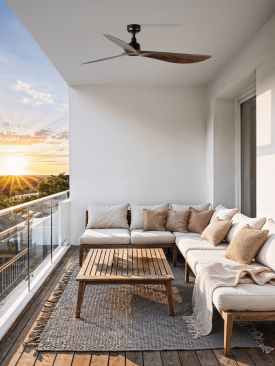
Faro Outwood outdoor Ceiling Fan.
Faro Barcelona’s Outwood collection, for example, employs UV-resistant wood finishes intended to blend naturally with exterior settings. With weather-resistant construction and an IP44 rating, the fans are designed to withstand humidity and outdoor exposure while maintaining a restrained aesthetic.
Rather than becoming visual focal points, they quietly disappear into the architecture.
A Weapon Against Summer’s Smallest Enemies
Comfort isn’t only about temperature.
Anyone who has spent an evening outdoors knows how quickly mosquitoes and other insects can turn an inviting terrace into an unpleasant experience.
The steady air movement generated by ceiling fans creates conditions that make it more difficult for flying insects to navigate and settle. The effect is simple but significant: fewer bites and fewer interruptions.
For restaurants, hotels, and homeowners alike, the ability to discourage insects without chemical repellents represents another layer of comfort often overlooked during the design process.
Sustainability Through Simplicity
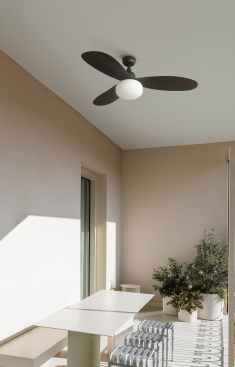
Faro Palma Outdoor Ceiling Fan.
Perhaps the strongest argument for outdoor fans is also the least glamorous.
They consume remarkably little energy.
As architects confront growing pressure to reduce operational carbon and improve building performance, ceiling fans offer an unusually efficient solution. Their energy requirements are only a fraction of those associated with conventional air-conditioning systems.
That makes them particularly attractive in climates where outdoor comfort can be enhanced through air movement rather than intensive cooling.
Manufacturers are increasingly aligning product development with broader environmental goals. Barcelona-based Faro Barcelona, founded in 1945 and now active in more than 140 countries, incorporates FSC-certified wood in several collections and has expanded sustainability initiatives across its operations, including repair and refurbishment programs intended to extend product lifecycles.
The company’s emphasis reflects a wider trend within the industry: products are increasingly being evaluated not only for how they perform but for how they are sourced, maintained, and ultimately reused.
The Return of Climate Intelligence
Perhaps the renewed interest in ceiling fans points to something larger happening within architecture.
For much of the last century, buildings became dependent on mechanical systems that insulated occupants from weather altogether. Comfort was achieved through sealed environments and ever-greater energy consumption.
Today, designers are revisiting older ideas.
Cross ventilation. Shading. Operable windows. Thermal mass. Natural light. Air movement.
These strategies are not nostalgic gestures. They are increasingly becoming necessities in a world defined by rising temperatures and escalating energy demands.
Within that context, the ceiling fan occupies an intriguing middle ground. It is neither high technology nor low technology. It is simply climate intelligence made visible.
And as architects continue to transform patios, terraces, and covered exteriors into fully realized living environments, they may discover that one of the most powerful design tools hanging overhead has been hiding in plain sight all along.