
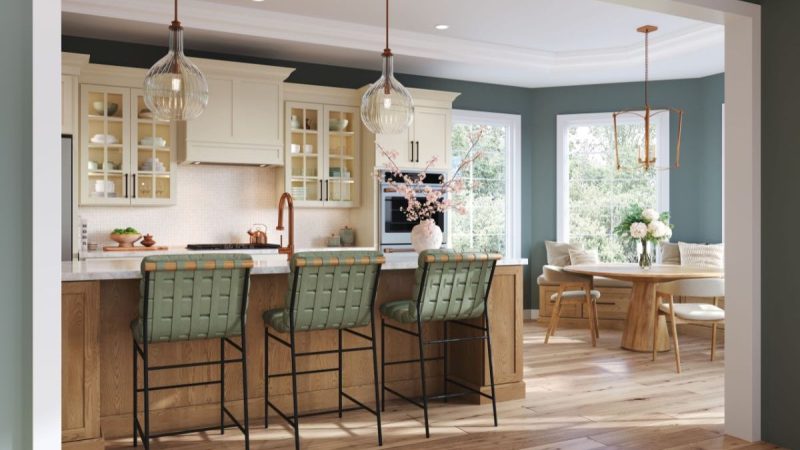
For more than a decade, production builders have lived in the “white shaker era.” No matter what else changed in the home, one detail felt almost non-negotiable: clean, square-edged white cabinets in a soft-modern or transitional style.
“That look has been incredibly dominant,” says Stephanie Pierce, Senior Director of Marketing and Innovation for MasterBrand Cabinets. “It was simple, streamlined, and honestly a little cookie-cutter, but it checked the boxes for broad appeal and resale.”
Now, a long-running survey of more than a thousand kitchen and bath designers across the U.S. and Canada suggests the market is moving in a direction that can actually help builders future-proof their kitchens. Conducted annually, the study taps into MasterBrand’s designer customer base, asking working professionals to report on what homeowners are asking for today and what they expect to specify over the next few years.
In its most recent wave, more than 1,000 designers participated, providing both quantitative rankings of colors and finishes and qualitative insight drawn from day-to-day client conversations. Because these respondents are on the front lines of kitchen projects, the survey acts as a bellwether for where buyer preferences are headed next.
Style diversity is driving color change
Soft-modern and transitional styles are still at the top of the list, but their dominance has dropped significantly. In their place, more varied looks are gaining ground: modern traditional, European-influenced modern, coastal, “raw organic,” refreshed farmhouse, and even mid-century and classic traditional.
Designers increasingly fuse at least two styles in the same project—say, a modern coastal shell with traditional detailing or a streamlined backdrop with a few organic, textural elements. As those style combinations evolve, color naturally follows. The stark, paper-white cabinet that anchored so many transitional kitchens is being replaced by warmer, more nuanced palettes that feel both current and livable.
White isn’t gone—but it’s getting warmer
For the first time in the survey’s nine-year history, bright white paint is no longer the No. 1 kitchen finish. It has been overtaken by light wood stains and softer, off-white opaques.
“White isn’t going away,” Pierce emphasizes. “It’s still a staple. But the bright, cool whites are giving way to creamier, off-white tones with brown, gray, or yellow undertones. They’re much easier to blend with the warmer woods that are coming back.”
Manufacturers and designers are leaning into that shift with “colored neutrals”—saturated, warm off-whites that read more like soft khaki or greige than true white. Paired with pale stains that have a hazy, whitewashed character, they create kitchens that still feel neutral but have more depth and flexibility over time.
These layered neutrals don’t just look richer in person; they also help extend the aesthetic life of the kitchen. Instead of a single, time-stamped color dominating the room, a mix of stains and opaques creates a more complex, less trend-sensitive backdrop.
The rise of woods, blues, and (especially) greens
After years of painted cabinets, stains are returning, but not in the full-oak-kitchen way many buyers associate with the 1990s. Today’s approach is more curated and mixed.
Light stains that recall white oak are often used strategically—on an island, a bank of tall cabinets, or a designated “zone” such as a pantry wall. The texture and grain bring biophilic warmth back into the home, playing well with nature-inspired palettes and the broader shift toward organic materials.
For painted accent colors, blue has been a force for nearly a decade, evolving from classic navies to a wide spectrum of mid-tones and softened pastels. Now, green is poised to take the lead.
“Designers told us that mid-tone greens are their top color preference over the next two years,” Pierce says. The most approachable versions are “succulent greens”—muted shades with gray or brown undertones rather than loud emeralds or harsh olives. That subtlety makes them surprisingly versatile when paired with countertops, flooring, and wall colors throughout the home.
On the horizon, Pierce is watching a family of red-brown hues—from plum-tinged browns to rose, terracotta, and desert-inspired pinks—though she notes this is more of an emerging palette than a single, defined “it” color.
What this means for production builders
If you build at scale, bold color can feel risky. But today’s trends make it easier to balance personality with prudence as long as you think in terms of palettes, not single hero colors.
“The perfect formula right now is a complex neutral palette,” Pierce says. “At least one light stain, one warm off-white, and then an optional color accent. That combination gives buyers choice and comfort without putting you on the bleeding edge of any one trend.”
To explore kitchen design trends, cabinet options, and resources that support your next community, learn more about MasterBrand here.