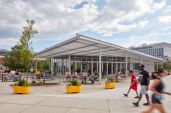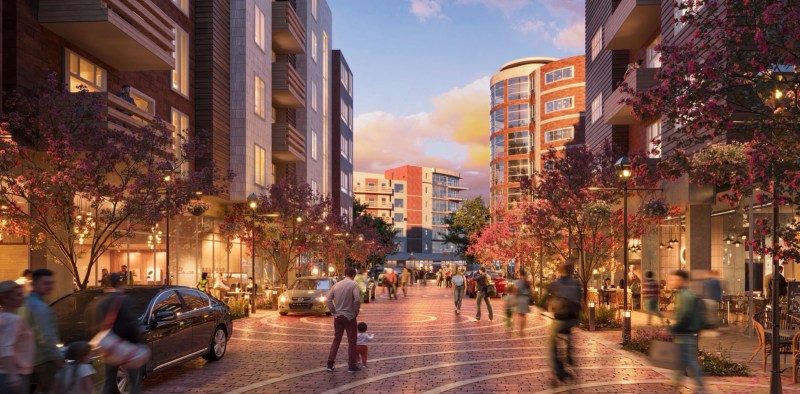
The lesson of the 2008 mortgage crisis — a lesson we still need to absorb — is that working Americans need more affordable workforce housing options, especially near existing services, transit, and jobs. California’s total housing deficit alone exceeds three million homes and continues to grow – and this deficit is primarily focused on workforce as well as low-income households.
Since 2008, housing production has run at roughly half the state’s historic average and restarting single-family subdivisions in increasingly remote locations will not close that gap. Neither will building small numbers of stand-alone affordable housing. The vast majority of the need is for working people, households that fall through the cracks — too rich to qualify for affordable housing, too poor to afford market rate housing in reasonable locations.
The Missing Middle of the Housing Market
The next generation of housing must focus on mixed income workforce housing — the places and price points that work for struggling working families, singles, older adults, and empty nesters. Today only 18% of our households are married with children and a shrinking fraction of those can afford the price along with the commute of a new subdivision.
The best solution for ‘affordable’ housing is in mixed income projects, rather than in stand-alone projects that tend to isolate occupants from the social and economic opportunities that surround them.
A Vast Infill Opportunity Hidden in Plain Sight
Meanwhile we have dramatically overbuilt strip retail: America has six times more retail per capita than the European average at the same time online shopping and big box retail is accelerating its decline. The result is falling strip commercial values, eroding local tax revenues, and spreading wastelands of asphalt and empty parking lots across the inner suburbs of virtually every American city.
There are over 100,000 acres of this underutilized land across California alone, located at the heart of our existing suburbs with a potential of millions of infill housing units. The rational solution is rebuilding the strip with mixed-use workforce housing — repairing and enhancing our existing communities, accelerating the transition from cars to walking, biking, and transit, and building denser housing where it is needed most. Offering an opportunity for those that work in our communities to live there.
Turning Aging Commercial Strips into Housing Boulevards
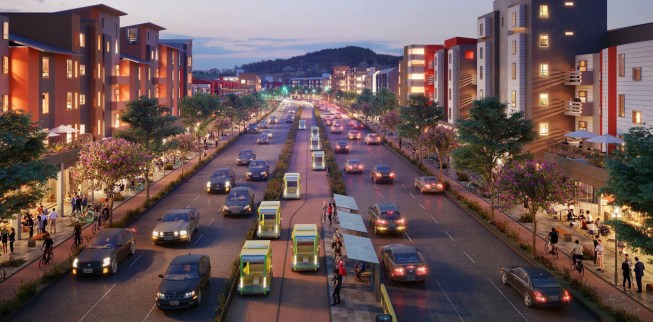
Housing developments support the next generation of transit.
The American strip was once the connective tissue of the suburban dream — a place to cruise, a commercial lifeline linking subdivisions, shopping centers, and office parks into an auto-based community. It was lined with signage landmarks, familiar trademarks, and even occasional gathering places.
But no more. We do our cruising online as much of the brick-and-mortar commercial life of the strip has migrated to big boxes or simply sits vacant. At the same time, the subdivisions it served have grown more expensive and more remote, no longer within reach of the working households that built this country.
Three Problems, One Solution
Redeveloping the strip into ‘Grand Boulevards’ combines three crises — the housing shortage, commercial decay, and failing mobility — into a single, coherent response: convert undervalued and underutilized strip commercial land to mixed-use, mixed-income workforce housing with mobility upgrades. A rich combination of townhomes, live-work units, multiplexes, lofts, condos, and mid-rise apartments is possible, scaled to parcel size, road width, and proximity to transit. On these underutilized arterials there is enough right-of-way to transform the auto-only asphalt of the strip into livable, multimodal boulevards with next generation transit lanes, bikeways, trees, and generous sidewalks. These ribbons of urbanism – compact and walkable — would reconnect our complex polycentric regions, weaving through local communities, historic city centers, and job clusters while unlocking massive infill housing opportunities.
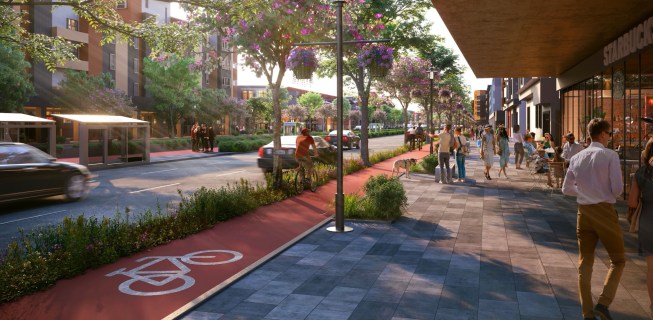
Ground floor Retail, broad sidewalks, bike lanes and transit.
The Grand Boulevards vision adds housing and upgrades dying commercial strips without disrupting stable neighborhoods or displacing existing housing. It generates increased property values that translate into a property tax windfall for school funding and local investment in transit, parks, affordable housing, and community services. Most important, it operates at a scale commensurate with the crisis itself — fairly distributed across a region’s towns, cities, and counties rather than concentrated in a handful of contested sites.
Why Mixed-Income Housing Works Better
To fully address what is at stake, we need to reframe the conversation around housing — shifting from a narrow focus on affordable housing to a broader commitment to Mixed-Income Workforce Housing. This is not merely a semantic adjustment. It reflects a hard-won understanding that isolating low-income households in stand-alone buildings produces worse outcomes for residents and worse economics for the public.
We have known for decades that concentrated poverty undermines the social and economic fabric of neighborhoods. What is less often acknowledged is that building affordable housing in isolation is also much more expensive on a per-unit basis. The numbers are stark. In Santa Clara County for example, affordable units in a standalone project can cost $200,000 more per unit than in a comparable mixed-income development.
More Housing, Better Economics
The arithmetic of public investment follows directly from this reality. A $30 million subsidy directed at a standalone affordable project yields roughly 100 units. The same subsidy, applied as part of a mixed-income development on a Grand Boulevard site, could leverage 500 units — 400 workforce units alongside the same 100 affordable units. Five times the production of critically needed housing for no additional public investment.
Affordable housing should be understood as a part of workforce housing, not a separate system, because solving for both together is more cost-effective and more socially durable than treating them in isolation.
Building at the Scale the Crisis Requires
There is a second-order benefit that is easily overlooked: scale. The construction industry is struggling, labor capacity has eroded, supply chains remain fragile, and these pressures drive housing costs steadily upward as production falls. Mixed-income projects at the scale that AB 2011 corridors make possible can help rebuild that capacity — revitalizing the pipelines of materials and skilled workers on which all housing production depends.
Accelerating mixed-income construction is not just a social policy; it is an economic stabilizer. A study by EPS showed $34 billion in bonds could be underwritten on the 700 miles of Bay Area arterials with the increased property values, increases that can only be unlocked with redevelopment.
Mixed-income construction is not just good social policy; it is an economic stabilizer.
California’s Model for Corridor Redevelopment
California’s Affordable Housing and High Road Jobs Act — AB 2011 — adopted in 2022 is the first major step toward implementing this vision at scale, and it offers a model for other states struggling with housing deficits, dying commercial strips, and the environmental costs of sprawl.
The legislation allows as-of-right zoning and streamlined environmental review on qualifying commercial land, radically reducing entitlement costs and delays that have long been the primary obstacle to infill housing in California.
Unlocking Housing Through Regulatory Reform
The bill is revolutionary on multiple dimensions. As-of-right redevelopment for any commercial parcel fronting a four- or six-lane arterial eliminates the drawn-out, expensive entitlement battles that have defeated infill projects for decades.
The law establishes the state’s first form-based code, defining height, setback, and active street-frontage requirements based on parcel characteristics and transit proximity rather than prescriptive density categories. It sets minimum rather than maximum densities from 30 dwelling units per acre on small parcels to 80 units per acre near transit, ensuring that the locational value of these sites is actually captured. A flexible build-to-line in the code sets a urban design pattern that reinforces the street without constraining the architecture.
It allows the market to determine parking needs, minimizing housing costs in areas where reduced-parking or car-free living is viable. And it supports the construction workforce through prevailing wage, apprenticeship, and benefits requirements, creating a potential massive growth of good jobs alongside the housing it produces.
The Numbers Behind the Opportunity
Using the law’s standards, a study utilizing UrbanFootprint software found that over 10 million units could ultimately be constructed on 108,000 acres of qualifying strip commercial land statewide. An analysis by Economic Planning Systems identified 2 millions of those units as market-feasible in 2022 conditions —unfortunately since that time construction costs have continued to climb rather than normalize after COVID. Nonetheless if just 10% of those market-feasible units were produced annually, California’s total housing output could more than double.
Fifteen percent of all AB 2011 housing must be affordable to households earning below 80 percent of area median income. Over time, this could drive annual affordable production from the state’s 2020 level of just 17,000 units toward 50,000 units per year — without requiring large government subsidizes, freeing limited public funds to concentrate on the homeless and very low-income populations.
From Silicon Valley to Southern California The productivity of Grand Boulevards becomes compelling when applied to real metropolitan geographies. The underutilized commercial land lining the San Francisco Bay Area’s 700 miles of six-lane arterials totals 15,400 acres.
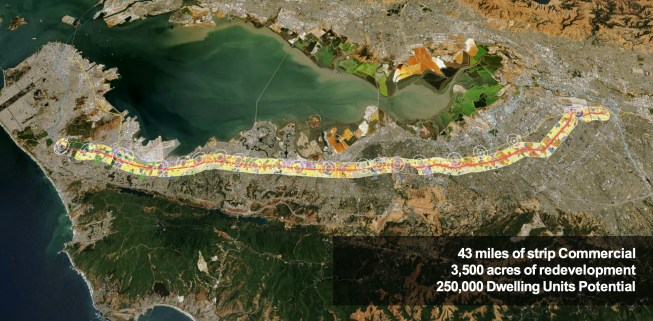
California Study: El Camino Key Corridor.
Redeveloped at AB 2011 densities, this land could accommodate up to 1.3 million new homes, and 260,000 affordable units — all close to existing jobs and services. The historic El Camino Real arterial alone, running 43 miles through the heart of Silicon Valley, could yield up to 250,000 apartments, including 37,000 affordable units, in one of the world’s most constrained housing markets.
In Los Angeles, where the logic of the strip first took hold in the American imagination, the numbers are even larger. Los Angeles County alone has nearly 20,000 acres of potential infill land, capable of absorbing up to 1.6 million dwelling units. These two regional studies — the Bay Area and Los Angeles — provided the empirical foundation for AB 2011 and establish the template for replication in other states.
The Pacific Northwest faces a parallel crisis as does much of the country. Boston Consulting Group projects a 20-year housing shortfall of 400,000 units in Washington State, 200,000 in Oregon, and 300,000 in British Columbia.
A Grand Boulevards analysis of the Cascadia corridor from southern Portland to Vancouver, BC identified over 42,000 acres of qualifying land along about 2,000 miles of existing arterials — capable of producing over 4.6 million units over the long term. The Boston Consulting Group estimates legislated entitlement relief savings in Seattle alone of up to $48,000 per unit; reduced parking requirements could save an additional $50,000 per stall in structured parking. The strategy scales.
Financing the Next Generation of Housing
Certainly mixed income projects on potential transit corridors are the best value – they produce much needed workforce housing, catalyze up to five times as much development, and put working people in the right locations. But given the current construction cost headwinds, realizing the potential of AB 2011 and other mixed-income housing will require a coordinated set of supportive financial instruments working in concert to prime the pump.
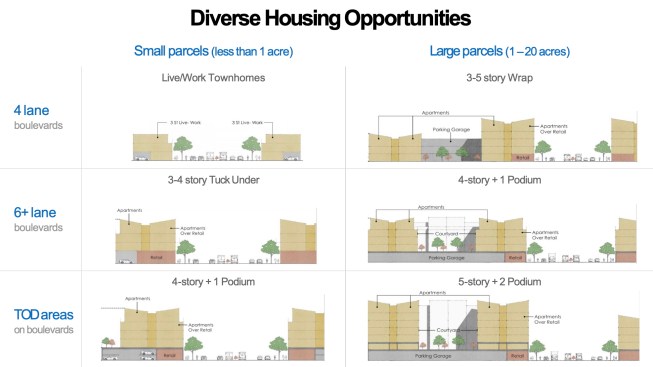
Diverse housing opportunities.
Financing Mixed-Income Growth
The public investment case is straightforward: property taxes from AB 2011 development average values up to 20 times greater than the commercial properties they replace, generating revenues that can underwrite bonds for affordable housing, mobility improvements, parks, and local services. But to jump start full potential, additional support mechanisms are needed:
- Local impact fee caps can reduce first-cost barriers on qualifying corridor sites
- Targeted property tax abatement for affordable and workforce units within mixed-income projects
- Tax Increment Financing (TIF) for key boulevard corridors to fund infrastructure improvements and transit
- Housing Production Funds and revolving credit facilities at the regional scale
- Restart of the national Low Income Housing Tax Credits 80-20 subsidy structures for mixed-income projects
- State housing bond initiatives that focus on mixed income projects solving many needs at once.
Each of these tools reinforces the others. Combined, they can transform the economic equation for mixed-income infill — making it the path of least resistance for developers rather than a niche strategy available only to mission-driven organizations.
The Payoff for Communities and the Climate
Grand Boulevard’s housing is not simply more abundant — it is intrinsically more sustainable. Analysis by UrbanFootprint software showed compact, transit-proximate dwellings on former strip commercial land generate 55 percent fewer auto miles than an average Bay Area house, produce 50 percent fewer greenhouse gas emissions, consume 39 percent less energy, require 62 percent less water, and reduce utilities and transportation costs for residents by 53 percent.
These are not projections from optimistic models; they are the documented co-benefits of denser, more urban development in locations where people can actually leave their cars behind.
Housing Where Jobs Already Exist
The social arithmetic is equally compelling. When housing is not close to job centers and services, commuting costs can erase any savings in housing cost. Lower-income workers forced to live far from the communities they serve face transportation costs that can cost 20 percent or more of household income toward fuel, vehicle ownership, maintenance, insurance, and parking. Regional road congestion, air quality impacts, and greenhouse gas emissions all rise as commutes lengthen. Quality of life, health, and time with family erode. Grand Boulevards puts housing where the jobs already are.
What Real-World Results Tell Us
The Minneapolis experience provides a compelling proof of concept as reported by a PEW study of empirical data. Beginning in 2017, the city adopted a comprehensive set of housing reforms — eliminating parking standards, allowing as-of-right commercial redevelopment on corridors and in transit districts, and permitting missing-middle development within single-family parcels. Over the five-year period through 2022, more than 20,000 units were permitted.
The outcomes were striking. Total housing construction in Minneapolis rose 12 percent versus just 4 percent statewide. City rents increased by only 1 percent over those five years, while statewide rents climbed 14 percent. Homelessness decreased 12 percent in the city, compared to a 14 percent increase across Minnesota.
Eighty-seven percent of new housing was built as larger 50-plus unit multifamily projects on corridors — demonstrating that the market responds robustly when entitlement barriers are removed. The results confirm what theory has long suggested: zoning for multifamily infill in the right locations produces real housing, at scale, with real effects on affordability.
Better Transit for Better Housing
Housing on the boulevard demands better transit on the boulevard. But too often, rail transit is too expensive to serve the decentralized geography of American metropolitan regions. Conventional bus service, while essential for captive riders, is frequently too slow and indirect to compete with the car for households that have a choice. When transit networks are expensive, scarce and slow, they cannot meaningfully reduce auto dependence.
The Transit Opportunity
On Grand Boulevards, the next generation of mobility could emerge alongside new density. Exclusive bus rapid transit lanes are an immediate opportunity, as is creating generous sidewalks, shops, street trees and bike lanes. Over time, these routes could be enhanced with next generation transit – I like to call it autonomous rapid transit (ART). The are like systems already being tested in Singapore and China that deploy autonomous vans and buses with algorithms that cluster origins and destinations, providing semi-express service around the clock. Think of it as a horizonal elevator — on call, not stopping at each floor. A Fehr & Peers analysis found that with such technology could cut operating cost in half, provide 24/7 service and run 30 percent faster. Fast, inexpensive, and ubiquitous transit may be the final piece that gets people out of their cars — especially when they already live on the boulevard.
A New Future for America’s Main Corridors
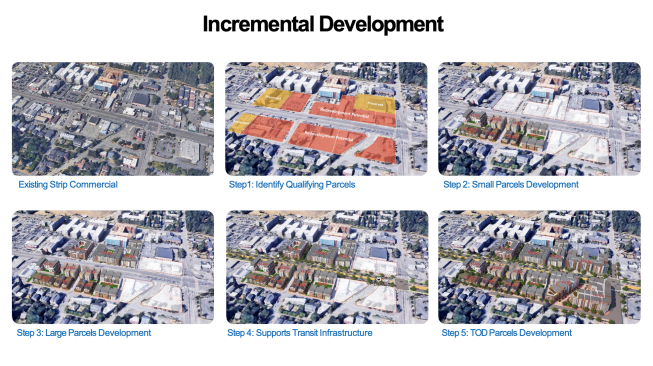
Incremental development.
Grand Boulevards is, at its core, a comprehensive proposition about how we choose to address our housing and mobility challenges. The aging strip is underutilized, undervalued, and deeply unloved — yet it represents one of the great unrealized opportunities in the history of American urbanism. It sits at the heart of our most urgent needs: housing affordability, workforce accessibility, environmental sustainability, and the repair of communities fractured by decades of auto-dependent sprawl.
Reimagining the American Strip
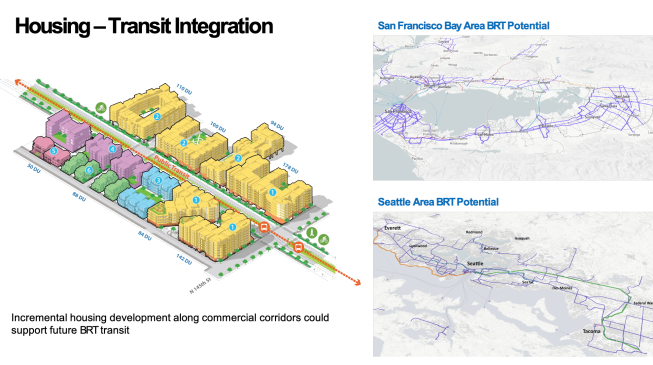
Housing–Transit Integration.
The shift this requires is not primarily technical — the tools are available and the evidence is accumulating. It is political and cultural. It demands that we redefine affordable housing as a component of a broader mixed-income strategy, not a separate and stigmatized system. It requires that we direct public subsidy toward projects that multiply its impact rather than those that merely concentrate the problem. It requires us to reinvent transit. And it asks that we recognize the strip not as a relic of a failed paradigm but as the raw material for something genuinely new.
In so many ways, cities define the physical limits of our social and human potential. The strip is part of that definition — for better or worse, it is woven into the fabric of nearly every American community. Grand Boulevards offers a chance to reweave it — into ribbons of urban life, affordable and connected, that serve the full range of people our cities are meant to welcome.