Few companies in the design industry have built their reputation as deliberately—or as successfully—as Herman Miller. For more than a century, the furniture manufacturer has shaped modern design through collaborations with some of the most influential creative minds of their eras, from Charles and Ray Eames, George Nelson, Alexander Girard, and Isamu Noguchi to Robert Propst, Bill Stumpf, and more recently Studio 7.5 and Industrial Facility.
Now the company is turning once again to a trusted creative partnership to help guide its future.
Industrial Facility Takes on a Larger Role
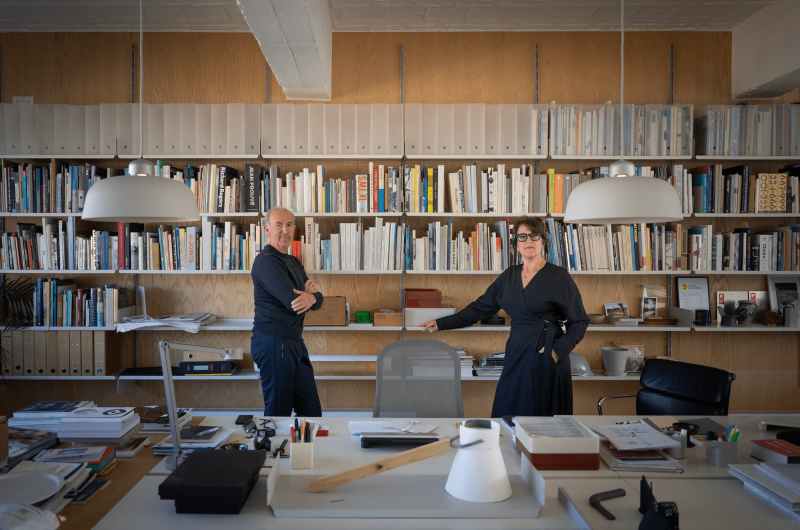
Herman Miller has appointed Kim Colin and Sam Hecht, founders of the London-based design studio Industrial Facility, as Global Creative Directors. In their new roles, Colin and Hecht will oversee the creative direction of the brand’s products, communications, and customer experiences worldwide, serving as stewards of one of modern design’s most recognizable names.
The appointment formalizes a relationship that has been evolving for nearly two decades. Since first collaborating with Herman Miller in 2006, Colin and Hecht have become two of the company’s most influential contemporary design partners, helping shape a portfolio that spans workplace systems, lighting, seating, storage, and lounge furniture.
Their projects for Herman Miller include the Lino Task Chair, Formwork Storage collection, Plex Lounge, Wireframe Sofa Group, Ode Lamps, Civic Table Program, Locale workplace system, and the widely adopted OE1 Workspace Collection, which anticipated the growing demand for flexible and adaptable work environments years before hybrid work became a dominant force.
A Strategic Appointment During a Period of Change
The announcement arrives at a consequential moment for both Herman Miller and its parent company, MillerKnoll.
In May, MillerKnoll disclosed that CEO Andi Owen would step down after leading the company through one of the most transformative periods in its history, including the landmark 2021 merger of Herman Miller and Knoll.
While the company has not directly linked Owen’s departure to the appointment of Colin and Hecht, the timing is notable. As MillerKnoll prepares for a leadership transition and continues to navigate shifting workplace trends, the decision to elevate two longtime design collaborators suggests that Herman Miller intends to reinforce its identity through design rather than dramatically reinvent it.
The move also comes as the broader furniture industry faces mounting questions about the future of work. Hybrid schedules, changing employee expectations, technological disruption, and economic uncertainty have forced manufacturers to rethink how offices function and what workers need from them. In that environment, creative leadership has become increasingly important as companies seek to distinguish themselves in a crowded marketplace.
For Herman Miller, the answer appears to lie in a design philosophy rooted in longevity, adaptability, and cultural relevance.
“Kim and Sam have been extraordinary partners to Herman Miller for over twenty years. They are transformational in their thinking, and passionate about creating solutions that are culturally resonant, commercially relevant, and long-lasting,” says Ben Watson, Chief Creative Officer, MillerKnoll. “We are thrilled to expand our partnership with Sam and Kim—I look forward to how they’ll help us shape the brand’s trajectory in the years to come.”
The Design Philosophy Behind Industrial Facility
The appointment reflects not only confidence in the pair’s past contributions but also a belief in the broader approach that has defined Industrial Facility since its founding.
Unlike many contemporary design studios that rely on formal experimentation or visual spectacle, Industrial Facility has built its reputation through rigorous observation and restraint. The firm’s products often appear deceptively simple, the result of extensive research into how people actually use objects in everyday life. The goal is not novelty for its own sake but solutions that endure.
That philosophy has earned Colin and Hecht an international client roster that includes Muji, Emeco, Mattiazzi, AndTradition, Google, and Santa & Cole, among others.
Their work has also entered the permanent collections of many of the world’s leading museums, including the Museum of Modern Art and Cooper Hewitt in New York, the San Francisco Museum of Modern Art, the Art Institute of Chicago, Centre Pompidou in Paris, the Victoria and Albert Museum in London, and numerous institutions throughout Europe.
Meet Kim Colin and Sam Hecht
Both designers bring distinctive backgrounds to the partnership. Colin, originally from Los Angeles, earned a Bachelor of Arts from UCLA before completing a Master of Architecture degree at SCI-Arc. Hecht, a London native, studied industrial design at Central Saint Martins and later earned a master’s degree from the Royal College of Art.
Their accomplishments extend well beyond professional practice. Both are Royal Designers for Industry and Fellows of the Royal Society of Arts. In 2015, Colin became the first female product designer to receive the prestigious RDI distinction. Hecht received the honor in 2008.
Both also maintain active commitments to design education. Colin has taught at institutions including ECAL, the Royal College of Art, and the Architectural Association, while Hecht has served as Visiting Professor at Karlsruhe University of Arts and Design and the Royal College of Art.
A Shared Commitment to Long-Term Design
For Colin, the expanded role represents a continuation of Herman Miller’s longstanding commitment to design as a cultural force.
“We’re taking a long view—and are thrilled to continue a Herman Miller tradition of enriching lives and contributing to culture over time. We take this responsibility to heart,” says Colin.
That emphasis on the long term has become increasingly rare in an industry often driven by rapid product cycles and shifting trends. Yet it remains one of the defining characteristics shared by both Herman Miller and Industrial Facility.
Hecht sees that shared perspective as central to the partnership’s success.
“Herman Miller continues to create new perspectives, because they believe, like we do, that design is very much alive,” he adds.
Why This Matters for Herman Miller’s Future
Seen through the lens of MillerKnoll’s broader transition, the appointment carries significance beyond a typical creative leadership announcement.
At a moment when the company is preparing for new executive leadership and navigating profound changes in the workplace, Herman Miller is doubling down on one of the assets that has historically differentiated it from competitors: its commitment to design.
Rather than searching for an outsider to redefine the brand, the company has entrusted two designers who have spent nearly twenty years helping shape its contemporary identity.
For a company whose history is inseparable from the designers it has championed, that may be the clearest signal yet about where Herman Miller believes its future lies.