For more than a century, presidential libraries have largely followed the same formula: monumental buildings filled with artifacts, archives, and carefully curated narratives about American leadership.
The new Theodore Roosevelt Presidential Library in Medora, North Dakota, argues that the building itself should not be the main attraction.
Instead, the landscape is.
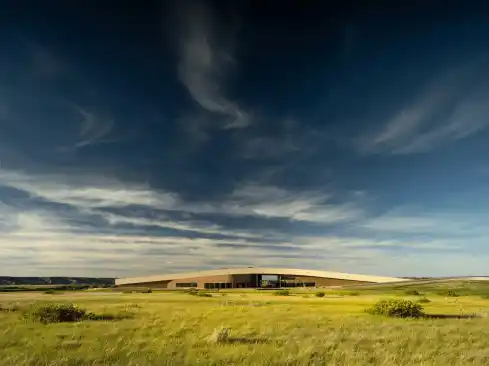
Opened on July 4, 2026, the 250th anniversary of the United States, the 96,000-square-foot institution designed by Snøhetta represents one of the most ambitious experiments in regenerative architecture ever attempted.
Situated on a 93-acre site adjacent to Theodore Roosevelt National Park, the project is pursuing full Living Building Challenge certification—the world’s most demanding environmental performance standard—and, if successful, will become the only Living Certified presidential library and the largest Living Certified cultural institution anywhere in the world.
Rather than celebrating Roosevelt through grand architectural symbolism alone, the project seeks to immerse visitors in the landscape that transformed him from an ambitious young politician into America’s most influential conservation president.
The result is less a museum than an ecological experience.
When the Building Disappears
Snøhetta’s guiding concept is deceptively simple: “The Library is the Landscape.”
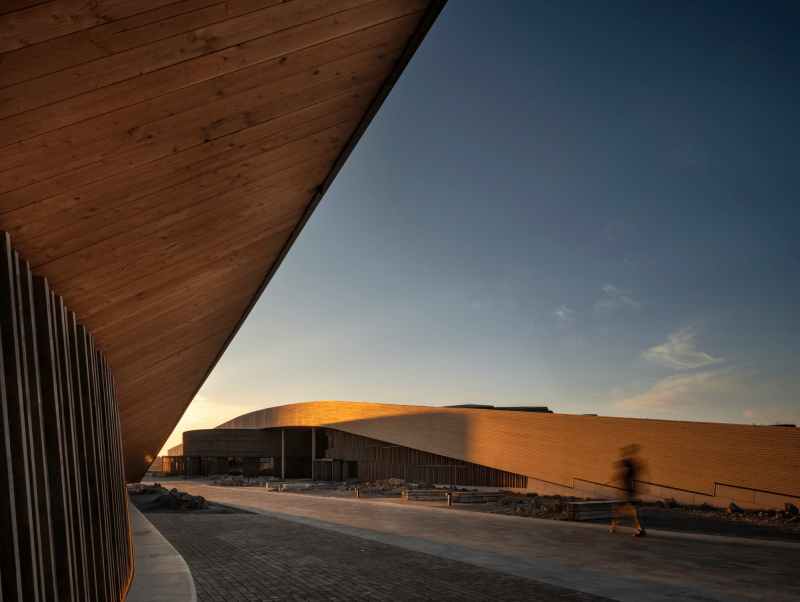
Instead of placing an object on the prairie, the design rises directly from a Badlands butte. A 121,000-square-foot living roof extends across the structure, effectively returning the building to the prairie while making its architecture part of the terrain itself.
Visitors don’t simply approach the library—they traverse it.
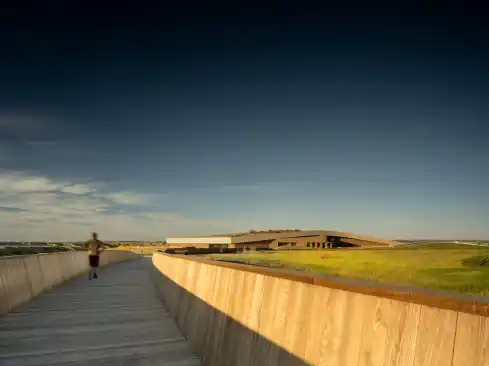
A nearly mile-long elevated boardwalk winds through restored grasslands at constantly shifting elevations, alternately lifting visitors above the landscape and bringing them into intimate contact with native ecosystems. Along the route are outdoor classrooms, contemplative gathering spaces, scenic overlooks, and even a suspended netted platform hovering above the terrain.
The approach fundamentally changes how visitors arrive at a presidential library. Rather than beginning in a parking lot and entering through a front door, people can arrive by hiking trail, mountain bike, horseback, or automobile, making it the first presidential library designed to be experienced through the landscape before entering the building.
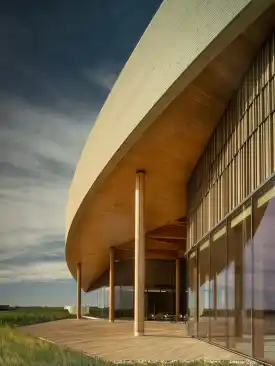
“Theodore Roosevelt understood that conservation is not simply about protecting land, it is about defining our relationship to the world and our responsibility to future generations. His conservation ethic emerged from a profound encounter with the American landscape, and we wanted visitors to experience that same sense of discovery. Rather than placing a building within the landscape, we sought to make the landscape itself the primary act of architecture,” says Craig Dykers, Snøhetta Founding Partner.
“Every path, every view, and every material decision is designed to deepen the connection between people and place, transforming a visit into an encounter with the earth. In doing so, the Library becomes more than a repository of history, it becomes an invitation to engage with the values of stewardship, civic responsibility, and wonder that continue to define Roosevelt’s legacy,” Dykers continues.
Architecture as Storytelling
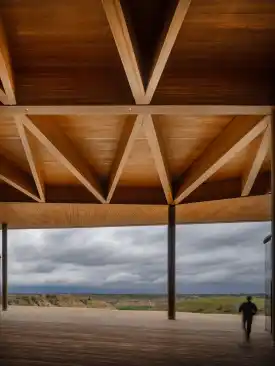
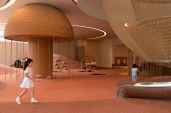
Inside, the architecture continues that narrative.
Rather than relying on monumental halls or ceremonial sequences, the interiors are organized as a carefully choreographed journey between light and darkness—a spatial metaphor reflecting Roosevelt’s own life and evolving conservation philosophy.
Large expanses of glass frame views toward Roosevelt’s historic Elkhorn Ranch and the surrounding Badlands that shaped his thinking about wilderness preservation. Skylights bring natural daylight deep into the galleries, reducing dependence on artificial lighting while maintaining a continual connection to the sky above.
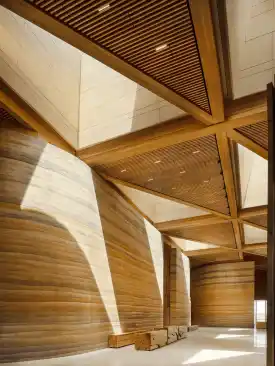
The building houses climate-controlled exhibition galleries, extensive digital archives, educational facilities, and an auditorium capable of hosting presidential debates, positioning the library not only as a historical institution but as a venue for contemporary civic discourse.
Building in one of America’s most demanding environments required an equally site-specific construction strategy.
“Do what you can, with what you have, where you are – building in the challenging Badlands locale requires strategy and resourcefulness. The project elevates local materials and relies upon North Dakota know-how to craft a building and landscape made from the Badlands,” says Snøhetta’s Project Director Matt McMahon.
Building from the Earth Itself
Nearly every material reinforces the project’s commitment to place.
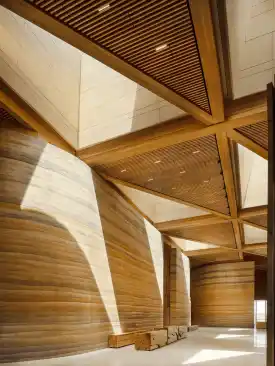
The structure combines mass timber, reclaimed regional wood, low-carbon concrete, and rammed-earth walls fabricated from locally sourced soils whose layered striations mirror the surrounding geological formations.
Many of the building systems were developed through collaborations between regional fabricators and national specialists, allowing locally available resources to meet the technical demands of one of the country’s most ambitious public buildings.
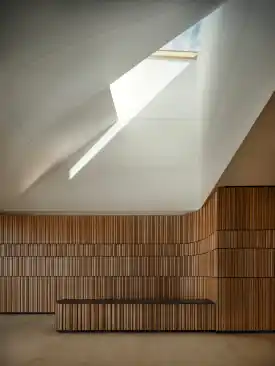
The project also eliminates chemicals listed on the Living Building Challenge’s Red List, while components have been designed for future disassembly rather than demolition—an increasingly important principle within circular construction.
The goal is a building that not only ages gracefully but can eventually be adapted, repaired, or reused rather than discarded.
A Museum That Restores Nature
Perhaps the project’s most radical ambition lies outside its walls.
Unlike many cultural institutions that minimize environmental damage, the Theodore Roosevelt Presidential Library seeks to improve the ecological health of its site.
Working with Resource Environmental Solutions and North Dakota State University, the design team developed the Native Plant Project, cultivating more than 200 native prairie species across the living roof and restored landscape while reconnecting the site to approximately 3,000 acres of adjacent National Grasslands.
The landscape itself becomes an active educational tool.
Seasonal grazing, haying, and controlled burns—essential ecological management practices that have historically shaped prairie ecosystems—will become part of the public programming, allowing visitors to witness restoration as an ongoing process rather than a finished product.
“The landscape is not the setting for this project, it is its primary teacher. Through restoration, access, and immersion, we sought to create opportunities for visitors to experience the ecological processes, seasonal changes, and living systems that continue to shape the Badlands. Our goal was to frame a landscape that invites exploration and discovery while demonstrating that stewardship is not a fixed goal, but an ongoing practice. As visitors move through restored prairie, encounter native species, and witness the rhythms of land management, they become participants in an evolving ecosystem. In this way, the landscape becomes something to engage with, care for, and learn from,” says Michelle Delk, Partner and Landscape Discipline Director, Snøhetta.
Raising the Bar for Regenerative Architecture
The library’s environmental ambitions extend well beyond energy efficiency.
Designed around a “Four Zeros” framework—zero energy, zero water, zero emissions, and zero waste—the project is pursuing not only full Living Building Challenge certification but also the highest levels of LEED and SITES certification while restoring the entire 93-acre property.
Achieving full Living Building certification is exceptionally rare, particularly for institutions of this size and complexity. The standard evaluates not only operational performance but also material health, equity, beauty, and long-term ecological impact, requiring buildings to demonstrate measurable environmental benefits after occupancy.
If certified, the Theodore Roosevelt Presidential Library will stand apart not simply as another presidential archive but as proof that major civic institutions can actively regenerate the environments they inhabit.
“To honor the Badlands and Roosevelt’s legacy, we sought boldness in balance with nature, and a vision beyond 100 years—just as he would have. Following TR’s call for ‘honesty and efficiency,’ we created a library that works with the land, draws on local wisdom, and will sustain itself for generations to come,” says Aaron Dorf, Snøhetta Director and Sustainability and Building Design Lead.
A Different Kind of American Monument
Presidential libraries traditionally preserve history.
The Theodore Roosevelt Presidential Library attempts something far more difficult: preserving the future.
Rather than commemorating Roosevelt solely through archives and artifacts, Snøhetta has transformed his conservation philosophy into architecture itself. The building disappears beneath native prairie, restores damaged ecosystems, and asks visitors to experience stewardship not as an abstract historical ideal but as a living civic responsibility.
At a moment when cultural institutions are increasingly confronting questions about climate resilience, biodiversity loss, and public engagement, the library offers an alternative model—one in which architecture does not merely occupy a landscape but actively heals it.
If it succeeds in achieving its ambitious environmental goals, the project may ultimately be remembered less as America’s newest presidential library than as one of the country’s most important demonstrations that architecture can leave a place better than it found it.