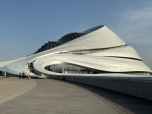
One justification for what I might term “fluid architecture”—architecture whose forms mirror or mimic flows—is that it represents the way of the future. Patrik Schumacher, who took over Zaha Hadid’s office and has recently rebranded it as ZHA, claims that what he calls “parametricism” is the “style of the 21st century.”
Others have argued that computers’ ability to absorb vast amounts of data and mold it semi-automatically into efficient shapes leads organically to the curves, bulges, billows, and bullnoses that characterize this mode of design. Both arguments are rooted in the fluid movement of people, goods, and data that defines modernity.
I have long been skeptical of such assertions, but the office buildings Ma Yansong and his firm M.A.D. have just designed for Tencent as part of that company’s new headquarters in Shenzhen for me have at least the look and feel of the future.
A City That Already Feels Like Tomorrow
The success of this sci-fi look has as much to do with the project’s location and client as it does with the design itself. Shenzhen, the polyglot instant-city of more than twenty million people—where over half the cars and virtually all the scooters glide silently under electric power—already feels as though it exists somewhere ahead of us. Its meticulous planning, streamlined architecture, and pervasive greenery create the impression of a city living in a future tense.
The site itself is a typical act of Shenzhen bravura: more than twenty million square feet of office, residential, and commercial space built for one of China’s most influential companies. Situated on an artificial island between the city’s waterfront core and the airport, it will soon be served by two dedicated subway stations.
Tencent’s portion of the development includes not only M.A.D.’s contribution and several unremarkable office structures by corporate American firms, but also a ridge of housing by MVRDV—human-made mountains lined with dormitory accommodations—and a new headquarters tower by Ole Scheeren, still under construction, whose three branching legs merge into a single monumental form.
All of this is designed to house Tencent, whose all-in-one app, WeChat, makes the socials and messaging systems we use in the U.S. just seem so last century. Integrating games, shopping, banking, messaging, and all sort of other widgets, it is its own virtual world.
How that ecosystem operates remains largely invisible, but sustaining the illusion apparently requires an army of coders, creatives, salespeople, and bureaucrats.
Building the Cloud
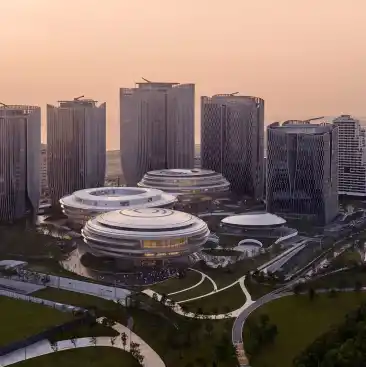
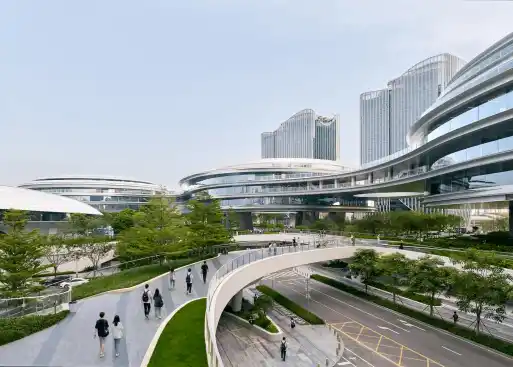
It is in this situation that Ma has designed what he calls a line of “clouds” housing, together with two rather blander towers, two million of the square feet Tencent needs, as well as commercial and meeting spaces. Lifted above a commercial podium, the four buildings mushroom out from smaller bases to expansive floors in four layers.
The pods connect with bridges that are large enough to become an integral part of the program elements, so that the spaces flow above the shops and podium in continuous lines of space for office cubicles, meeting rooms, and all the other parts of regular commercial operations. The two largest of the objects circle around courtyards to ensure that light reaches all these spaces.
While most of this ooze of offices is standard in its functions, the structure also hosts a open spaces that Tencent intends to use not only for large meetings and presentations, but also for product launches. A double-height area at the end of the line provides views over the adjacent port and office area, but also the headquarters tower, so that any show there will have the company’s signature building as a backdrop.
Ma calls this the “Cloud Room,” emphasizing his desire to make the buildings float like the mountains and aerial phenomena indicated by the brushwork of Chinese landscape painting, but the name seems more of a paean to the power of the computing cloud to swallow up almost all.
The Seduction of Flow
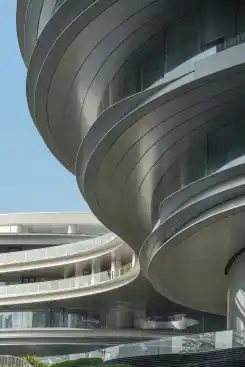
Photo: Zhang Chao.
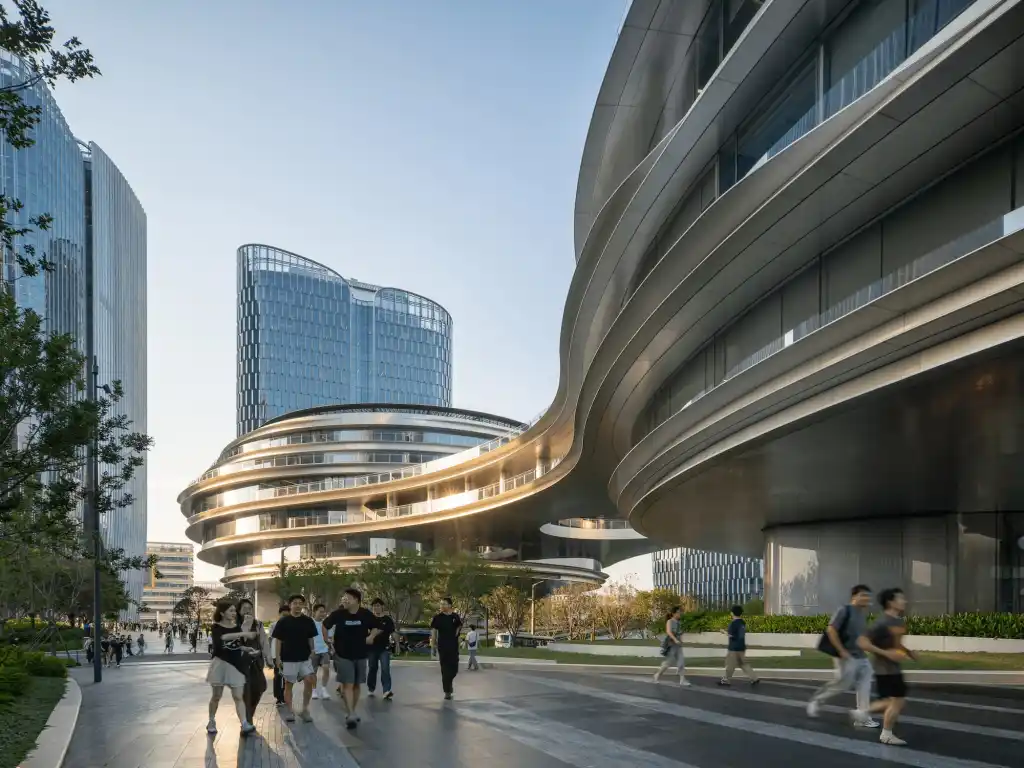
What makes the complex unusual is not so much its functions or even its style, as the way it forms a complete environment. After you rise onto the shared open spaces, you find yourself surrounded everywhere by curves that sweep and whiplash around you in a continuity of form I have not seen in many other buildings.
By emphasizing the horizontal lines hovering over the base and suppressing the top, Ma has been able to achieve that sense of flow. Because the client devoted a decent budget to the project, he was able to use large panes of glass and aluminum that in all but the sharpest curves keep going, at least visually, beyond the seams and lines of division.
Your eye is not caught by any moment, and where the ceiling overhangs morph into railings, M.A.D. has developed transitions that make that transformation appear natural. Because everything is metal or glass –even the underside of the pods as you move underneath them—the sheen and muted reflections distract from whatever any imperfections you might be able to find.
Where the Future Meets the Workplace
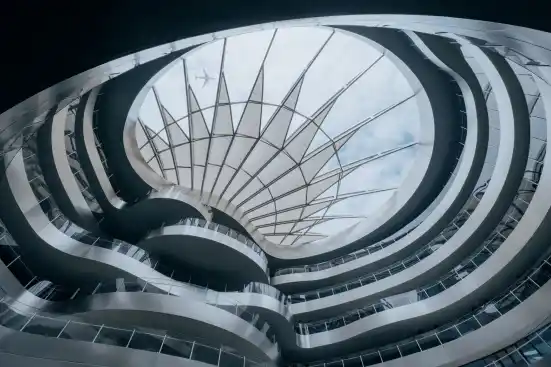
Photo: Zhu Yumeng.
The interior does not have quite the verve of the exterior, because here the project gets down to business. Only in the larger meeting area, reached by escalators shooting through ovoid openings in the ceilings of the lower floors and unfolding under domes that melt into arched entries, do you have the same sense of fluidity the outside provides.
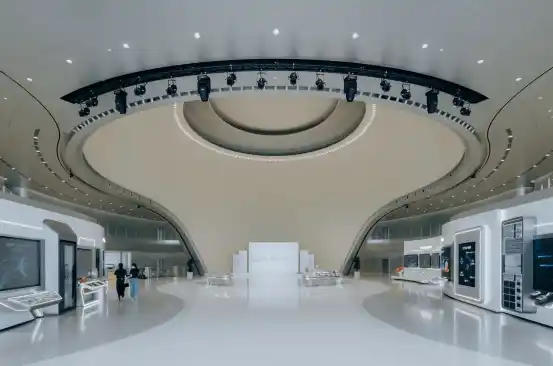
Photo: Zhu Yumeng.
Here the detailing is slick enough to hide some of the necessary technical elements, and the designers have managed to calm the sweeps down wherever they have to accommodate vertical elements such as doors.
When I visited the Tencent Campus, they had opened the just-finished M.A.D part of the project to employees and guests to experience the spaces for the day, which only added to the sense of openness the architecture expresses.
The Limits of Openness
I am sure that, once the campus is in full operation, that sense of human movement echoing and enhancing the design will dissipate, making me wish that Tencent had taken the next step towards making full use of their site and literally opened at least some of the building to what is, especially on this waterfront site, a generally pleasant climate. The chill of the air conditioning on the interior was matched by the mien of the many security guards checking our badges.
A Beautiful Vision of Corporate Power
In that sense, the M.A.D. design is a promissory note for what could be a truly fluid architecture: one in which inside and outside, public and private, and open and closed melt to such an extent that the fixed forms truly disappear.
WeChat’s amoeba-like ooze through the digisphere could be matched in meatspace in an architecture that leaves only a memory of limits in its reflective and continually developing surfaces –even if Big Brother is always watching.
Project Credits
Tengyun Center
Shenzhen, China
2020 – 2026
Typology: Office Campus
Site Area: Approximately 72,000 square meters
Building Area: Approximately 412,000 square meters
Principal Partners in Charge: Ma Yansong, Dang Qun, Yosuke Hayano
Associate Partner in Charge: Kin Li, Xu Chen
Design Team: Liu Hailun, Fu Xiaoyi, Jose Maria Urbiola, Antoine Muller, Liu Zifan, Rozita Kashirtseva, Alan Rodríguez Carrillo, Yoshio Fukumori, Yin Jianfeng, Chen Hongbin, Yang Wenzhi, Zeng Hantao, Song Minzhe, Sun Yingna, Li Jiaqi, Tan Miao, Yu Lin, Li Gang, Sun Feifei, Zhao Guijia, Wu Qiaoling, Hou Jingxue, Wang Ruipeng, Feng Xuhui, Li Lingfeng, Zhang Kai, Zhou Qinyuan, Cheng Xiangju, Du Jie, Na Kyung Eun, Gan Mengjia, Xiao Yuhan, Cao Xi, Zhuang Fan, Chen Hao, Chen Rui, Pan Anyi, Claudia Hertrich, Reinier Simons, He Shunpeng, Reem Mosleh, Peng Kaiyu, Huang Yufu, Haruka Tomoeda, Pittayapa Suriyapee, Li Cunhao, Lei Kaiyun, Ma Yiran, Niu Shaobo, Ma Yin, Ma Yue, Zhang Tong, Zhao Lilu, Jiang Yunyao, Xue Yawen, Wang Zhuyun, Qiang Siyang, Zhu Yunfan, Natawat (Jack), Huang Juntao, Gao Chang, Song Chi, Wang Shuobin, Zhu Yuhao, Zhou Haimeng, Li Hui
Client: Tencent Technology (Shenzhen) Co., Ltd.
Executive Architect: Shenzhen General Institute of Architectural Design And Research Co., Ltd.
Contractor: China Construction 4th Engineering Bureau 6th Corp., Limited
Project Management: Arcadis Shanghai Limited
Structural Consultant: Meinhardt (Shenzhen) Ltd.
Façade Consultant: SuP Ingenieure GmbH
Interior Design: MAD, Woods Bagot Architectural Design Consultants (Beijing) Co Ltd.,
Lighting Consultant: Lighting Planners Associates Inc. & Lighting Planners Associates (S) Pte. Ltd., China Academy of Urban Planning and Design (CAUPD)
Landscape Consultant: SWA Group, Shenzhen Hope Design Co., Ltd.
Signage Consultant: Brand U Creative Studio Shanghai Co.
Transportation Consultant: T. Y. Lin International Engineering Consulting (China) Co. Ltd.
Acoustic Consultant: GRANDY Engineering Consultants (Shanghai) Ltd.
Commercial Consultant: Shenzhen Champion Retail Operation Management Co., Ltd.
MEP Consultant: WSP Engineering Technology (Beijing) Co., Ltd.
Photography: AOGVision, Zhang Chao, Zhu Yumeng, Sun Haiyong
The views and conclusions from this author are not necessarily those of ARCHITECT magazine.
Read more: The latest from columnist Aaron Betsky includes reviews of: Harbin Opera House | The Bruce Springsteen Center | Zeitz MOCAA | The Fagan House |The Dries Van Noten Foundation | The Revenge of the Arch | Out There | The Shakers | The V&A Storehouse | Fins on Buildings | New Museum & The Studio Museum in Harlem | The Modern Museum | Monuments | Infrastructure | Interior Design | Viollet-le-Duc | Malibu High School | Architecture without Architects | Louis Kahn’s Fisher House | Meow Wolf | Generative AI | Frank Gerhy | Robert A.M. Stern | Lars Lerup | Princeton Art Museum | Victor Legorreta | Mexico City Underwater | On Vitruvius | On Olive Development | Calder Gardens | White House and Classical Architecture | Louis Kahn’s Esherick House | Ma Yansong’s Fenix Museum | The Cult of Emptiness | An Icon in Waiting | Osaka Expo | Teamlab | the Venice Biennale of Architecture | On Michael Graves | On Censorship or Caution? | Uniformity in Architecture | Book on Frank Israel | Legacy of Ric Scofidio| Fredrik Jonsson and Liam Young | DSR’s New Book | the Stupinigi Palace | Living in a Diagram | Bruce Goff | Biopartners 5 |Handshake Urbanism | the MONA | Elon Musk’s Space X | AMAA | DIGSAU | Art Biennales | B+ | William Morris’s Red House | Dhaka | Marlon Blackwell’s new mixed-use development | Eric Höweler’s social media posts,| Peter Braithwaite’s architecture in Nova Scotia,| Powerhouse Arts, | the Mercer Museum, | and MoMA’s Ed Ruscha exhibition.
Keep the conversation going—sign up to our newsletter for exclusive content and updates. Sign up for free.