For much of the past century, America’s most celebrated museums have competed through spectacle. They have chased iconic architecture, blockbuster exhibitions, and ever-larger expansions in an effort to attract tourists, donors, and international attention. Yet as museums grapple with questions of accessibility, representation, and civic relevance, a different model is beginning to emerge—one that asks not simply how a museum can display art, but how it can become part of everyday public life.
That ambition is on full display in Memphis.
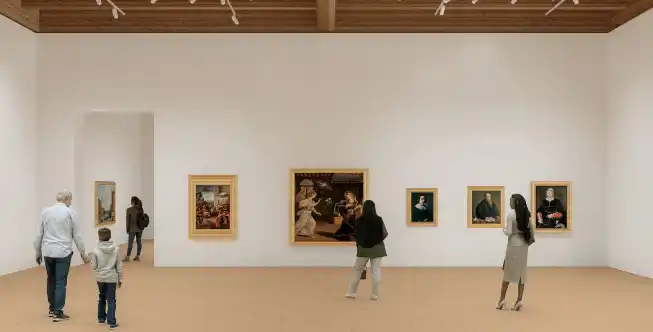
North Gallery rendering.
When the new Memphis Art Museum opens on December 6, 2026, the institution formerly known as the Memphis Brooks Museum of Art will debut not only a dramatically larger home designed by Herzog & de Meuron, with local firm archimania serving as architect of record, but an entirely new identity rooted in openness, community, and place. Situated on a reconstructed bluff overlooking the Mississippi River, the 123,500-square-foot cultural campus represents one of the most significant new museum projects completed in the United States in recent years.
Its ambitions extend well beyond architecture.
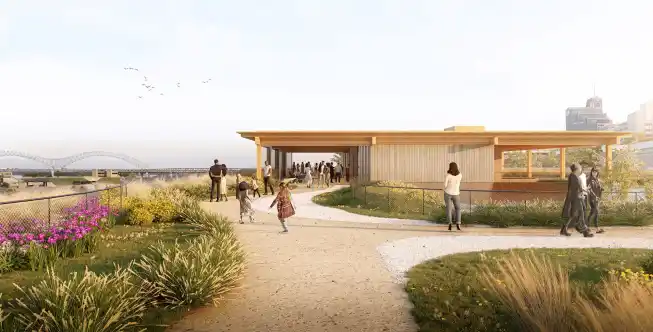
Roof Pavilion rendering.
The museum has announced that admission will remain permanently free for residents of Shelby County, dramatically lowering barriers to access while positioning the institution as civic infrastructure rather than simply a cultural destination. At the same time, its inaugural exhibition program abandons the familiar chronological march through art history in favor of thematic installations that encourage visitors to discover unexpected relationships across cultures, continents, and centuries.

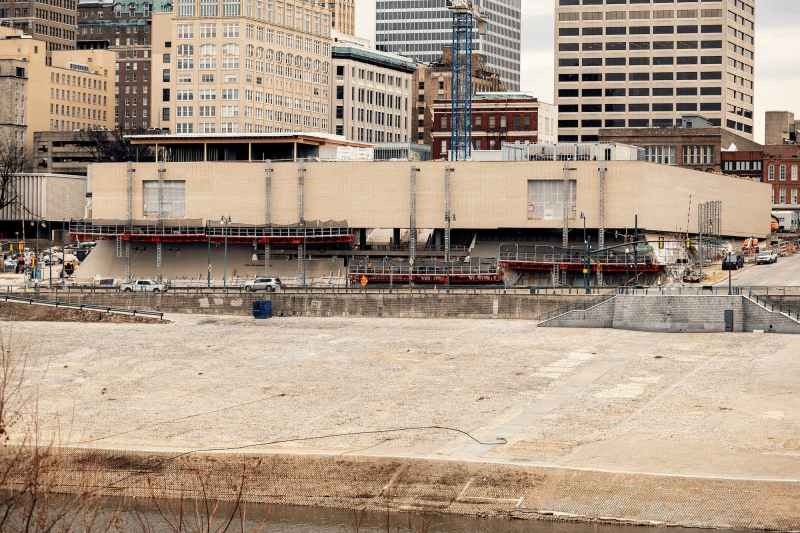
Museum construction detail. Photo courtesy Houston Cofield.
Together, those decisions signal a broader shift in museum thinking—one that sees architecture, curatorial practice, and public space working together to create an institution designed less as a monument than as a gathering place.
Reclaiming the Riverfront
Few American cities possess a more powerful natural setting than Memphis. For generations, however, much of the city’s relationship with the Mississippi River has been fragmented by infrastructure and disconnected development.
The new museum seeks to help change that equation.
Occupying a prominent site along the riverfront, the campus anchors a larger effort to reconnect the city with one of its defining geographic features. Rather than functioning as an isolated object building, the museum extends into the public realm through outdoor gathering spaces, generous landscaping, and expansive views toward the river.
Herzog & de Meuron’s design combines monumental civic presence with an unusual degree of openness. A 10,000-square-foot community courtyard forms the heart of the campus, while a 50,000-square-foot rooftop art garden, outdoor amphitheater, pedestrian plaza, and extensive public spaces invite visitors to experience the building long before purchasing a ticket—or, for local residents, without purchasing one at all. Nearly all of the museum’s public-facing amenities have been organized on a single level, making the building significantly more accessible than many traditional museum layouts.
The project also reflects growing interest in low-carbon construction. The museum will be among the first major American museums constructed using laminated mass timber, a material choice that acknowledges both sustainability goals and Memphis’s historic identity as the Hardwood Capital of the World.
For Herzog & de Meuron, whose portfolio ranges from the Tate Modern in London to the Pérez Art Museum Miami and M+ in Hong Kong, the Memphis commission represents another exploration of how cultural architecture can shape urban life. Rather than relying on sculptural excess, the building appears designed to frame landscape, encourage movement, and dissolve conventional boundaries between museum and city.
A Museum Designed Around Stories, Not Timelines
Architecture establishes the framework, but the museum’s curatorial strategy may prove equally consequential.
Most encyclopedic museums continue to organize collections geographically or chronologically, encouraging visitors to move through distinct civilizations and historical periods. Memphis Art Museum is pursuing something markedly different.
Instead of presenting a linear narrative, approximately 30,000 square feet of galleries will host nineteen thematic “short stories,” bringing works into conversation through shared ideas, materials, histories, and emotions rather than national origin or chronology. Visitors may encounter Renaissance painting alongside contemporary abstraction, or discover unexpected parallels between medieval religious imagery and present-day artistic concerns.
The approach responds directly to the architecture itself.
The galleries form a continuous loop surrounding an interior courtyard, with multiple entry points and several exhibition spaces opening toward views of the Mississippi River. Rather than prescribing a single route, the building encourages visitors to wander, make connections, and construct their own narratives as they move through the museum.
“Museums are storytellers,” said Dr. Patricia Lee Daigle, Chief Curator, Memphis Art Museum. “And the stories they tell often extend far beyond a single gallery. A theme may emerge in one space and reappear several galleries later. A work of art may create a bridge between two ideas. Even a glance across the courtyard can reveal an unexpected narrative.”
That philosophy reflects broader changes occurring across museums worldwide, where institutions increasingly seek to dismantle rigid art historical categories in favor of more inclusive and interdisciplinary interpretations.
Centering Memphis
Although the museum houses more than 10,000 works spanning five millennia and six continents, its inaugural program repeatedly returns to Memphis itself.
The opening exhibition, Making Beauty: Hooks Brothers Studio, 1907–1984, exemplifies that commitment.
Featuring more than 150 photographs, the exhibition examines the celebrated Black-owned photography studio whose images documented everyday life, resilience, and dignity during the Jim Crow era. Developed in partnership with the National Civil Rights Museum, the exhibition positions the Hooks Brothers not only as local photographers but as significant contributors to the global history of photography, placing their work in dialogue with figures such as James Van Der Zee.
Elsewhere, exhibitions such as The River Calling: Storytelling in Memphis and the Mississippi Delta investigate the visual culture of the American South through artists deeply connected to the region, while Head to the Sky explores the breadth of Black American experience across generations, balancing historical struggle with joy, creativity, and optimism.
Other thematic installations range widely across artistic traditions. Speaking in Shapes examines geometric abstraction through artists including Samuel Levi-Jones, Elizabeth Murray, and Dyani White Hawk. Medieval Bodies reconsiders European religious art through contemporary questions of identity and mortality. Rhapsodies in Black investigates the influence of jazz on Black abstraction, pairing paintings with an immersive soundtrack that reinforces connections between visual art and musical innovation. An Inner Vision traces decades of collecting by Barbara and Pitt Hyde, linking American modernism with international contemporary art.
The result is an inaugural program that positions Memphis simultaneously as a regional cultural center and a participant in broader global conversations.
Architecture as Civic Infrastructure
Increasingly, museums are expected to do far more than preserve collections.
They are asked to educate, convene communities, activate neighborhoods, and contribute to economic development. Cultural buildings have become tools of urban policy as much as repositories for art.
The Memphis Art Museum embraces that expanded role.
Its community courtyard, outdoor performance spaces, education studios, rooftop gardens, and public amenities suggest a building intended to remain active throughout the day rather than functioning solely as a destination for exhibition-going. Even visitors with little interest in spending hours inside galleries can experience the architecture as part of everyday civic life.
The museum’s decision to provide free admission permanently to Shelby County residents reinforces that philosophy.
Rather than treating accessibility as a temporary initiative or philanthropic experiment, the institution has embedded it into its operating model.
“Memphis Art Museum will carry Memphis to the world, but it belongs first and foremost to the people of this city,” said Dr. Zoe Kahr, Executive Director, Memphis Art Museum. “Free admission is a forever invitation to our Shelby County neighbors to come back again and again, bring your family, bring your friends, and make this museum a regular part of your life.”
The museum also announced that its central gathering space will be named Hyde Square in recognition of lead donors Barbara and Pitt Hyde and the Hyde Family Foundation.
A New Cultural Landmark
Museum openings often promise transformation. Few fully deliver.
The true measure of the Memphis Art Museum will not be the elegance of Herzog & de Meuron’s architecture alone, nor the strength of its inaugural exhibitions, impressive as both appear. Instead, its success will ultimately depend on whether local residents embrace it as part of daily civic life rather than an occasional destination.
The ingredients are certainly in place.
The institution combines world-class architecture with an expansive public realm, an internationally significant collection with deep local storytelling, and a commitment to free access that removes one of the most persistent barriers separating museums from their communities.
“Today marks the official countdown to December 6, when we will open our doors and welcome Memphis and visitors from around the globe to this dynamic new cultural landmark on our riverfront,” said Dr. Zoe Kahr, Executive Director, Memphis Art Museum. “This new museum creates an extraordinary place where world-class art, iconic architecture, and the creative energy of our city come together. It will offer Memphians and visitors alike new opportunities for inspiration, connection, and discovery for generations to come.”
For decades, American museums have largely measured success by attendance figures, blockbuster exhibitions, or architectural spectacle. Memphis Art Museum is making a different wager. It suggests that the future of museums may depend less on attracting occasional tourists than on becoming indispensable to the communities that surround them.
If that vision succeeds, the building overlooking the Mississippi River will represent more than another acclaimed work by Herzog & de Meuron. It could become one of the clearest examples yet of how architecture can transform not only an institution, but the civic identity of an entire city.