After more than three years of declining business conditions, the U.S. architecture profession is still searching for signs of a durable recovery.
The latest AIA/Deltek Architecture Billings Index (ABI), released today, offers a measure of relief—but not reassurance. While June’s national ABI score climbed to 47.3, nearly three points higher than May’s reading of 44.5, it remains below the critical threshold of 50, signaling that a majority of architecture firms continue to report declining billings. More importantly, the improvement does little to alter the larger narrative: the profession remains in one of the longest sustained contractions since the index began more than three decades ago.
For architects hoping that falling inflation, stabilizing material costs, or pent-up demand would finally translate into new work, the June data instead points to a market that is still hesitant to commit. Firms continue to navigate an environment defined by geopolitical uncertainty, elevated borrowing costs, cautious clients, and a pipeline that is showing signs of fatigue.
The ABI has now spent 41 consecutive months below the growth threshold—a remarkable stretch that underscores how unusually persistent this downturn has become.
A Recovery That Continues to Stall
The June report contains several encouraging indicators, but each comes with an important caveat.
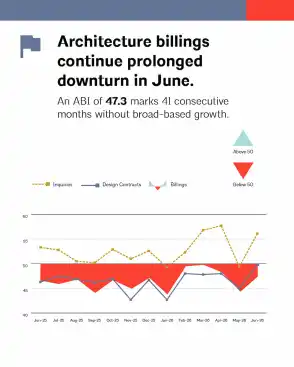
Project inquiries—the earliest measure of potential future work—rose to 56.1, suggesting clients are once again exploring projects after a modest pullback in May. Yet inquiries do not necessarily become commissions, and firms have spent much of the past three years watching promising conversations fail to evolve into signed contracts.
That pattern remains evident in June’s Design Contracts Index, which registered 49.8. Although effectively flat, it still falls just below the growth threshold, indicating that firms are winning new work only slowly and inconsistently.
In other words, clients are talking—but many are still waiting before making significant investments.
That hesitation has become one of the defining characteristics of the post-pandemic design economy. Developers continue to contend with expensive financing, institutional clients face uncertain public funding environments, and corporations remain cautious about launching major capital projects amid an unpredictable economic outlook.
Backlogs Begin to Thin
Perhaps the most concerning figure in the June report is not the ABI itself but the continued erosion of firm backlogs.
Average backlogs slipped to 6.3 months during the second quarter, down from 6.6 months in the first quarter. While the decline appears modest at first glance, it signals that many firms are gradually exhausting work already under contract without replacing it at the same pace.
For smaller practices, the situation is considerably more severe.
Architecture firms generating less than $250,000 in annual billings experienced one of the sharpest quarterly declines in recent years, with average backlogs dropping from 4.9 months to just 3.1 months.
For firms operating with limited financial reserves, shrinking backlogs translate directly into increased business risk. As projects conclude without equivalent replacements entering the pipeline, staffing decisions become increasingly difficult, investment slows, and competition for available work intensifies.
Large firms often have the scale, geographic diversity, and sector mix to weather prolonged slowdowns. Smaller firms rarely enjoy that luxury.
Regional Recovery Remains Uneven
The June data also highlights how uneven the recovery continues to be across the United States.
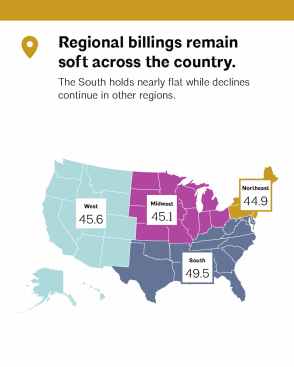
The South once again outperformed every other region with an index of 49.5, coming close to stabilization even though it remained slightly below expansion territory.
The West posted a reading of 45.6, followed by the Midwest at 45.1 and the Northeast at 44.9, indicating that firms in those regions continue to experience broader declines in billings.
The regional differences reflect varying local economic conditions, development pipelines, population growth, and public investment strategies. Markets benefiting from continued migration and infrastructure investment have generally proven more resilient, while regions more dependent on commercial office development or slower institutional spending continue to struggle.
Institutional Work Holds Up Best
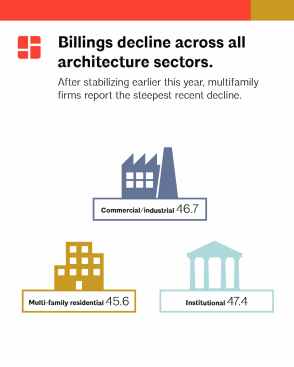
No major practice sector escaped contraction during June, although some performed notably better than others.
Institutional work—including education, healthcare, civic, and government projects—proved the most resilient with a sector score of 47.4.
Commercial and industrial work followed at 46.7, while multifamily residential projects continued to weaken at 45.6, reflecting the ongoing impact of higher borrowing costs on housing development.
Mixed-practice firms—those without a dominant specialization—recorded the weakest performance at 42.7, suggesting that diversification alone has not insulated firms from broader market uncertainty.
The continued weakness in multifamily design is particularly notable given persistent nationwide housing shortages. While demand for housing remains structurally strong, financing challenges and construction costs continue to delay many projects before they reach the design stage.
A Historic Downturn Continues
For AIA Chief Economist Richard Branch, the June numbers represent improvement—but not enough to change the profession’s overall trajectory.
“Architecture firms remain mired in one of the longest running downturns in the 30-plus year history of the ABI, which now stretches to 41 months without a majority of firms reporting billings growth,” said AIA Chief Economist Richard Branch. “The uncertainty over the conflict in Iran along with high interest rates and significant labor shortages will continue to weigh on construction – and architect billings over the next several months.”
Branch’s assessment reflects a broader reality confronting the construction industry. Financing remains expensive despite expectations that interest rates could eventually moderate, labor shortages continue to constrain project delivery, and international geopolitical tensions have introduced another layer of uncertainty for investors considering large capital commitments.
The result is a market where projects increasingly move forward more slowly—even when demand exists.
Waiting for the Next Cycle
The Architecture Billings Index has historically served as one of the industry’s most reliable leading indicators, typically forecasting nonresidential construction activity nine to twelve months into the future.
That makes June’s report significant not because conditions worsened, but because they failed to improve enough to signal a meaningful turning point.
The increase in project inquiries offers evidence that clients remain interested in building. Flat contract activity suggests that projects are still advancing, albeit cautiously. Yet declining backlogs and another month of contracting billings demonstrate that architecture firms continue to operate in an environment where optimism is consistently tempered by economic uncertainty.
After 41 months of contraction, the question is no longer whether the profession is experiencing an unusually long slowdown—it clearly is. The more pressing question is how much longer firms can continue waiting for the recovery that has repeatedly appeared just over the horizon, only to remain frustratingly out of reach.