For a film festival ostensibly about architecture and design, this year’s Architecture & Design Film Festival is surprisingly preoccupied with what already exists.
Old buildings. Aging housing projects. Discredited architectural styles. Public spaces whose success can only be measured years after the ribbon cutting. Modernist movements whose official histories are being rewritten. And, perhaps most provocatively, architects whose contributions were obscured or erased while their male collaborators became canonical figures.
That tension between architecture’s impulse to make something new and the increasingly urgent need to reconsider what it has inherited runs through ADFF, which returns October 12–17 to open the Architecture & Design Film Festival’s 2026/2027 season. Now in its 18th year, ADFF is expanding geographically while also widening its lens on what constitutes an architectural story.
For the first time, the New York festival will open at the Museum of Modern Art before moving to its longtime home at Village East by Angelika for five additional days of screenings. The season then travels to Toronto, Vancouver, Mumbai, the festival’s inaugural Detroit edition, and Chicago.
“You can draw a line through almost every film in this year’s festival: what do we do with what’s already been built,” says Kyle Bergman, founder and festival director of the Architecture & Design Film Festival. “Movements like the Bauhaus and Googie are being handed back to the people who lived them, and to the people that history left out of the credits. And more than one of these films is watching a housing experiment play out in real time, with no guarantee it works.”
It is a useful framework for a lineup that often turns away from the familiar architectural documentary—the heroic designer, the pristine building, the sweeping drone shot—and toward a messier question: What happens after architecture enters the world?
Before the Pritzker
ADFF begins with an architect who has suddenly become much more famous.
Opening night at MoMA will feature the world premiere of MUNDO FRÁGIL, by artist-filmmakers Ila Bêka and Louise Lemoine, an intimate portrait of Chilean architect Smiljan Radić filmed two years before he received the 2026 Pritzker Architecture Prize.
The timing gives the 90-minute film an accidental significance. Rather than documenting an architect in the wake of architecture’s highest honor, Bêka and Lemoine encountered Radić before the machinery of global recognition had fully descended.
The filmmakers spent a week traveling with him across Chile, from the Atacama Desert to the Cordillera mountains. The resulting road movie uses the country itself as a way into Radić’s imagination, examining the relationship between landscape, mythology, material, and a body of work that has always resisted easy classification.
Radić, a Chilean architect of Croatian heritage, has deliberately maintained a relatively small Santiago practice even as his international reputation has grown. His architecture frequently oscillates between opposites: primitive and sophisticated, rough and delicate, monumental and strangely fragile. Buildings can appear geological in one moment and almost handmade in the next.
Bêka and Lemoine, known for treating architecture anthropologically rather than simply documenting buildings as objects, appear particularly well matched to him. Their film is less interested in assembling a conventional career retrospective than in discovering how an architect sees.
Following the screening, Radić will join Bêka and Lemoine in conversation, moderated by Martino Stierli, the Philip Johnson Chief Curator of Architecture and Design at MoMA.
What Happens After the Architect Leaves?
That question of how architecture is actually experienced becomes even more explicit in the festival’s other world premiere, Jonathan Goodman Levitt’s Five Living Buildings (by Renzo Piano).
The title is telling. These are not five Renzo Piano buildings presented as masterpieces. They are five buildings presented as inhabited organisms.
The film travels across four continents to the Stavros Niarchos Foundation Cultural Center in Athens; Emergency’s children’s hospital in Entebbe, Uganda; the Whitney Museum of American Art in New York; the OōEli complex in Hangzhou, China; and the Centre Pompidou in Paris, which turns 50 in 2027.
But Piano and his buildings are only part of the story. The film follows student interns, gardeners, doctors, patients, security guards, museum visitors, maintenance workers, and retirees—the people whose daily routines ultimately transform architecture from drawings, steel, glass, concrete, and institutional ambition into lived space.
It amounts to a quiet challenge to architectural authorship. Buildings may carry an architect’s name, but their lives belong to everyone else.
Copan.
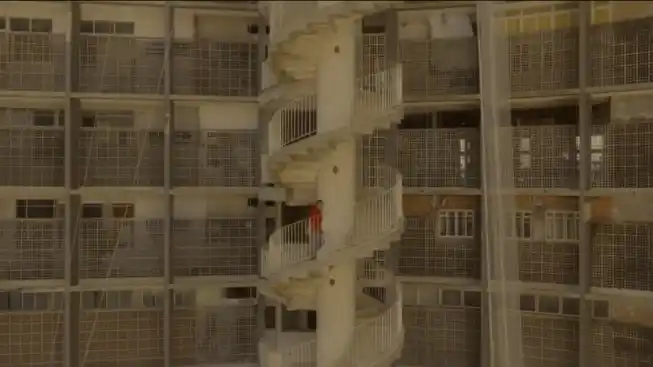
The same question resurfaces, with much higher political stakes, in COPAN, Carine Wallauer’s portrait of Oscar Niemeyer’s enormous residential building in São Paulo.
Home to more than 5,000 residents across roughly 120,000 square meters, Copan has long been one of modern architecture’s great experiments in urban density. Wallauer, herself a resident, turns the camera inward. A contentious election for the building’s administrator unfolds while Brazil simultaneously faces the national election between Luiz Inácio Lula da Silva and Jair Bolsonaro.
Suddenly Niemeyer’s sinuous landmark becomes something more complicated than an icon. It becomes a miniature democracy.
Residents debate power, representation, leadership, and change while living inside one of the twentieth century’s most ambitious visions of collective urban life. Architecture does not solve those conflicts. It contains them.
Housing Is Never a Finished Experiment
That uncertainty also drives Louise Detlefsen’s The Tingbjerg Experiment, which follows the transformation of one of Copenhagen’s most stigmatized housing districts.
Tingbjerg is undergoing a dramatic intervention prompted by Denmark’s controversial 2018 “parallel society” legislation. Its population is expected to double as private housing is inserted among existing public housing in a largely immigrant neighborhood—a transformation researchers have characterized as the largest Danish social-housing experiment since World War II.
The premise is the sort of thing architects and planners often render convincingly: change the housing mix, introduce new residents, create new activity, encourage integration.
Reality is less obedient.
What happens when new homes rise on lawns outside existing residents’ windows? Does introducing private housing produce integration, or simply displacement and resentment? Can architecture manufacture community? The film deliberately offers no guarantee that the experiment will produce the outcome policymakers intended.
Bêka and Lemoine explore a related question at the scale of public space in The World in a Square, their portrait of Superkilen in Nørrebro, one of Copenhagen’s most ethnically and socially diverse neighborhoods.
Rather than treating the much-published park as a finished piece of landscape architecture, the filmmakers spend a summer there with the people who use it. An activist, astronomer, tattoo artist, cook, and babysitter become guides to a neighborhood shaped by migration, religion, politics, conflict, and unexpected encounters.
The question is no longer whether Superkilen is good design. It is whether design can actually help strangers live together.
The Greenest Building May Be the One You Don’t Demolish

The 2026 Architecture & Design Film Festival opens at MoMA with films that challenge architecture’s obsession with the new. Featuring Smiljan Radić, Renzo Piano, Oscar Niemeyer, Denise Scott Brown, Bauhaus, Googie architecture, housing experiments, and adaptive reuse, this year’s lineup asks what happens to buildings—and architectural history—after the architects leave. Photo, Still from Bauhaus Forever.
If several ADFF films challenge architecture’s faith in social engineering, Barbara Buser – Swiss Pioneer of Sustainability challenges another of the profession’s habits: its tendency to equate environmental progress with technological innovation.
Basel architect Barbara Buser’s approach is considerably more direct. She saves buildings.
Directed by Gabriele Schärer, the film follows Buser as she rescues structures from demolition, transforms former industrial sites into urban spaces, and builds with salvaged materials.
She does not need to turn adaptive reuse into a slogan. It is simply the way she practices architecture.
That makes the film particularly timely. As architects increasingly confront the enormous carbon cost embedded in demolition and new construction, reuse is moving from the margins of architectural practice toward its center. The radical proposition may also be the simplest one: before designing another supposedly sustainable building, ask whether an existing one can be kept.
Who Gets Written Into Architectural History?
ADFF’s reconsideration of what already exists extends beyond buildings to architectural history itself.
Nico Weber’s bauhaus forever. returns to one of modernism’s most mythologized movements through the strange condition of Berlin’s Bauhaus-Archiv/Museum für Gestaltung. Filmed over five years while the institution is displaced and a new museum rises behind construction fences, the documentary finds an unexpectedly apt metaphor.
The Bauhaus lasted only 14 years. Its afterlife has lasted a century.
What began as an effort to overturn conventions has itself become heritage, institution, commodity, brand, and myth. The archive devoted to preserving that legacy is simultaneously being rebuilt. The history, like the building, remains under construction.
Googie.
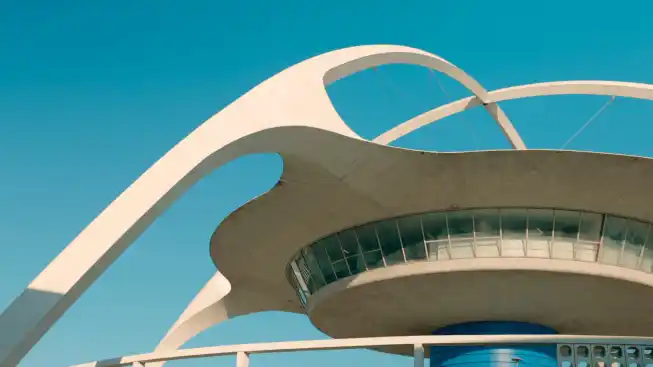
Jake Gorst’s Googie performs a different act of rehabilitation. The film revisits the neon signs, dramatic rooflines, boomerang forms, coffee shops, bowling alleys, banks, car washes, and roadside spectacles that transformed postwar Los Angeles.
Long dismissed as kitsch, Googie architecture was designed for a city experienced through a windshield. Its buildings had seconds to grab the attention of passing motorists. Their exuberance captured an American fascination with cars, consumer culture, technology, and the Space Age.
Many of those buildings have disappeared. The ones that remain are increasingly defended by preservationists who see Googie not as an embarrassing detour from architectural seriousness but as one of the most distinctive expressions of midcentury Los Angeles.
But perhaps the festival’s most pointed act of historical revision comes with An.Ash Smolar’s Out of the Picture.
The documentary begins with one of architecture’s most notorious exclusions: the 1991 Pritzker Architecture Prize, awarded to Robert Venturi alone despite Denise Scott Brown’s intellectual and professional partnership with him.
Scott Brown’s story becomes the starting point for a larger investigation into how architectural history decides who enters the frame and who disappears from it. Through interviews, archives, research, and animation, the film considers the institutional and cultural mechanisms that marginalized generations of women architects, including figures such as Eileen Gray.
The question is not simply why women were overlooked. It is how architectural history was constructed in ways that made overlooking them possible.
Architecture After the Hero Shot
Other films widen the festival’s scope further. Máximapark – From Greenhouses to a Living Landscape documents the transformation of a former market-gardening district near Utrecht into a community-driven landscape designed by Adriaan Geuze, with elements including Piet Oudolf’s Vlinderhof garden. The Tower That Built A City follows Toronto’s CN Tower from engineering project to mocked spectacle to national icon, while simultaneously charting Toronto’s emergence from a self-conscious “second city” into a global cultural center.
Taken together, the films suggest that the most consequential architectural stories may begin precisely where conventional architecture coverage often ends.
After the building opens.
After the architect leaves.
After the photographs are taken.
After the theory collides with the people who actually have to live with it.
“This festival is about surfacing the questions facing architects and designers right now, and these films give us the chance to explore, discuss, and consider them—an active engagement with the past, present, and future that offers unique insight into how the field is evolving,” Bergman says.
That may also explain why ADFF’s 2026 lineup feels particularly relevant at a moment when architecture is being forced to reconsider some of its most persistent assumptions: that new is inherently better than old; that a celebrated building can be understood through its architect; that design can reliably engineer social outcomes; and that architectural history has accurately recorded the people responsible for making it.
Eighteen years after the Architecture & Design Film Festival began, the medium of film is proving especially useful for challenging those assumptions. A photograph can freeze a building at the moment its architect wants us to see it. A film can return years later and watch what happened.
And what happened after the architecture was finished may turn out to be the more interesting story.
ADFF runs October 12–17, 2026, opening at the Museum of Modern Art before continuing at Village East by Angelika. The festival’s 2026/2027 season continues in Toronto, Vancouver, Mumbai, Detroit, and Chicago.