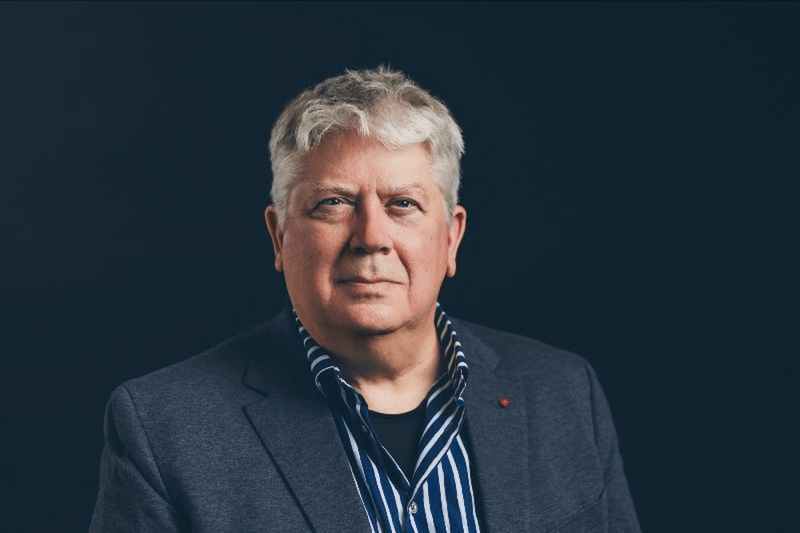
At a moment when architecture is being asked to confront everything from climate change and material scarcity to social inequity and the future of design education, the SOM Foundation has selected an educator and advocate accustomed to pushing the discipline beyond the boundaries of conventional practice.
Peter MacKeith has been named executive director of the SOM Foundation, succeeding Iker Gil and taking charge of an organization that has spent nearly five decades supporting emerging designers, educators, and researchers working across the built environment.
The appointment follows a global search and brings MacKeith back into the orbit of Skidmore, Owings & Merrill. In addition to his extensive academic career, MacKeith previously edited SOM Journal, the firm’s professional journal devoted to history, theory, criticism, and the examination of architectural practice.
MacKeith arrives at the foundation after a decade as dean of the Fay Jones School of Architecture and Design at the University of Arkansas, where he served from 2014 until earlier this year. During his tenure, the school expanded its research activities, facilities, and opportunities for students, while MacKeith increasingly positioned design education as a vehicle for investigating larger questions about materials, construction, culture, and place.
One of the most visible manifestations of that approach is the Anthony Timberlands Center for Design and Materials Innovation, designed by Grafton Architects and Modus Studio. The project established a new center for timber and wood-product research while bringing the work of Pritzker Prize-winning Grafton Architects to the Arkansas campus.
MacKeith’s appointment also follows his prominent role on the international architecture stage. In 2025, he served as lead commissioner of the U.S. Pavilion at the Venice Architecture Biennale. Organized in collaboration with the Crystal Bridges Museum of American Art and DesignConnects, PORCH: An Architecture of Generosity used one of the most familiar elements of American architecture as a lens through which to consider gathering, exchange, public life, and generosity in the built environment.
For the SOM Foundation, that combination of education, research, institution-building, and public advocacy appears central to the appointment.
“Peter’s trajectory mirrors that of the SOM Foundation: more than four decades of broadening impact with practitioners across the profession. We look forward to applying his expertise to forge new collaborations that will continue to expand the influence of the SOM Foundation and its mission,” said Scott Duncan, Chairman of the SOM Foundation Board and SOM Partner.
From Fellowships to a Broader Design Mission
Founded by SOM in 1979 under the leadership of Bruce Graham, the SOM Foundation operates as an independent nonprofit organization focused on cultivating emerging leadership and research in architecture and related fields.
Over its history, the organization has provided more than $3.5 million in fellowships, grants, and mentorship opportunities to students, recent graduates, and faculty working in architecture, landscape architecture, interior architecture, urban design, structural engineering, and other disciplines.
Underlying those programs is a larger ambition: expanding the design profession’s capacity to respond to major societal, environmental, and spatial challenges.
That mandate aligns closely with MacKeith’s career.
Across his academic and administrative positions, he has argued for an expanded conception of architecture and design education—one in which applied research, material experimentation, cultural knowledge, and public engagement are treated not as peripheral concerns but as fundamental parts of architectural practice.
“I am honored and privileged by this appointment and appreciate the trust and responsibility placed in me by the SOM Foundation board,” said MacKeith. “I believe my background, education, experience and ambitions as a committed and creative educator in the fields of architecture and design education have prepared me to meet the responsibilities of design advocacy, education, and leadership for the SOM Foundation.”
MacKeith’s career has moved repeatedly between academia, publishing, curatorial work, research, and institutional leadership.
He is an ACSA Distinguished Professor, a two-time DesignIntelligence Educator of the Year, and a Design Futures Council Senior Fellow. In 2021, AIA Arkansas presented him with its Award of Merit for his contributions to architecture and design education in the state. This fall, he is slated to receive the chapter’s highest honor, the E. Fay Jones Gold Medal.
His ties to Finland extend back decades. A 1990 Fulbright Fellow in architecture to Finland, MacKeith was named a Knight, First Class, of the Order of the Lion of Finland in 2012 in recognition of his contributions to Finnish architectural culture.
Publishing has provided another through line in his career. MacKeith has authored or edited 14 books, including the recently published Out There! New American Architecture, written with Robert Ivy and Cathleen McGuigan; Radical Practice: The Work of Marlon Blackwell Architects, with Jonathan Boelkins; and The Finland Pavilions: Finland at the Universal Expositions 1900–1992, with Kerstin Smeds.
He has also served on the editorial and management boards of Places Journal and edited Perspecta, the Yale Architecture Journal, including its 1988 issue “On Materiality.” His previous work with SOM Journal included issues devoted to “Collaboration/Teamwork” and “Leadership/Authorship”—subjects that now take on additional relevance as he assumes leadership of the foundation itself.
Building on a Decade of Expansion
MacKeith inherits an organization that changed significantly during Iker Gil’s tenure as executive director.
Over the past decade, the SOM Foundation expanded fellowships for students and faculty in the United States, Europe, and China while introducing programs intended to broaden access to architecture and design.
Among them are the Robert L. Wesley Award, created to expand opportunities for BIPOC students, and the Gordon Bunshaft Award, which introduces high school students to architecture.
Gil also worked to make the research produced through the foundation’s fellowships more visible and accessible. Public programming created opportunities for fellows to exchange knowledge and connect academic research with professional practice, while a substantial effort was undertaken to document the foundation’s history dating back to 1979.
That work resulted in an expanded digital archive and web presence as well as a physical archive and research center inside SOM’s Chicago office. The initiative made decades of fellowship reports and research accessible to scholars while providing a venue for small exhibitions drawn from projects supported by the foundation.
The foundation also strengthened connections between academia and practice through the William F. Baker International Research and Design Forum, staged at institutions including the Illinois Institute of Technology, the University of Stuttgart, and Escuela Técnica Superior de Arquitectura de Madrid.
Rather than signaling a break with that trajectory, MacKeith’s appointment suggests its expansion. The question now is how a foundation originally created to support promising young designers can use research, education, mentorship, and public advocacy to exert greater influence on a profession facing dramatically different circumstances from those of 1979.
MacKeith frames that task in unusually expansive terms.
“Iker Gil’s extraordinary period of leadership of the SOM Foundation has positioned it well to advance further in addressing the historical and contemporary challenge of architecture: how to build a better world,” said MacKeith. “The critical moment we live in now – characterized by economic, social and environmental challenges – calls for vigorous leadership in architecture and design, founded on clear vision, sound judgment, dedicated intelligence, deep empathy, and passionate advocacy. I look forward to leading the work of the SOM Foundation forward as a dynamic act of public design and research, in ambitious ideals, in synthetic process, and in collaborative production.”
For an organization founded almost half a century ago around the idea that investing in emerging designers could shape the future of the profession, MacKeith’s appointment comes at an consequential juncture. Architecture’s challenges are no longer limited to what or how to build. They increasingly encompass questions of resources, climate, access, education, public trust, and who gets to participate in shaping the built environment.
MacKeith’s task will be to turn the foundation’s fellowships, research, institutional history, and growing international network into a platform capable of engaging those questions—and, as he puts it, to make that work a “dynamic act of public design and research.”