What does it mean to devote more than forty years of your life to collecting objects designed, quite literally, to escape the ground? For Malcolm Goodman, an English engineer who became an unlikely authority on the art and science of kite making, the answer took the form of more than 1,000 kites gathered from around the world. His collection, housed on the ground floor of his home, became a private museum of sorts: an extraordinary accumulation of airborne inventions that spanned continents, cultures, and generations of experimentation.
Now, Goodman’s singular passion is the subject of Mr. Goodman: The Kiteman, a book published by Maharam in collaboration with Kite Club, a creative collective whose members share an enthusiasm for the deceptively simple technology of flight. Accompanied by an exhibition at Kunsthal Rotterdam, the project transforms one man’s personal obsession into a broader exploration of design history, craftsmanship, engineering, and the enduring human desire to make things fly.
The story of how Goodman’s collection found a new audience began, appropriately enough, on the internet. Members of Kite Club—creative director Peter Hebbing, industrial designer Bertjan Pot, and photographers Maurice Scheltens and Liesbeth Abbenes—discovered Goodman through a YouTube video in which the collector, surrounded by decades of accumulated kites, appealed for someone to give his collection a permanent home.
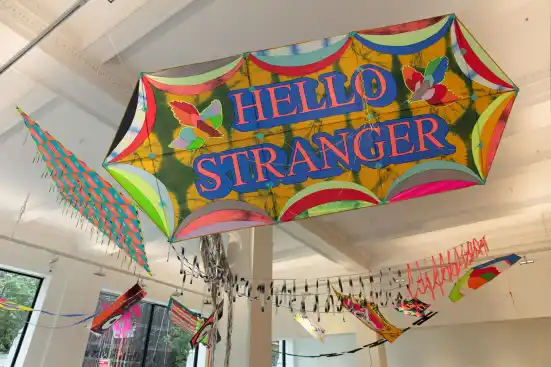
Kite by member of the Kite Club.
For a group already fascinated by the creative possibilities of kite making, the video presented an irresistible opportunity. Here was a collection that extended far beyond the familiar diamond-shaped kite of childhood memory. Goodman had spent decades acquiring examples that demonstrated the extraordinary diversity of the form, from highly specialized functional designs to elaborate decorative constructions. More importantly, his collection reflected a lifetime of relationships with kite makers around the world, many of whom had helped advance the craft through their own innovations.
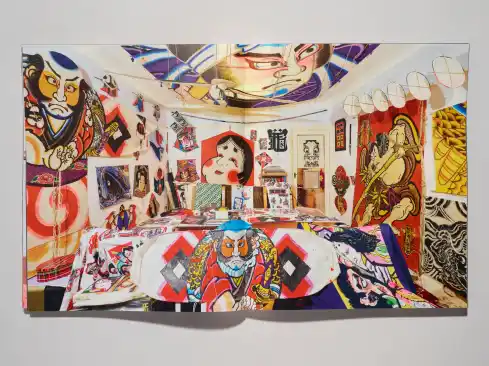
Malcolm Goodman, The-Kiteman's collection. Photo Credit Schelten Abbenes.
Kite Club contacted Goodman and began working with him to preserve the collection, helping to pack and safeguard the objects while exploring how to communicate their significance to a wider audience. The resulting publication is both a portrait of an unusually dedicated collector and an examination of the kite as an object that occupies a fascinating intersection of art, engineering, and cultural expression.
A Museum of Things That Fly
At first glance, the kite might seem an unlikely subject for serious design scholarship. Its essential components—lightweight materials, a structural framework, a tether, and the aerodynamic forces of the wind—have remained remarkably consistent even as its forms have multiplied across cultures. Yet that apparent simplicity conceals a rich history of technical invention and visual experimentation.
Goodman’s collection illustrates the remarkable range of possibilities contained within this elementary idea. Among its more than 1,000 objects are examples of the American “Gibson Girl” kite, a design associated with wartime emergency communications, and the Malaysian wau bulan, or moon kite, whose distinctive curved silhouette and decorative traditions have made it an enduring cultural symbol.
These two examples alone suggest the breadth of the collection. One represents the kite as a practical instrument, developed to serve a specific technical purpose. The other demonstrates how the same basic principles of flight can produce an object of elaborate craftsmanship and cultural meaning.
Between these extremes lies a universe of experimentation. Kites can be aerodynamic devices, graphic compositions, sculptural constructions, or expressions of regional identity. They can be engineered for stability, maneuverability, visibility, or spectacle. Their materials and structures reveal the different ways makers have responded to the challenges of wind, weight, balance, and movement.
For an engineer like Goodman, these variations offered an endlessly renewable source of fascination. Each kite represents a particular solution to a shared problem: how to transform a lightweight assembly of materials into something capable of taking flight.
Yet the collection is more than an inventory of ingenious solutions. It is also a record of the people who made them. Goodman developed relationships with leading kite makers, and the objects he acquired became tangible evidence of an international community united by a specialized but remarkably expansive passion.
From Private Obsession to Public Archive
The challenge of translating such a collection into a book is considerable. A kite is an object designed to be experienced in motion, animated by forces that cannot be fully captured on a printed page. Remove the wind, and what remains might appear to be little more than an arrangement of fabric, paper, rods, and string.
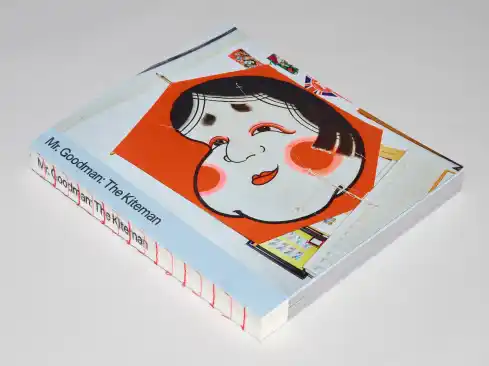
Mr. Goodman The Kiteman book. Photo Credit Scheltens Abbenens.
For Mr. Goodman: The Kiteman, photographers Scheltens & Abbenes approached the collection as a visual world in its own right. Their photographs document more than 280 kites, revealing the remarkable graphic and structural qualities of objects that are often appreciated primarily for their performance in the air.
The selection encompasses intricate miniatures, boldly patterned surfaces, and utilitarian constructions whose forms follow the demands of function. Viewed together, the kites become a compelling study in geometry, proportion, material economy, and visual invention.
Some can be understood as graphic designs temporarily given three-dimensional form. Others resemble delicate architectural structures, their lightweight frameworks organizing space through tension and balance. Still others demonstrate an almost industrial clarity, reducing the object to the minimum components necessary to achieve flight.
The photographs also document the sheer density of Goodman’s domestic collection. Images of the ground floor of his home, which once functioned as a private kite museum, convey the scale of his commitment. What began as a personal interest eventually occupied an entire interior landscape.
There is something particularly compelling about this transformation of a home into an archive. Unlike a conventional museum collection assembled according to an institutional mandate, Goodman’s accumulation grew from curiosity, personal encounters, and the sustained attention of an individual collector. Its organizing principle was not simply historical importance or aesthetic distinction, but a lifelong fascination with the subject itself.
That makes the collection valuable in ways that extend beyond the individual objects. It preserves the choices, relationships, and discoveries of someone who devoted decades to understanding a field that rarely receives the same critical attention as furniture, architecture, or industrial design.
The Kite as a Modernist Experiment
For twentieth-century modernists, the kite offered an almost perfect synthesis of art, engineering, and play. Its elemental construction—lightweight materials, geometric forms, and a delicate balance of tension and movement—embodied many of the principles that animated modernist design. At the Bauhaus, artists and designers explored the relationships among abstraction, movement, and material experimentation, while Alexander Calder transformed similar interests into kinetic sculptures that responded to air currents and gravity. The kite offered a compelling proposition: a structure liberated from the ground, animated by nature, and capable of transforming the invisible force of wind into a visible expression of form.
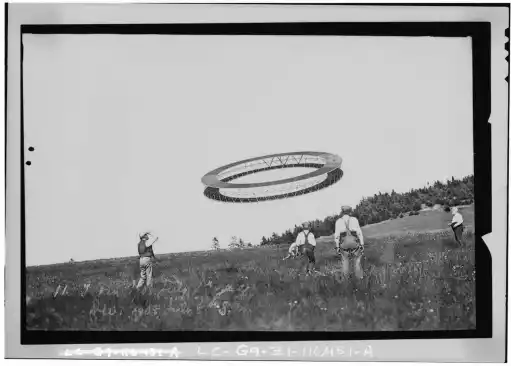
Alexander Graham Bell (right) and his assistants observing the progress of one of his tetrahedral kites. Photo courtesy Library of Congress.
The relationship between kites and modern architecture becomes especially compelling in the work of Buckminster Fuller, whose investigations into lightweight structures and geometric efficiency echoed experiments undertaken decades earlier by Alexander Graham Bell. Beginning around the turn of the twentieth century, Bell developed elaborate tetrahedral kites assembled from repeating triangular cells, demonstrating how small, rigid components could be combined into remarkably large flying structures. Fuller later explored related principles in his octet truss and other structural systems, using interconnected geometric units to achieve strength with an economy of materials.
The connection was more than coincidental. Fuller acknowledged the relationship between Bell’s tetrahedral constructions and his own geometric investigations, and in the 1970s received original kite components made by Bell from members of the inventor’s family. Although Fuller is not principally remembered as a kite designer, the lineage from Bell’s airborne experiments to Fuller’s structural thinking illustrates how the kite could function as a laboratory for architectural innovation. What began as an effort to harness the wind became part of a much larger exploration of how lightweight, modular structures might transform the built environment.
The connection between architecture and kite making was not limited to structural theory. In the 1940s, Texas architect Wilbur E. “Bill” Green worked with engineer Raymond Christiansen on the development of the delta kite, a triangular design that would become one of the most recognizable and commercially successful kite configurations of the twentieth century. Their experiments helped lead to the Gayla kite, whose aerodynamic simplicity, lightweight construction, and ease of flight represented a departure from traditional framed designs.
For Green, the kite presented a problem familiar to architects: how to reconcile geometry, structural stability, material efficiency, and performance. Its elegant triangular profile demonstrated how a carefully conceived structure could achieve remarkable results with minimal means. It also suggested that some of modernism’s most inventive ideas emerged not from monumental buildings or expensive industrial products, but from the playful application of engineering principles to everyday objects.
While Green approached the kite as an exercise in engineering, the Japanese American sculptor Isamu Noguchi explored its artistic and cultural possibilities. His sculpture The Kite (1959), realized in anodized aluminum, translated the familiar flying object into an abstract geometric composition. Noguchi also explored the subject in his monumental Bolt of Lightning…A Memorial to Benjamin Franklin, conceived in 1933 and completed in Philadelphia in 1984, which incorporated references to Franklin’s famous kite experiment.
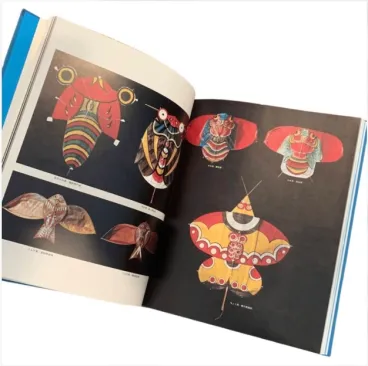
Tsutomu Hiroi book on kites (published in Tokyo by Tsutomu Hiroi in 1972).
His fascination extended beyond sculpture, however. Noguchi collected Japanese kites and maintained a close relationship with the Japanese kite maker Tsutomu Hiroi, who had worked as his assistant before developing his own practice. Noguchi contributed a preface to Hiroi’s 1972 book, reflecting on the kite’s capacity to reconnect people with elemental natural forces. For Noguchi, the kite was simultaneously an object of sophisticated craftsmanship, an expression of cultural tradition, and a means of experiencing the natural world.

Poul Henningsen published P.H.s Dragebog for Børn fra 8–128 År (Poul Henningsen's Kite Book for Children from 8 to 128 Years).
The Danish architect, designer, and cultural critic Poul Henningsen brought a similarly expansive curiosity to kite making, approaching it as both a technical challenge and a form of creative play. Best known for his ingenious PH lighting systems, Henningsen published P.H.s Dragebog for Børn fra 8–128 År (Poul Henningsen’s Kite Book for Children from 8 to 128 Years) in 1955, a practical guide to constructing and flying kites whose playful title suggested that creative curiosity should have no age limit. His enthusiasm reflected the same fascination with physical forces, geometric relationships, and experimentation that shaped his celebrated lighting designs.
His enthusiasm for kite making reflected the same fascination with physical forces, geometric relationships, and experimentation that shaped his celebrated lighting designs. Just as his multilayered lamps manipulated the movement and reflection of light, the kite maker worked with another invisible natural force: the wind. Both required an understanding of how carefully arranged surfaces could transform physical phenomena into something useful and beautiful. Henningsen’s interest also reflected his broader belief in accessible, democratic design, in which invention and aesthetic pleasure were not reserved for expensive objects or elite institutions. For him, the kite offered a particularly appealing expression of that philosophy: an inexpensive construction capable of producing extraordinary visual and physical effects.
For Charles and Ray Eames, the kite can be understood within a larger world of toys, games, folk objects, and everyday inventions that offered lessons in design. The couple famously rejected the distinction between serious work and play, approaching even the simplest objects with curiosity about their construction, materials, and possibilities. Their fascination with spinning tops, masks, miniature objects, and other examples of vernacular ingenuity reflected a belief that good design was not necessarily expensive, complicated, or monumental.
The kite exemplifies this sensibility. Like the molded-plywood furniture and experimental structures developed by the Eames Office, it depends on the intelligent use of lightweight materials, structural efficiency, and an understanding of how form responds to physical forces. A kite also possesses the qualities the Eameses prized in objects: accessibility, ingenuity, visual delight, and the capacity to inspire curiosity. Although kite making was not a central focus of their documented work, their philosophy offers a compelling way to understand why such humble flying objects deserve a place in design history.
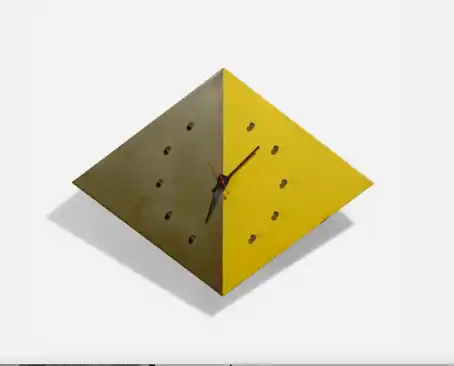
Irving Harper for George Nelson & Associates, Kite Wall Clock, model 2201B, Howard Miller Clock Company, 1952-53. Photo courtesy Wright Auctions.
The fascination with kite-like forms also surfaced in the work of American modernist George Nelson. In 1952–53, his design office created the Kite Clock for the Howard Miller Clock Company, transforming the familiar geometry of a flying kite into a playful domestic object. Produced in several striking color combinations, the clock exemplified Nelson’s conviction that everyday products could combine functional precision with visual wit. Although there is no clear documentation that Nelson himself experimented with flying kites, his broader investigations into lightweight structures, unconventional materials, and geometric abstraction reveal an affinity with the principles of kite making.
Taken together, these modernist examples help illuminate why Goodman’s collection matters beyond the specialized world of kite enthusiasts. Bell’s early experiments and Fuller’s structural investigations demonstrate the kite’s relationship to architectural engineering, while Green, Spohn, Noguchi, and Henningsen engaged directly with kites as objects of technical or artistic experimentation.
The Eameses and Nelson, meanwhile, explored related ideas through furniture, lighting, toys, and everyday products. Their work suggests that the kite occupies a revealing position within the history of modern design, bringing together structural intelligence, material efficiency, visual delight, and the unpredictable forces of nature. In this sense, Goodman’s collection can be understood as an unexpected archive of ideas central to modernist thinking, revealing how generations of craftspeople, engineers, and artists—many working outside established design institutions—arrived at ingenious solutions to the same fundamental challenge.
The Kite as a Design Object
For Kite Club, Goodman’s collection offered an opportunity to reconsider the kite as a serious subject of contemporary design discourse.
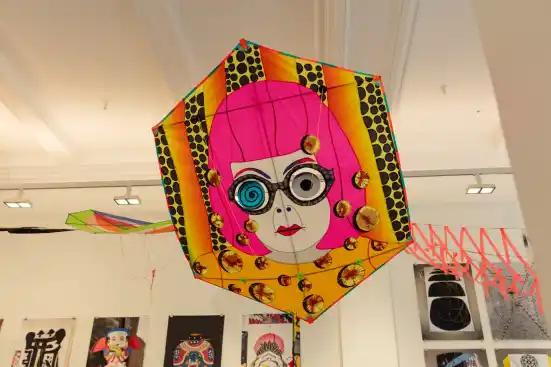
Kite by Kite Club member.
The collective itself emerged from a shared enthusiasm for single-line kites, beginning with members posting their handmade creations on Instagram. What started as an informal exchange developed into a broader collaborative practice encompassing exhibitions, workshops, and publications.
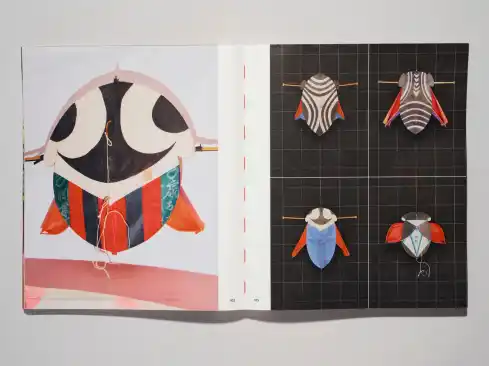
Spread from Mr. Goodman: The Kiteman. Photo courtesy Scheltens Abbenes.
In 2025, the group published One Single Kite, a book that documented the stages of making a kite. That project focused attention on process: the sequence of decisions, techniques, and material choices required to produce an object capable of flight.
Mr. Goodman: The Kiteman expands that inquiry from the making of an individual object to the larger cultural and historical world in which kite making exists.
Design historian Emily King contributes an introductory essay that reconstructs aspects of Goodman’s life in kiting, drawing together anecdotes from his decades of collecting. Additional short essays by King and Pot provide context for the objects, connecting individual examples to historical developments and contemporary kite culture.
The book consequently operates on several levels. It is a photographic survey of an extraordinary collection, a biographical account of an unconventional collector, and a contribution to the growing recognition of vernacular and often overlooked forms of design.
It also raises a larger question about the boundaries of design history. Why do certain objects become celebrated as icons of innovation while others, equally inventive and culturally significant, remain largely outside the institutional canon?
The kite provides a particularly revealing case study. Its development has involved generations of makers working across different cultures, often outside formal design institutions. Its success depends on an intimate understanding of materials and physical forces, yet its visual expression can be exuberant, playful, and highly individual.
Unlike many designed objects, a kite also depends on an element its maker cannot control. The wind completes the design. However carefully conceived, the object only fully realizes its purpose through an interaction with the natural world.
That relationship between precision and unpredictability gives kite making an unusual character. It demands technical discipline while allowing considerable freedom of expression.
A Different Kind of Design Legacy

Maharam Showroom, New York City.
Maharam’s involvement in the publication reflects the textile company’s longstanding engagement with creative disciplines beyond its primary business. The connection to kite making is especially fitting. Like textiles, kites depend on the behavior of flexible surfaces, the properties of materials, and the relationship between structure and movement. Fabric, color, pattern, and tension can all become central to their performance and appearance.
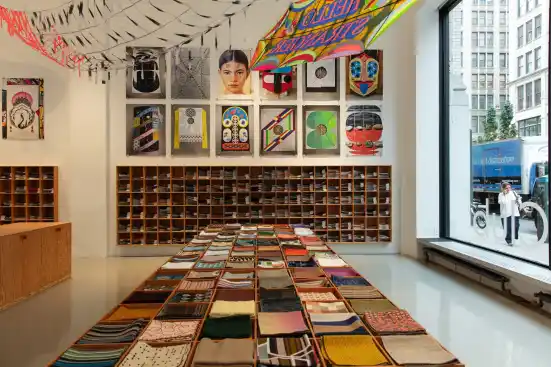
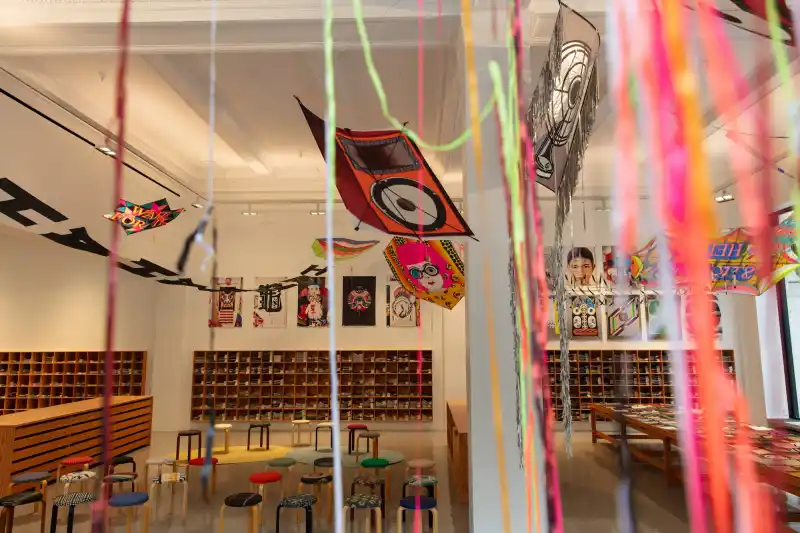
Kite Club Installation at Maharam showroom.
But the significance of Mr. Goodman: The Kiteman extends beyond these formal connections. The project demonstrates how a specialized private collection can become a resource for a much wider creative community when its contents are carefully documented and interpreted.

Kite by Kite Club member.
Too often, collections built through individual dedication remain inaccessible to researchers and the public, or risk being dispersed when their owners can no longer maintain them. Goodman’s decision to seek a permanent home for his kites was an acknowledgment that the collection had acquired a significance beyond his own enjoyment.
Kite Club’s response suggests one way of addressing that challenge: bringing together practitioners, historians, photographers, and publishers to make the knowledge embedded in a private archive more widely available.
The accompanying exhibition at Kunsthal Rotterdam, which ran through August 30, 2026, extended the project into a public setting, offering another opportunity to encounter the collection and its story.
There is also an appealing contradiction at the heart of the undertaking. Kites are among the most ephemeral of designed objects, intended to move through open air and respond to changing conditions. Goodman, by contrast, spent more than forty years collecting, preserving, and organizing them. His life’s work was devoted to holding on to things whose essential purpose is to fly.
Perhaps that is what makes the story so resonant. Goodman recognized that these apparently modest objects carried within them histories of invention, cultural exchange, and individual imagination worth preserving. In gathering them, he created something greater than the sum of its parts: an unconventional archive of human ingenuity.
And through Mr. Goodman: The Kiteman, that archive offers a reminder that some of the most inventive examples of design are not necessarily found in buildings, museums, or manufactured products, but in objects conceived to do something wonderfully simple—catch the wind and rise into the sky.
Mr. Goodman: The Kiteman is published by Maharam in collaboration with Kite Club, with photography by Scheltens & Abbenes and essays by Emily King and Bertjan Pot. The accompanying exhibition at Kunsthal Rotterdam ran through August 30, 2026. An installation by Kite Club highlighting the collective’s shared passion for kite design are on view at Maharam’s New York showroom through October 16.
Kite Club at Maharam
On view until October 16
Monday–Friday, 9:00am–4:30pm
257 Park Avenue South
New York, NY