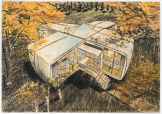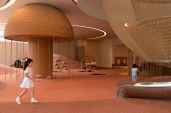
In 2012, visitors to the Hyundai Motor Group Pavilion at the Yeosu Expo in South Korea encountered three enormous white walls that suddenly appeared to come alive. Hyper-Matrix, a kinetic installation by the media art group Jonpasang, consisted of thousands of 320-millimeter foam cubes attached to individually controlled actuators. Projecting outward and inward, the cubes transformed flat surfaces into rippling landscapes, patterns, and images; a field of pixels with physical depth.
I visited the installation that year and was struck by the literal translation. A pixel, defined as a picture element defined by its location and value on a two-dimensional grid, had effectively become a voxel, or volumetric pixel, in three-dimensional space. But what made “Hyper-Matrix” remarkable was not the cube itself, but the fact that every cube was addressable (independently accessed and controlled by a computer). Thousands of simple, nearly identical elements could suddenly produce complex, customized effects because each could be controlled independently.
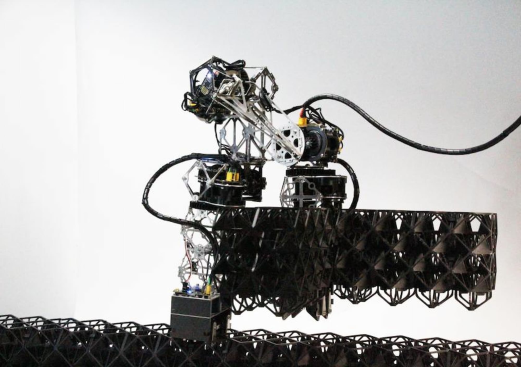
Researchers at MIT produced a robotic assembler and a user-friendly interface for generating voxel-based building layouts and feeding instructions to the robots. Photo courtesy MIT.
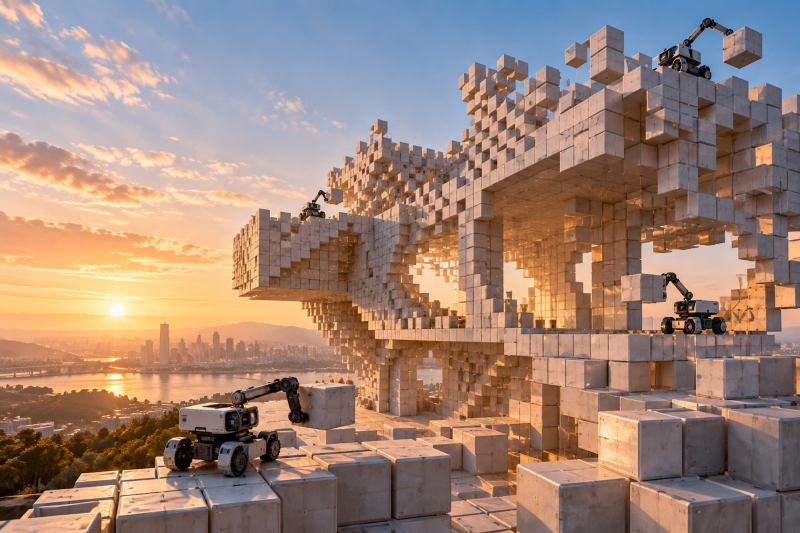
Researchers at MIT’s Center for Bits and Atoms are exploring the voxel’s possibilities further. A team led by Miana Smith and Neil Gershenfeld recently developed lightweight lattice-structured voxels designed for robotic building construction. The interlocking units mechanically self-align, allowing small Modular Inchworm Lattice Assembler robots (MILAbots) to carry them across an emerging structure, drop them into position, and step on them to engage their snap-fit connections. Multiple robots can operate simultaneously, while a computational interface translates a voxelized design into movement and assembly instructions.
The proposition challenges a basic assumption about construction: that making larger things generally necessitates larger machinery. Conventional building requires trucks, cranes, scaffolding, and substantial site mobilization. Voxel construction offers another model. It will eventually be possible to build a large structure with constituent parts and machines of comparatively small size.
This approach could have significant environmental implications. MIT’s research endeavor compared plastic, plywood, and steel voxels with conventional systems and estimated embodied-carbon reductions as high as 82 percent in some scenarios. Yet the results also showed that voxelization is not intrinsically sustainable: material choice matters considerably, with some plastic configurations performing poorly. Sustainability is therefore better understood as a potential, albeit fundamental, outcome of a shift toward physically programmable architecture.
Building with standardized pieces is hardly new. Cut stone, brick, concrete block, dimensional lumber, and prefabricated components all represent variations on an ancient notion: simplifying construction through repeatable elements. The voxel is the latest manifestation of this tradition.
Recent research into a Voxel-based Modular Architectural Design Strategy (VMADS) makes this lineage particularly clear. Researchers Jianing Luo, Boyuan Yu, Yangzhi Li, Yi Shi, and Adam Fingrut developed reusable wooden H-shaped blocks organized according to a Tetris-like three-dimensional voxel grid. Computational methods determine how the blocks pack and connect, while robotic fabrication translates these instructions into physical assemblies. The team’s experiments explored applications ranging from furniture to architectural components and larger structures.
As previously indicated, the critical distinction between VMADS and conventional modular construction is not form, material, or building method, but addressability. Modularization imparts repeatability, but addressability enables programmability.
This distinction also changes how we might think about customization. Digital fabrication has long promised mass customization, often by making every manufactured component different. A broader interpretation of voxelization suggests that each addressable building block can be extremely differentiated.
For example, researchers at the Karlsruhe Institute of Technology recently developed an adaptive robotic process for turning irregular reclaimed wood into large structural components. The pieces, sourced from building demolition, industrial offcuts, and used pallets, are scanned and digitally mapped so their geometric and material differences can be incorporated into computational design and robotic fabrication.
Another recent experiment applies a similar logic to limestone quarry waste. Researchers scanned irregular stone fragments, computationally determined appropriate arrangements, and robotically processed mating surfaces to produce dry-stacked spanning assemblies. Rather than expending resources to transform heterogeneous stone into standardized products, the process exploits the intrinsic differences between pieces.
Strictly speaking, neither system consists of voxels. Yet both reveal a broader possibility for the voxel concept. An irregular stone can become computationally addressable if the system knows which stone it is, its geometry and properties, where it belongs, how it should be oriented, and how it connects to its neighbors.
Of course, voxelization can also go the other direction. Voxel-based construction can employ highly standardized components to create highly customized architecture. Like pixels on a screen, identical components can generate practically limitless configurations simply by occupying different positions.
Yet these approaches need not be mutually exclusive. One voxel might match thousands of structural neighbors, while another is customized as an aperture, connection, sensor, photovoltaic device, or mechanical component. Thus, voxel customization can reside either in the unit or in the arrangement of units.
Voxelization raises many questions, including: what is the resolution of architecture? As with tight construction tolerances, smaller voxels permit finer geometric differentiation, but this higher definition demands greater control. Smaller voxels are easier to handle but require more components, connections, assembly operations, and data. In contrast, larger voxels hasten construction but, as their size approaches that of standard building modules, may offer little advantage over typical construction methods.
Today, most of these experiments remain at the scale of furniture, components, and small prototype structures. Significant questions about fire resistance, durability, lateral loading, building envelopes, services, codes, and large-scale construction remain unresolved. (The MIT researchers themselves identify several of these as subjects for further investigation.) Nevertheless, the small scale makes the proposition tangible, enabling us to imagine how an entire building might eventually be conceived not as a singular object, but as an aggregation of individually knowable pieces.
That possibility also gives new meaning to an intriguing linguistic coincidence. Architects and computer scientists both use the word “architecture.” One discipline designs structures for human habitation; the other, for computation.
As physical components become computationally addressable, these definitions begin to converge. Architects may increasingly design not only physical structures but also the informational rules governing them. Meanwhile, computer scientists will become increasingly concerned with smart buildings and the Web of Things (WoT).
In this way, the distinction between architecture and computer architecture is likely to diminish, thanks in no small part to the voxel.