Utopia can sure have a lovely view. At Monte Veritá (“Mountain of Truth”) a hill above Ascona on the Swiss shore of Lake Maggiore, my window opened out to the Alpine ideal of water, mountains, and artfully tumbling villages. Before and after sessions of a small conference organized by the Trussardi Foundation about the uses and abuses of AI in art, I surveyed this scene from a room that could have been lifted out of the Bauhaus and explored grounds scattered with traces of a succession of organic farms, free love communities, and mystical movements. It occurred to me that solarpunk, the vision of technology and agriculture fusing in anarchistic experiments about which I wrote in my last blog has a long history at places such as this.
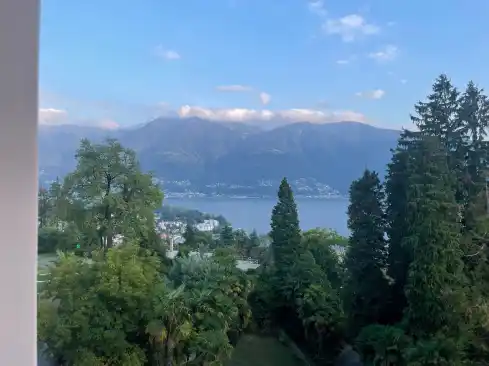
There is something both touching and presumptuous about calling a hill the Mountain of Truth. In 1900, a group including the dancer Ida Hofmann, the son of an Antwerp industrialist, Henri Oedenkoven, and the brothers Karl and Gusto Gruesser settled on what was then simply Monte Monescia with ambitions that extended beyond enjoying the scenery. They wanted to change how people ate, dressed, worked, lived together, and inhabited their bodies. Vegetarianism, natural healing, cooperation, and the emancipation of women were parts of a larger project: escaping a society whose industrial organization seemed to have separated human beings from nature and from themselves.
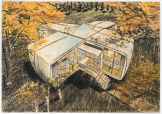
In turned that to discard restrictive clothing, work outdoors, expose yourself to sunlight, and share daily life required different spaces. The timber dwellings they built and called light-and-air huts offered an alternative to the heavy interiors and ceremonial arrangements of bourgeois domesticity. One of them, Casa Selma, survives as evidence of that experiment. It provided enough shelter to allow its occupants to live as much as possible beyond its walls, and its simplicity is its charm.
Like many utopian communities, however, this one failed when the initial enthusiasm waned and conflicts arose. The place was beautiful enough, though, that it kept attracting the kind of free-livers and -thinkers who came to Ticino from all over Europe and even America to escape local restrictions. Over the next half century, both Monte Veritá and the surrounding region attracted anarchists, artists, spiritual seekers, and advocates of bodily reform.
There was a lot of experimentation with diet and sex, and strange rites and rituals were performed in response to the mountains and lakes, but not a great deal of building emerged. Adolf Loos argued during this period for architecture as a mark of civilization, but he also made it clear that anti-civilization, which is what most of the seekers on the hill wanted, needed pure construction, not refined proportions and decoration.
Instead, there were above all dances. The father of modern dance, Rudolf von Laban, established his school here in 1913, and the dancer and choreographer Mary Wigman was among those involved in its experiments. Moving bodies could make spaces that buildings only enclosed. In the performances and exercises alike, clearings became stages and the landscape became part of a collective composition. The possibility of another society appeared in the relationships between people as they moved. Architecture could support such an event, but it could neither prescribe nor guarantee its existence.
To keep going, however, it turns out something more permanent was needed, if only for economic reasons. The colony developed into a sanatorium for paying guests, but people seeking release from conventional life needed accommodations, meals, and services, and those needs had to be financed. Hofmann and Oedenkoven departed in 1920, eventually going to Brazil. Artists subsequently ran the property as a hotel. In 1926, the banker and art collector Baron Eduard von der Heydt acquired Monte Veritá. What had begun as an effort to escape bourgeois society increasingly became somewhere that society could take a restorative holiday.
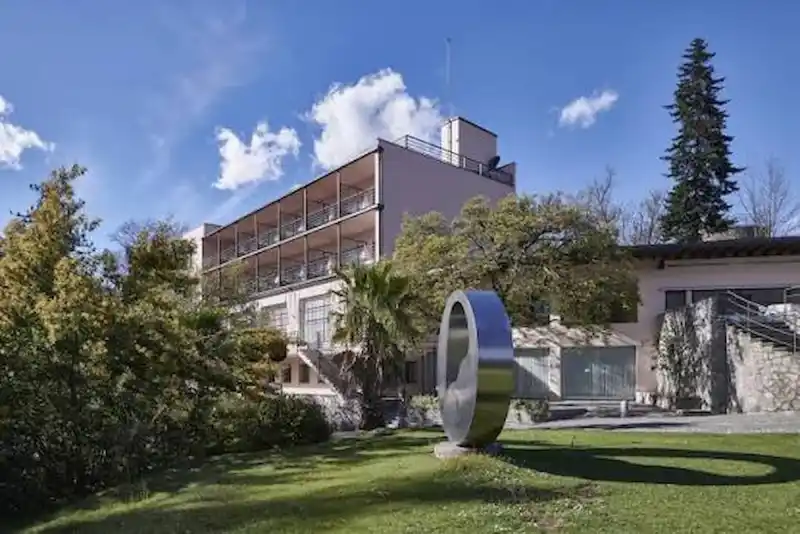
The modernist hotel von der Heydt commissioned from the German minimalist architect Emil Fahrenkamp, built between 1927 and 1929, gave this transformation a permanent form. Now called the Bauhaus Hotel, it organized the earlier aspirations into flat roofs, projecting loggias, large windows, and measured geometries. The dispersed experiments of the hill coalesced around an architecture that could accommodate visitors with efficiency and elegance. There was some irony here, of course: a banker supplied the means to give the rejection of industrial civilization the appearance of industrial modernity.
What Fahrenkamp produced is a restrained and well-arranged, if not particularly innovative fragment of a German siedlung housing development. The building’s horizontal lines establish a set of lines etched into the uneven terrain and abundant growth. Terraces and openings dissolve the mass from the outside and from the inside turn the landscape into something you can contemplate. The whole is a fragment of a modernist ideal visible from Ascona below.
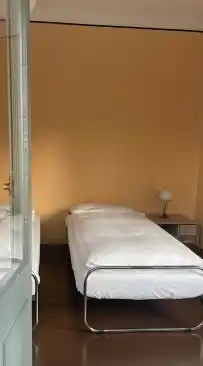
The Bauhaus Hotel is a condensation of ideals dispersed in time and space around Monta Veritá. Fahrenkamp gave the concerns with light, air, hygiene, and bodily well-being that were central to both the reform colonies a materiality and social organization. The question then becomes who can enjoy these phenomena and freedoms and on what terms. A room with a view could preserve something of the original promise but only by converting it into a commodity. Freedom has acquired a reception desk.
A restoration in 2007, which included and added to its historic furniture, did a remarkable job at making the pre-World War II’s expensive idealism present. Another aspect of the Monte Veritá experience emerged a few decades before that, when the curator Harald Szeemann became fascinated with Monte Veritá and its movements. In 1978 he organized “Monte Verita: The Breasts of Truth,” which continued his fascination with “outsider” art to include the evidence the found there and in the surrounding area.
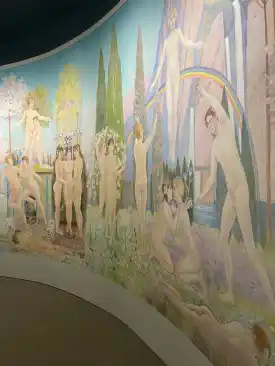
Preserved in another one of the original structures, the Casa Anatta, the exhibition is now an artistic installation. It is the anchor for site specific art installations commissioned by the local commune and ongoing cultural events that have taken the utopian ideal into the other, though related realm where such visions wind up residing, namely in art. My favorite installation is a 360-degree canvas installed in a purpose-built pavilion. Painted between 1919 and 1929 by Elisarion (Elisàr von Kupffer), it depicts a younger version of himself posing as dozens of different nude elves or satyrs frolicking in a queer version of one of the painter Puvis de Chavanne’s classical idyls.
The conference I attended, which included its own temporary installations and performances, inevitably wound up asking how such forms of free living, as well as the attempts to catch and stabilize them using technology such as buildings or exhibitions, could form the basis for a more open, sensual, and sustainable way of living and making. The beauty of sites such as Monte Veritá, which reminded me also of the original buildings of the Aspen Institute or the Open City in Valparaiso, Chile, is that they have the power to inspire us to believe that we can do something outside of the strictures of everyday social relations and the regulations they produce.