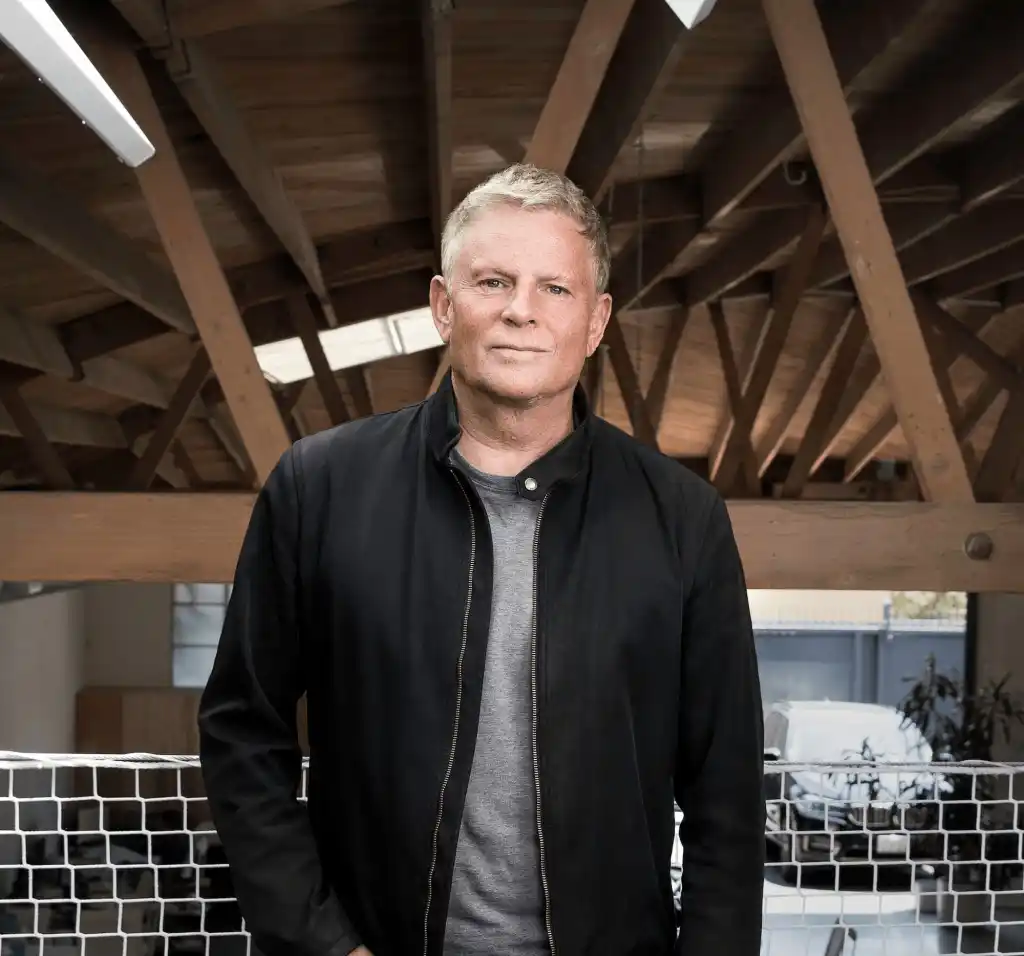
Lorcan O’Herlihy, FAIA, the Irish-born architect whose inventive housing projects helped reshape Los Angeles and whose belief that architecture should serve society influenced a generation of designers, died on June 14 after a battle with glioblastoma. He was 66.
Over a career spanning more than four decades, O’Herlihy championed a vision of architecture that rejected the notion that density and social responsibility were incompatible. Through his Los Angeles–based practice, Lorcan O’Herlihy Architects—better known as LOHA—he demonstrated that affordable housing, supportive housing, and market-rate residential buildings could all aspire to the same architectural ambition.
His projects, often inserted into overlooked urban sites and constrained lots, became laboratories for new ways of living together. They challenged the assumptions of Southern California’s suburban traditions and argued for a more communal, more equitable city.
From Dublin to Los Angeles
Born in Dublin in 1959, O’Herlihy grew up in a creative family. His childhood was spent traveling to cities around the world where his father Dan O’Herlihy acted in films including The Adventures of Robinson Crusoe, Waterloo and The Dead.
O’Herlihy recalled that the experience of the dense, pedestrian-oriented cities of Europe with public squares and parks informed a lifelong commitment to architecture centered on social spaces.
He studied architecture at the Architectural Association in London and later at California Polytechnic State University, San Luis Obispo. In his early career, he worked for several influential firms, including Kevin Roche John Dinkeloo and Associates, I. M. Pei & Partners, and Steven Holl Architects. Among his formative experiences was participation on the team responsible for the Grand Louvre Museum project in Paris.
Roche once said, “I have always felt that Lorcan is an amazing architect with a very deep poetic knowledge which he realizes in inventions of space and material.”
Those years exposed him to architecture at multiple scales and instilled a belief that buildings could operate as cultural and social infrastructure.
In the early years of his career, he took a year off architecture and gave himself a year to paint to decide which to pursue. He chose architecture, but also became an accomplished painter.
By the early 1990s, Los Angeles became his adopted home. In 1994, he established his own practice, and initially designed single-family homes, making a splash with the Trancas House for his parents in Malibu and the Vertical House in Venice for his own family, whose striking facade with a checkerboard pattern made of charcoal cementboard and colored glass garnered plaudits and awards. The firm would become one of the city’s most respected design studios.
From the beginning, LOHA occupied a somewhat unusual position. The office was capable of producing elegant custom residences, but O’Herlihy increasingly devoted his energy to multifamily housing and urban issues at a time when such work was often overlooked by the profession.
Frances Anderton, an architecture writer and longtime friend, says he was a “standout architect who recognized a new need in densifying Los Angeles. Where a prior generation of Los Angeles architects made their mark with single-family homes, he was in the vanguard of multifamily housing design. He designed buildings for a range of income levels that are exceptionally inventive architecturally while being planned for optimum livability – with flowing plans, access to natural light and airy personal outdoor spaces, together with the ingenious addition of shared social space.”
“What intrigues me most is how the city is changing,” he told the Los Angeles Times in 2004. “For a long time we saw all this horizontal sprawl. But now people who moved to the suburbs are coming back into urban areas. This is a big paradigm shift, and we’d better address it right now.”
The observation would prove prophetic.
An Alternative Vision for Los Angeles
Long before “missing middle housing” entered the architectural lexicon, O’Herlihy was experimenting with new models for density.
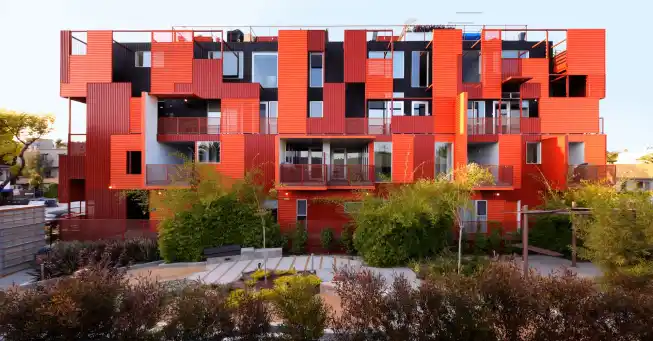
Formosa 1140. Photo by Lawrence Anderson.
Formosa 1140, built in 2008 in West Hollywood, was a stunning example of this. There, O’Herlihy, the project’s developer Richard Loring and city planner John Chase conceived the idea of giving back a portion of the site as a pocket park for the neighborhood, with, as backdrop, the artful facade of the 11-unit structure: a grid of vivid vermilion and orange panels, whose colors were a nod to the nearby red Formosa café and bar, where O’Herlihy’s father had often spent evenings with Orson Welles.
“Formosa was one of those projects where when I show it to people they’re just stunned, whether it’s in person or pictures, because it kind of looks like a painting more than a building,” says Loring.
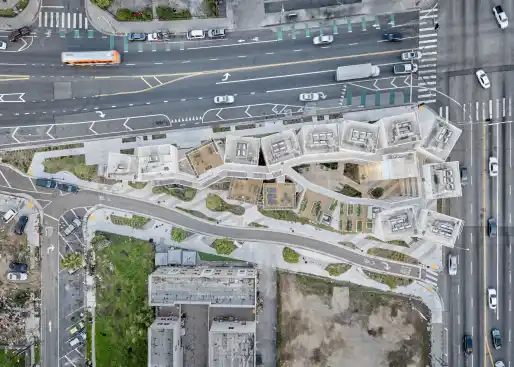
Isla Instersections Supportive Housing and Paseo. Photo by Eric Staudenmaier.
O’Herlihy became a sought after designer for many housing developers, with notable structures including Habitat825, Cloverdale749, Mariposa1038, MLK1101 Supportive Housing, Isla Intersections. Each experimented with materials and ideas for enhancing the urban realm beyond the boundaries of the site, and the projects revealed his ability to transform difficult sites into communities that emphasized interaction, shared space, and dignity.
Unlike many architects associated with iconic formal gestures, O’Herlihy’s work focused on relationships—between buildings and streets, between neighbors, and between public and private space.
His architecture was contemporary and expressive, yet it was rarely about spectacle. Instead, it sought to elevate everyday life.
That approach earned widespread recognition. Over the years, LOHA amassed more than 200 awards and built projects across three continents. He awards include the prestigious Maybeck Award, the AIA California Lifetime Achievement Award and the AIA/LA Gold Medal.
But O’Herlihy remained particularly committed to Los Angeles, whose complexity and contradictions provided the context for much of his experimentation.
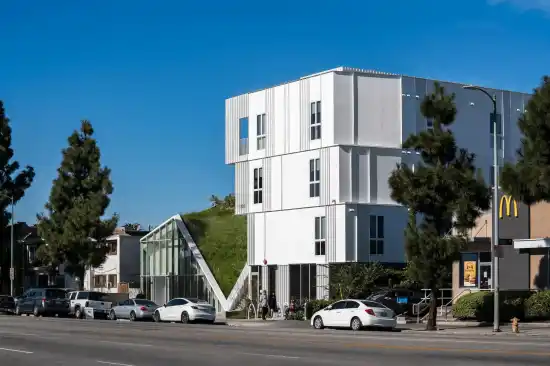
MLK 1101 Supportive Housing. Photo by Paul Vu.
In 2018, Los Angeles Times architecture critic Carolina A. Miranda described his work as creating “intimate spaces for a denser L.A.,” noting how projects such as King 1101 Apartments offered housing for formerly homeless residents while emphasizing community rather than institutional anonymity.
Developed by the local nonprofit Clifford Beers Housing, MLK1101 includes ground-floor retail space and a central staircase that leads to an elevated courtyard for residents. There’s a security gate at the top of the stairs, not on the sidewalk, a subtle design move that helps blur the line between the public and private realms. “The design strategies open the building toward the street and foster a sense of community within the neighborhood,” O’Herlihy said.
Recognition From the Profession
By the late 2010s, LOHA had become one of the most admired firms in the United States.
In 2018, the office was ranked No. 1 in design in ARCHITECT’s annual Architect 50 survey. The recognition reflected not simply the firm’s visual sophistication, but its consistent commitment to housing and urban issues.
Lawrence Scarpa, FAIA, principal of Brooks + Scarpa and a longtime friend of O’Herlihy’s (they collaborated on several projects), praised the architect for taking a “fairly mundane program like housing” and coming up with a fresh slant. “Every project is different,” Scarpa said. “He’s always searching, always looking for new ideas. And he has the tenacity to get stuff done. When everyone says, ‘No you can’t,’ Lorcan says, ‘Yes I can, and here’s how.’ And he does it with grace and style and beauty.”
Unlike many firms chasing increasingly global commissions, LOHA built its reputation through a relentless focus on architecture’s civic responsibilities.
Its projects combined inventive forms with unusually thoughtful social agendas. Outdoor corridors became communal spaces. Courtyards became catalysts for interaction. Density became an opportunity rather than a compromise.
O’Herlihy resisted the distinction between affordable housing and architecture of design excellence. To him, those categories were inseparable.
At a moment when the profession often struggled to reconcile aesthetics with social purpose, he insisted that architects had an obligation to do both.
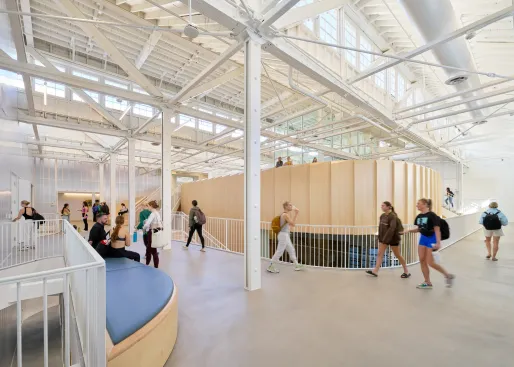
Sandi Simon Center for Dance. Photo by Eric Staudenmaier.
He also built other building types, creative offices and cultural facilities including the Sandi Simon Center For Dance, at Chapman University. He built extensively in Detroit and his native country Ireland where he became lauded for the Flynn Mews House in Dublin.
Architecture as Activism
Few phrases became more closely associated with O’Herlihy than “architecture is a social act,”which is also the title of his 2017 monograph. More than just a slogan, it was the principle that guided his life’s work. “When we design a building, we’re concerned about how it impacts the sidewalk and the street, and how it impacts the social and civic world,” he said in an interview in ARCHITECT magazine. His term for this approach: “Amplified urbanism.”
The idea represented a rejection of architecture as isolated object-making. Instead, he saw buildings as participants in larger political, economic, environmental, and social systems.
According to LOHA, the office sought to embrace “architecture’s role as a catalyst for change.”
That philosophy resonated with younger architects confronting issues of housing affordability, climate change, and urban inequality.
His lectures—often delivered under titles such as “Amplified Urbanism”—examined how architecture could respond to crises while strengthening communities.
For O’Herlihy, density was never merely about increasing unit counts. It was about enabling relationships. His much-acclaimed urban infill work, for example, emerged as a result of difficult sites, limited budgets, and negotiations with city planners and grumpy neighbors. “It’s more complicated to do work that is responsive to your neighbors and the city,” O’Herlihy said in an interview in Builder magazine. “But I see those constraints as beneficial to producing better architecture.”
His work repeatedly returned to the question of how people live together.
A Different Kind of Practice
Though celebrated internationally, O’Herlihy maintained a reputation for generosity and collaboration.
Colleagues frequently described him as energetic, optimistic, and deeply engaged with younger designers.
He fostered a studio culture that emphasized mentorship and experimentation.
Earlier this year, LOHA announced a collective ownership structure that expanded leadership throughout the firm—a move reflecting O’Herlihy’s longstanding interest in shared responsibility and collaboration.
The decision suggested that succession and continuity had become important concerns. Rather than concentrating authority, the new structure distributed it.
In many ways, the move mirrored the values present throughout his architecture.
Community, shared ownership, and participation, all mattered.
His longtime director and close friend Ghazal Khezri said, “Lorcan was a deeply creative and intuitive designer. He truly believed in architecture’s ability to build community, equity, and agency. Every project was special for its potential to have a social impact. Through his kindness and enthusiasm, he created an office where generations of architects could grow, feel supported, and contribute to the work. I feel lucky to have known him and to have shared this city and this work with him. It’s hard to imagine LOHA without him,”
LOHA will carry forward Lorcan’s vision, guided by the values he set from the beginning: care for people and place, honesty in work, and a quiet belief in the power of good design.
Beyond Style
Although critics often discussed the visual qualities of LOHA’s work—the angular forms, expressive geometries, and inventive use of circulation—O’Herlihy resisted being defined stylistically.
His buildings changed because cities changed.
What remained constant was his commitment to urban life.
He believed architecture should respond to the realities around it, whether rising housing costs, shifting demographics, or questions of equity.
This adaptability enabled his work to remain relevant across decades.
While other architects became associated with singular formal languages, O’Herlihy became associated with an attitude of optimism, a belief that cities could improve, and that architecture matters.
And he believed design had the capacity to elevate the human condition.
Teacher, Author, Advocate
Beyond practice, O’Herlihy was an influential educator and lecturer, and was a long time professor at USC School of Architecture.
His work was exhibited widely and published internationally. His writings and public presentations encouraged architects to reconsider their responsibilities to society.
His 2017 book, Architecture Is a Social Act, distilled many of the ideas that had animated his career.
In an era increasingly dominated by branding and image, the title itself felt almost radical.
For O’Herlihy, architecture’s purpose extended far beyond aesthetics.
Buildings were instruments of social change.
They could create opportunities, foster interaction, and strengthen communities.
That conviction earned him admirers far beyond Los Angeles.
A Lasting Legacy
The significance of Lorcan O’Herlihy’s career lies not only in the hundreds of projects produced by his firm, but in the questions he asked.
What if density could be humane?
What if affordable housing could be beautiful?
What if architecture’s highest purpose was not prestige but participation?
Those questions have become increasingly urgent as cities confront housing shortages, social fragmentation, and environmental pressures.
Long before such concerns dominated architectural discourse, O’Herlihy was designing responses.
His buildings offered alternatives.
They proposed that architecture need not choose between beauty and equity.
That conviction helped shape a generation of younger architects who increasingly see practice as a vehicle for social engagement.
Today, many of the ideas that O’Herlihy championed have entered the mainstream. Co-housing, adaptive urban density, supportive housing, and socially conscious design are no longer peripheral concerns.
In many ways, the profession caught up with him.
Lorcan O’Herlihy leaves behind a body of work distinguished not by monuments but by communities.
Even in moments of tragedy, O’Herlihy remained fundamentally optimistic. After his parents lost their home in the 2018 Woolsey Fire, he spoke empathetically to communities devastated by the 2025 Los Angeles fires, urging them to see rebuilding as an opportunity for renewal.
“It’s a very difficult time, and it’s overwhelming,” he said. “But there is a way forward. I use the term ‘reinvent.’ That’s what we all should do collectively—to rebuild and renew our lives. It is immensely challenging, but we know that it is doable. I’ve been through this experience myself, and I know that you all can do it as well.”
The sentiment captured the outlook that animated much of his career: the belief that architecture—and the communities it serves—could emerge from adversity stronger, more connected, and more hopeful than before.
He leaves behind buildings that foster encounters among strangers, a practice designed to endure beyond its founder, and an idea that feels more urgent than ever: that architecture, at its best, is not simply the making of objects, but an act of service.
LOHA will carry forward O’Herlihy’s vision, guided by the values he established from the beginning—care for people and place, honesty in the work, and an abiding faith in the power of design to improve everyday life.
O’Herlihy is survived by his wife, Cornelia Hayes O’Herlihy, and their twin sons, Daire and Darcy. His funeral will take place in Glencar, Ireland.
For four decades, he argued that cities could become more humane, more inclusive, and more generous. Through his buildings—and through the generations of architects he inspired—that argument will continue.