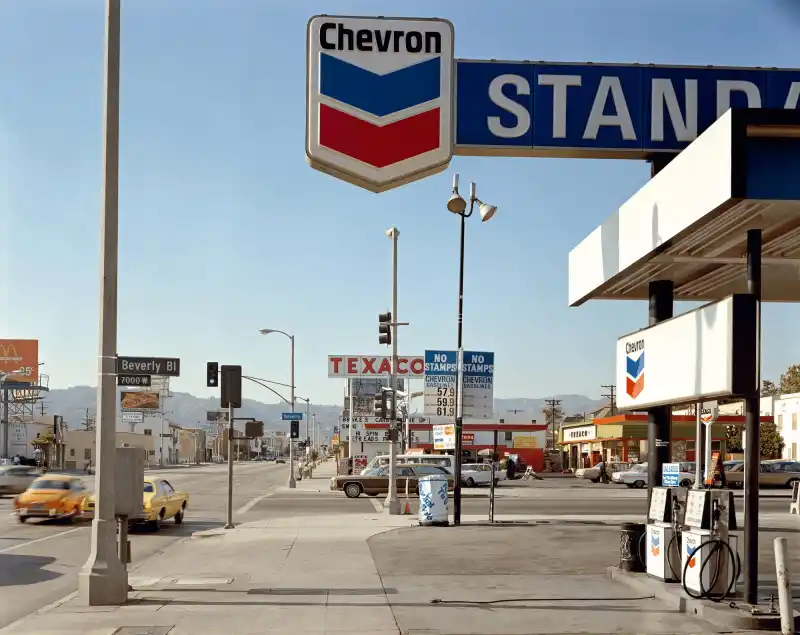
Beverly Boulevard at La Brea, June 21, 1975. The place and time are specific. The image is achingly clear. The subject is banal: a Chevron gas station in the foreground, a Texaco station beyond that and, in the distance, the Hollywood Hills. To the left, La Brea’s shops and cars recede in relentless perspective.
Beverly is only visible as a street sign. The air is –remarkably for that time and place—clear, shading from a light, almost white-blue to a full cerulean at the top of the image, indicating that the time must be close to dawn. That empty ether takes up more than half the image.
On a recent trip to Los Angeles, I drove by the site, which has not changed all that much in more than fifty years –the Chevron is still there, the Texaco is gone, some of the little buildings have become mini-malls. It is a few blocks from where I lived when I first moved to the city in 1985, but I did not know Stephen Shore’s photograph, titled with the exact moment and site he took the image, until much later.
Since then, it has become a touchstone for me of where architecture starts: with hard looking at what is there, not what you want to see or concentrate on. The image and the idea do not stop there. The photograph also shows a way of composing what you see that moves towards an understanding of where and when you are. That realization can set you, as a viewer, up for the either affirmative or cathartic experience of art or, as an architect, for the grounding and transformation of that site into something that you might call architecture.
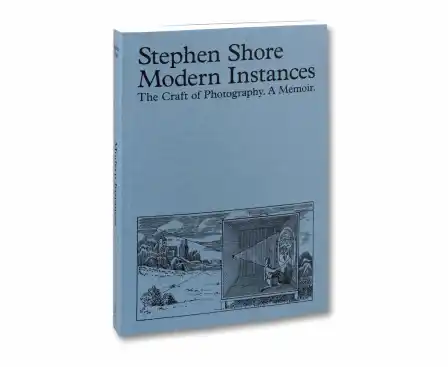
Modern Instances: Stephen Shore, The Craft of Photography : a Memoir, Mack, 288 pgs.
Upon returning home, I picked up the recently published third edition of the collection of memories, musings, and philosophical statements that make up Shore’s book Modern Instances: The Craft of Photography. A Memoir. I turned to the piece he wrote about the Los Angeles photograph and found that he had, at least retrospectively, much the same in mind.
It turns out that Shore’s image has a direct connection to architecture: Denise Scott Brown and Robert Venturi had commissioned him to “explore the contemporary American landscape” and he began in Los Angeles. The site seemed “quintessential Los Angeles” to him, but he also had his own motivation: he was “exploring visual structure.”
In the essay, Shore distinguishes between composition and structure. The first, he points out, is synthetic. It is what a painter does with a blank canvas. “A photographer,” by contrast, “starts with the whole world. Every decision they make brings order.” That act is not objective or value-free; it “imposes[s] our preconceptions” on the site.
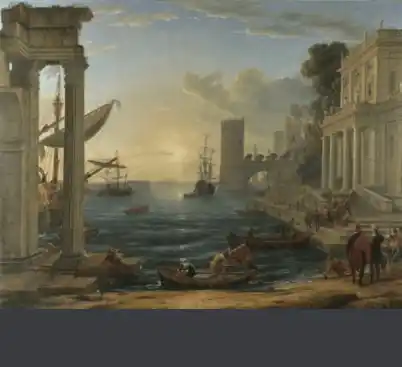
Claude Lorrain, Seaport with the Embarkation of the Queen of Sheba, 1648, The National Gallery, London.
Looking back at the picture he took, Shore realized later that he has channeled his training and tastes to impose a classical order on the chaos he found. Specifically, he had made La Brea Boulevard look like the ports surrounded by neo-classical buildings the painter Le Lorrain created in the 17th century.
Shore, in seems to me, was discovering that reality as much as he was insinuating it through his craft. This part of Los Angeles was and largely still is made up of signs and billboards, one- to two-story boxes clad in light-colored stucco, asphalt and concrete pavers, and a sky that dominates all.
Look more closely, and you can see that both the underlying grid out of which the perspective emerges and the geometries of the buildings, along with the vertical rhythm of lamp posts and signs that echoes classical columns (if you squint), surround a void that is as difficult to cross as the water across which cars rather than boats sail. Le Lorrain is indeed there not just in the photograph, but in Los Angeles.
The analogy is, I fully realize, stretched, but it points to the underlying logic built into the way we have been organizing, whether consciously or as a matter of habit and convenience, humanmade space for centuries. It is how we make sense of the world as we built and then navigated through it with either our cars or our eyes.
What is different on this site and then is the lightness and openness, the breakdown of that order and the very fact that its vernacular qualities free it from grand values built into its classical antecedents. The world we know is there, but barely. It is exploding and dissipating in front of our eyes.
In the rest of the book Shore mostly takes his observations in a different direction. He is interested ultimately in T.S. Eliot’s “objective correlative,” which he quotes the poet defining as “a set of objects, a situation, a chain of events which shall be the formula of that particular emotion; such that when the external facts, which must terminate in sensory experience, are given, the emotion is immediately evoked.”
The kind of architecture he likes, it turns out, is somewhat more conventional in its ability to evoke not underlying structures, but emotions and, at best, to create a sense of awe in the viewer. He cites the Pantheon and the Ibn Tulun mosque in Cairo as places that “open the heart.”
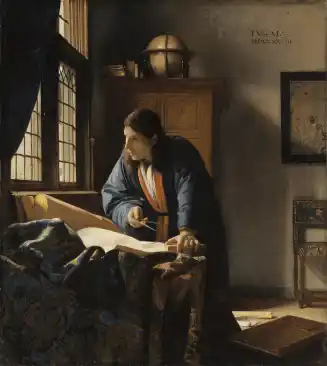
Johannes Vermeer, The Geographer, 1669, Städel Museum, Frankfurt, Germany.
In the Roman example, “space and time elongate,” while in the space between the arm and the sill the painter Johannes Vermeer left in his The Geographer, from roughly the same period as Le Lorrain’s works, the space “vibrates.” Shore is drawn to the amazing, even though the body of his work I know seems mainly made up of the beauty, the weirdness, and therefore the objective corollary of the apercu or raised or knitted eyebrow rather than wonder.
Architecture, it turns out, is for him, as for so many artists, just a tool. It is a “bridge to reality” to encompasses both social relations and the aspirations of the maker and their client –he calls that a building’s style—that above all “become accessible to the camera.” Whether we can know and thus develop a stance, whether critical or not, towards both those social forces and what the maker has hade of them Shore leaves beyond the discussion. It seems he is happy with just being in awe of it all.
Yet Shore also quotes Louis Sullivan’s Kindergarten Chats, in his call to “cultivate attention –the art of seeing, the art of listening… To pay attention is to live, and to live is to pay attention; and, bear in mind most of all, that your spiritual nature is but a higher faculty of seeing and listening –a finer, nobler way of paying attention.”
That is more akin to what I get out of Stephen Shore’s work, and specifically out of Beverly Boulevard: its structure is so refined and knowing, it is so full of images and forms organized; and it so attentive to this particular place at this particular time that the scene extends to include me. I cannot understand its meanings fully, nor am I moved or amazed by what I see, but a sense of knowing it in a way that, for all the times I walked or drove by that site or paused at a traffic light and barely noticed it, comes to me through this magistral photograph.
That knowledge does not tell me what to do with this still largely undeveloped area, but it does tell me that there is a strange, but beautiful vernacular architecture there, exactly as Scott Brown and Venturi believed, that Shore found and has now made available to all of us.