There is another New York hiding behind the one most of us see every day.
It is beneath the Cathedral of St. John the Divine, where tombs and artifacts occupy subterranean spaces rarely open to the public. It is inside a former newsstand on the downtown 6-train platform at 51st Street and Lexington Avenue. It is behind the scenes at the Metropolitan Museum of Art, inside a sanitation facility in Brooklyn, and embedded in the infrastructure, archives, landscapes, libraries, and buildings that most New Yorkers pass without ever entering.
For one month this fall, some of those doors are opening.
Archtober, New York City’s annual architecture and design festival, returns October 1 through 31 for its 16th edition, bringing together nearly 100 organizations for tours, exhibitions, talks, open houses, and events across the five boroughs and beyond. This year’s official theme, “In Our Hands,” asks architects, designers, and citizens to consider their responsibility for shaping the future of the city. But the festival’s most immediate appeal may be considerably more visceral.
It lets you get inside New York.
Not just the architectural landmarks that appear in guidebooks, but the strange, overlooked, utilitarian, subterranean, and newly completed spaces that reveal how the city actually works.
And in 2026, that includes everything from OMA’s New Museum expansion and the Studio Museum in Harlem to a modular public restroom.
Welcome to architecture tourism, New York style.
The City You Walk Past Every Day
Archtober has always been based on a deceptively simple proposition: New Yorkers are surrounded by extraordinary architecture, but much of it remains invisible.
Sometimes that is because a building is literally inaccessible. Sometimes it is because we stop noticing something we encounter every day. And sometimes it is because architecture culture has trained us to pay attention to museums, skyscrapers, and expensive houses while overlooking the public bathrooms, libraries, landscapes, transit systems, and sanitation buildings that actually keep a city functioning.
The 2026 festival pushes against those distinctions.
“Our world is changing rapidly, bringing new challenges and new opportunities for the architecture and design community,” says Jesse Lazar, Assoc. AIA, Executive Director, AIA New York and the Center for Architecture. “This year’s Archtober theme, In Our Hands, is a reminder that the future isn’t something that simply happens to us—it’s something we shape together. As architects, designers, and engaged citizens, we have both the responsibility and the opportunity to create a more just, resilient, and inclusive city for the communities we serve.”
The festival divides that sprawling proposition into five categories—Nature, Media, Culture, History, and Education—but the categories matter less than what happens when they are superimposed onto New York itself.
Suddenly, the city becomes an enormous architectural exhibition.
First Stop: Underground
One of Archtober’s most intriguing new destinations requires no grand entrance at all. You simply swipe into the subway.
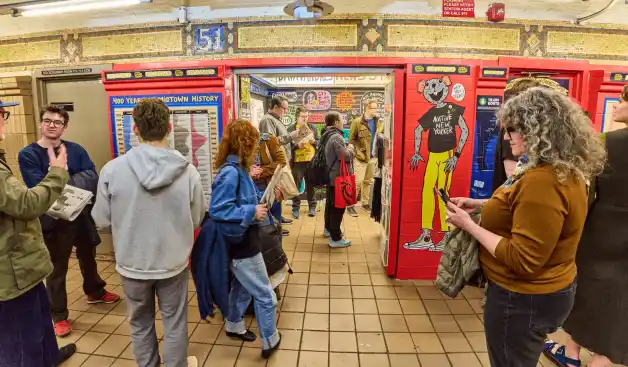
Data Vandals at 51st Subway Station. Photo courtesy Mark Shaw.
For the first time, the festival is collaborating with Data Vandals to take over a former newsstand on the downtown 6-train platform at 51st Street and Lexington Avenue.
Artist Jen Ray and data-visualization expert Jason Forrest, who work together as Data Vandals, have transformed the kiosk into an unusual hybrid of newsstand, gallery, public forum, and data experiment as part of the MTA’s Vacant Unit Activation Program.
The location could hardly be more different from the pristine white gallery traditionally associated with architecture exhibitions.
About 52,000 straphangers pass the newsstand each day. Its exterior mural is visible around the clock, while the interior hosts changing exhibitions, surveys, talks, music, events, and a free newspaper. Instead of asking people to visit an architecture exhibition, it catches them on their way somewhere else.
For Archtober, the installation will feature new public surveys asking commuters to reconsider their role in the city and what they want from its future. Designed in partnership with Greater, Archtober’s longtime design agency, the project will also use its exterior murals to identify nearby architectural sites.
“Archtober has always been about helping people see the city through a new lens, and this collaboration with Data Vandals brings that mission directly into the everyday experience of New Yorkers,” says Katie Mullen, Director of Archtober and Director of Exhibitions and Programs at the Center for Architecture. “The subway is where people from every neighborhood and background intersect, making it an ideal setting for conversations about the city we share and the one we want to build together. We hope this installation reminds people that great design isn’t confined to museums or iconic buildings—it’s all around us, and we all have a stake in its future.”
It is a small intervention with a larger implication. One of the most interesting architectural spaces in Archtober may be a piece of obsolete infrastructure repurposed as a place for public conversation.
Then Go Even Deeper
If a subway platform is not subterranean enough, Archtober is offering another way beneath the city.
Throughout October, the Cathedral of St. John the Divine in Morningside Heights will conduct special Halloween-themed tours of its crypt, giving visitors access to the cathedral’s earliest construction and worship space.
The tours reveal tombs, artifacts, and portions of the building’s underground architecture that even regular visitors to the cathedral are unlikely to encounter.
It is precisely the kind of place that makes architectural tourism compelling. The familiar monument suddenly becomes unfamiliar.
Buildings, after all, conceal almost as much as they reveal. Behind walls, beneath floors, above ceilings, and below ground are layers of construction, infrastructure, history, alterations, failures, and changing uses. Seeing those layers can fundamentally change how a building is understood.
The crypt is not simply an atmospheric Halloween attraction. It is another version of New York: the city underneath the city.
The Buildings Everyone Wants to See
Not everything on Archtober’s itinerary is hidden.
Some of the festival’s biggest draws will be among the most closely watched architectural projects in New York.
On October 1, Archtober’s popular Building of the Day series begins with a tour of the New Museum expansion led by OMA. The following day, Studio Gang will lead a tour of the Shirley Chisholm Recreation Center.
On October 14, the series arrives at the Studio Museum in Harlem with a tour led by Adjaye Associates.
These projects represent a different kind of access. They are major public buildings, but Archtober offers the opportunity to experience them through the people involved in their design rather than simply walking through them as visitors.
The distinction matters.
An architect-led tour can reveal why a stair is positioned where it is, how a facade responds to its surroundings, why one material was chosen over another, what compromises occurred during construction, or how a building changed between competition proposal and completion.
For architects, those details are part of the work. For the public, they are often invisible.
Archtober makes them part of the experience.
The Met You Don’t Know
The Metropolitan Museum of Art is among the most visited cultural institutions in the world, but even a building visited by millions contains spaces that remain largely unknown.
Archtober will offer two opportunities to look beyond the Met most visitors recognize.
On October 15, Young & Ayata will lead a Building of the Day tour of the Nolen Study Room in the Thomas J. Watson Library. Six days later, Beyer Blinder Belle and Peterson Rich Office will present the museum’s Condé M. Nast Galleries.
These are not the monumental spaces most tourists race to photograph. That is precisely their appeal.
Architecture is often most revealing at the smaller scale: a reading room, an interior intervention, a threshold between old and new construction, or a gallery whose apparent simplicity conceals an enormous amount of technical coordination.
They offer another way of understanding a familiar institution by looking at the rooms inside it that receive less attention than its masterpieces.
The Architecture Nobody Instagrams
Then there is the public restroom.
On October 17, 1100 Architect will lead a tour of the NYC Parks Luis Lopez Playground Modular Public Restroom.
Placed beside tours of major museums and cultural institutions, a modular toilet might initially look like an eccentric addition to an architecture festival.
It may actually be one of the most important.
Public bathrooms represent one of those fundamental pieces of civic architecture that become visible mainly through their absence. New York has long struggled to provide enough clean, accessible public restrooms. Designing them involves questions of durability, maintenance, accessibility, cost, safety, infrastructure, and public policy.
In other words, almost everything that makes urban architecture difficult.
That makes a modular public restroom an unusually concentrated architectural problem. It also challenges the assumption that architecture worth touring has to be monumental.
A city is not made only from the buildings on postcards.
How New York Actually Works
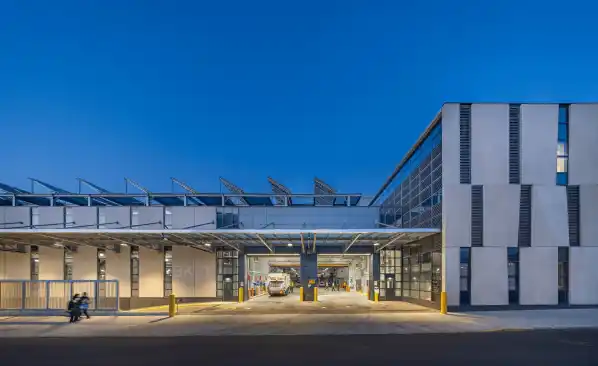
Building of the Day: DSNY Brookly District 3 Garage by Dattner Architects. Photo by Albert Vecerka, ESTO.
Archtober drives that point home on October 31, when its Building of the Day series concludes at the Brooklyn District 3 Department of Sanitation Facility with a tour led by Dattner Architects.
Sanitation buildings rarely appear on a visitor’s architectural itinerary, despite the fact that sanitation is one of the systems without which New York would become unlivable within days.
That contradiction is useful.
Cities depend on enormous networks of spaces that most residents are encouraged not to notice: sanitation garages, utility structures, maintenance facilities, loading areas, mechanical rooms, transit infrastructure, waste-transfer facilities, and storage buildings.
They are architecture without glamour but with enormous consequence.
Opening those spaces to architectural scrutiny expands the definition of what deserves design attention. It also reveals something about how New York functions when nobody is looking.
A Different View From the Water
Some of the best ways to understand New York architecture require leaving the sidewalk altogether.
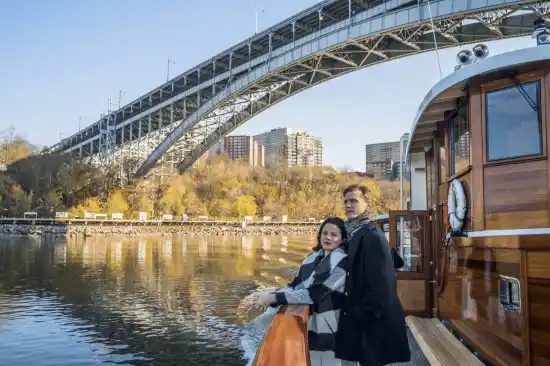
Classic Harbor Line Tour.
Classic Harbor Line will again partner with AIA New York for architecture tours examining the city from the water. The cruises look at waterfront resiliency, adaptive reuse, historic preservation, industrial infrastructure, public space, and the evolving relationship between New York neighborhoods and their shorelines.
From the water, familiar buildings become parts of much larger systems.
The shoreline reveals the infrastructure that made New York an industrial and commercial powerhouse, but it also exposes one of the city’s greatest vulnerabilities. Rising seas and increasingly severe storms are transforming waterfront architecture from a question of real-estate desirability into one of urban survival.
That makes the harbor an architectural classroom.
SCAPE’s October 8 tour of Gowanus Lowlands offers another perspective on that changing relationship between landscape and city. Here, architecture is not a discrete object but part of a larger ecological and infrastructural system.
This is the New York that can be difficult to understand from photographs: architecture as interconnected landscape rather than isolated building.
Architecture Among the Dead
Few places reveal New York’s layered history as dramatically as Green-Wood Cemetery.
On October 16, Architecture Research Office will lead visitors through the Green-House at Green-Wood, bringing contemporary architecture into dialogue with one of the city’s most extraordinary historic landscapes.
Cemeteries occupy a peculiar place in architectural history. They combine landscape architecture, infrastructure, sculpture, horticulture, monuments, buildings, and urban planning, yet are rarely considered part of everyday city life.
Green-Wood is especially significant because its landscape predates many of New York’s great public parks and became a model for the idea of the cemetery as a designed pastoral environment.
Archtober’s inclusion of the site again expands the festival beyond buildings. Architecture becomes something encountered among trees, graves, pathways, topography, and memory.
Leave New York to Understand New York
The festival’s definition of the city stretches beyond the municipal boundary.
In Rhinebeck, T Space will offer guided tours of the Steven Myron Holl Foundation woodland campus on October 4 and 18. Visitors can explore the Architecture Archive, which holds approximately 1,200 models along with watercolors and a research library.
Also on view is Threads: Anne Lindberg + H. L. Hix, a site-specific installation designed to be experienced by walking beneath and around it as changing daylight alters the work.
In New Canaan, Connecticut, The Glass House will continue fall programming that includes a September 24 dinner with Liz Diller and an October 6 conversation with Mark Lamster about his new book, Welcome to Paradox City.
Grace Farms, also in New Canaan, will host Founders Architecture Talk | Creative Visions Inspired by the Landscape on October 24.
Together, the excursions suggest that understanding New York’s architecture also means understanding the broader Northeastern network of architects, institutions, landscapes, and experiments surrounding it.
The Hidden City Is Also in the Archives
Some of Archtober’s most inaccessible places are not physically difficult to enter. They are hidden in history.
At Van Alen Institute, Open Access: Exploring 130 Years of American Design gives five emerging designers access to the institution’s archive and asks them to interpret it anew. Rather than treating archival material as fixed history, the exhibition encourages participants to question what was collected, what was valued, and what those decisions mean today.
At the Center for Architecture, Dark Matter U: Justice, Pedagogy, Design looks at one of the first BIPOC-led transdisciplinary networks in the built environment and the role collective organization can play in changing architecture and design culture.
Humanist modernity: Maciej and Stanisława Nowicki brings another architectural history into focus, examining two figures whose work moved between Poland and the United States.
Poster House similarly challenges familiar histories of design through Designed to Be Red: Native American & Indigenous Poster Works, while Cuteness, Conservatism, & Consumption: Lefor-Openo and Postwar France examines an underrecognized female design duo.
The hidden New York, in other words, is not just behind locked doors. It also consists of people, objects, and histories that have been overlooked.
And Then There Are the Pumpkins
Architecture tourism does not have to be reverential.
On October 28, architects will gather at the Center for Architecture for Pumpkitecture, the festival’s annual pumpkin-carving competition, where teams go “gourd-to-gourd” for the Pritzkerpumpkin.
Members of the public can watch and vote.
It is ridiculous, highly competitive, and probably one of the few architectural events where destroying the structure is ultimately part of the plan.

SoHo Design District. Photo by Matthew Carasella.
SoHo Design District will provide another after-hours alternative with Live Art in SoHo, bringing installations, music, and events into participating design showrooms.
The programs serve an important function within a festival that otherwise tackles climate change, cultural identity, artificial intelligence, history, education, and public infrastructure.
They make architecture fun.
Look Again
After 16 editions, Archtober has accumulated hundreds of buildings and sites across New York. The festival continues to make many of them accessible digitally through the Archtober Guide on Bloomberg Connects, which includes project photography and interviews with architects and landscape architects.
But the real pleasure of Archtober remains stubbornly physical.
It is standing somewhere you have never been allowed to stand before.
It is walking through a door you have passed a hundred times without noticing. It is looking beneath a cathedral, behind a museum gallery, inside a sanitation building, around a cemetery, or across the city from the water and realizing that the New York you thought you knew is only one version of it.
That is what makes architecture festivals different from architecture exhibitions. The city doesn’t have to be represented inside a gallery because the city is already there.
Archtober simply gives you permission to look at it differently.
And sometimes, it gives you the key to get inside.