For more than two decades, the Venice Architecture Biennale has served as architecture’s global stage for ideas. It has become a forum where architects debate climate change, technology, urbanization, migration, artificial intelligence, and the future of cities. In 2027, however, the exhibition’s newly appointed curators are proposing something far more radical: less talking, more building.
A Biennale Focused on Making, Not Talking
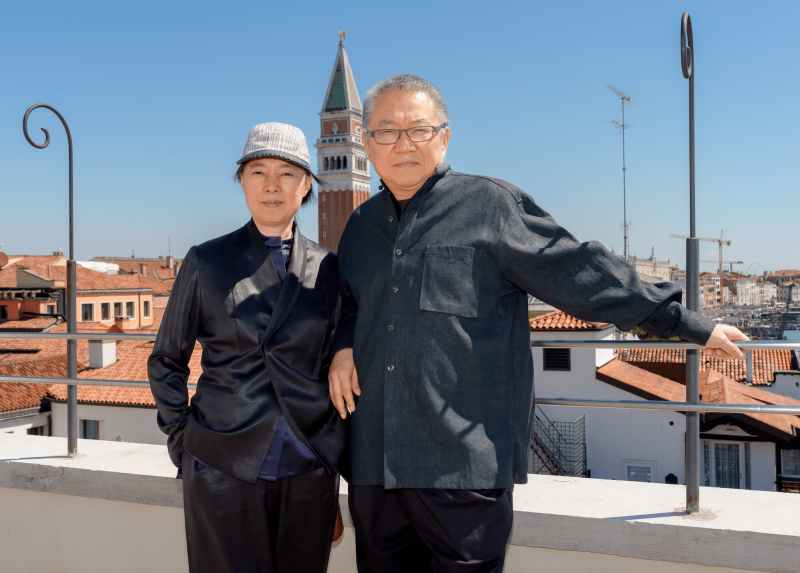
The 20th International Architecture Exhibition of La Biennale di Venezia, which will run from May 8 through November 21, 2027. It will be curated by Chinese architects Wang Shu and Lu Wenyu, founders of Amateur Architecture Studio, who are among the most influential voices in contemporary architecture.
Their theme, Do Architecture—For the Possibility of Coexistence Facing a Real Reality, represents a direct challenge to many of the assumptions that have shaped architectural discourse over the last several decades.
Rather than celebrating architecture as a conceptual exercise, Wang and Lu argue that the discipline must return to the physical act of making—to construction, materials, craftsmanship, and direct engagement with place.
“We believe that architecture is not only something to be discussed but, more importantly, something to be done first-hand,” the curators write. “The philosophy of architecture is a philosophy of how to do: a practice that confronts real reality, in real places, through real construction.”
A Response to Architecture’s Technological Turn
One of the most intriguing aspects of Wang Shu and Lu Wenyu’s appointment is how sharply their vision contrasts with that of the previous Venice Architecture Biennale. In many ways, Biennale Architettura 2027 reads as a quiet rebuttal to the profession’s recent fascination with technology.
Whereas the 2025 Biennale, Intelligens. Natural. Artificial. Collective., curated by Carlo Ratti, framed artificial intelligence, computation, and collective intelligence as critical tools for navigating planetary crises, Wang and Lu argue that architecture’s deepest problems cannot be solved through technology alone.
Their answer is surprisingly simple: build better, build more carefully, and reconnect architecture to the realities of land, materials, labor, memory, and community. If the last Biennale asked how intelligence can help save the world, the next one asks whether architecture has forgotten how to build it.
The Central Challenge: Coexistence
The exhibition arrives at a moment when architecture faces mounting pressures from climate change, rapid urbanization, artificial intelligence, and unprecedented technological transformation. Yet Wang and Lu reject the notion that technology alone can solve the discipline’s problems. Instead, they frame architecture’s central challenge as one of coexistence.
Their curatorial statement is structured around a series of questions rather than declarations. Can active and passive environmental strategies coexist? Can architecture and land exist in balance? Can local craftsmanship stand alongside advanced construction technologies? Can memory coexist with innovation? Can cities and rural settlements develop together without erasing the distinctive qualities of either? Can large firms and small studios coexist? And perhaps most provocatively, can human tactility survive the rise of artificial intelligence?
These questions form the intellectual framework of the exhibition, but they also reveal the curators’ broader critique of architecture’s recent trajectory.
Critiquing Global Standardization
Drawing on anthropologist Claude Lévi-Strauss, Wang and Lu argue that among the many crises facing humanity, the rupture between nature and human-made construction may be the most profound. They contend that architecture’s growing scale and professionalization have amplified that divide, producing a global landscape increasingly characterized by standardization, demolition, and cultural erasure.
“The attempt to impose a single architectural language worldwide is not so much extraordinarily difficult, as it is extraordinarily arrogant and frightening,” they write.
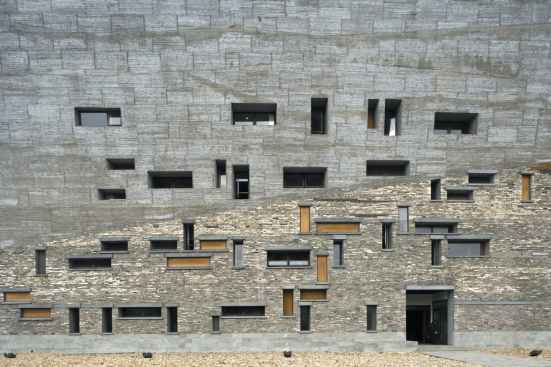
Ningbo Historic Museum by Amateur Architecture Studio. Photo by Lv Hengzhong.
The Philosophy Behind Amateur Architecture Studio
That critique is deeply connected to the philosophy of Amateur Architecture Studio, the practice Wang and Lu established in 1997. Long before sustainability became a dominant architectural concern, the pair were experimenting with reclaimed materials salvaged from demolished villages and urban districts throughout China. Their work transformed architectural debris into a vehicle for preserving cultural memory, creating buildings that physically embodied histories threatened by rapid development.
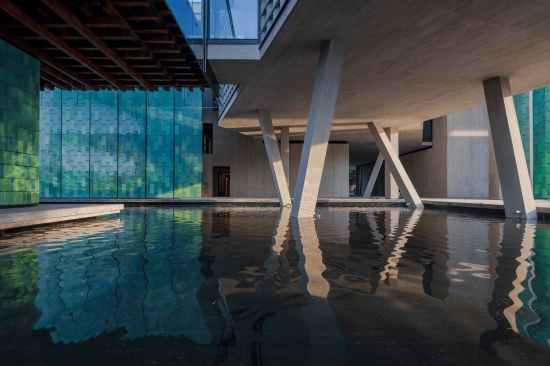
The National Archives of Publications and Culture in Hangzhou, by Amateur Architecture Studio. Photo by Ji Yun.
Those ideas were first articulated in Wang’s influential 2000 manifesto, “Amateur Architecture,” which serves as an intellectual foundation for the Biennale. The manifesto rejects architecture as a closed professional system and instead embraces spontaneity, incompleteness, and participation.
“Amateur Architecture is architecture that comes infinitely close to spontaneous order,” Wang wrote. “It relies on the contact between body and architecture, not on the frenzy of the retina.”
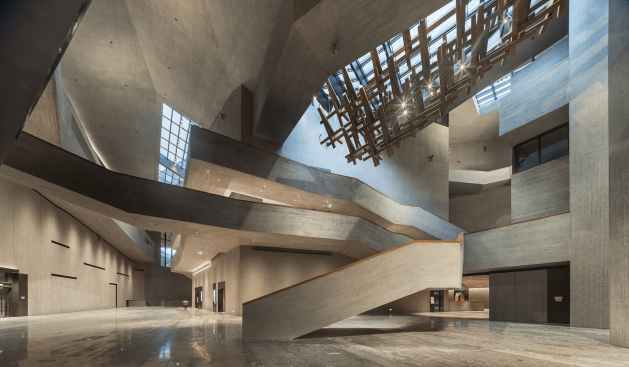
Xi'an Opera House and Concert Hall, by Amateur Architecture Studio. Photo by Laksana Studio.
Architecture as an Ongoing Process
For Wang and Lu, architecture is not a finished object but an ongoing process. Buildings should be capable of adaptation, repair, and continued evolution. Architecture, they argue, should leave room for users to participate in shaping their environments rather than simply consuming them.
The Biennale’s title itself—Do Architecture—reflects this emphasis on action over theory.
“All these questions point to one essential path,” the curators write, “facing real reality and local practice, and directly ‘do architecture,’ especially a kind of ‘do’ that is grounded in bodily touch.”
Reimagining Architectural Education
The emphasis on physical engagement also extends to architectural education, which will play a major role in the exhibition. Both Wang and Lu have spent decades teaching at the China Academy of Art, where they founded the Department of Architecture in 2003 and later established the School of Architecture. Their educational model prioritizes material understanding, craftsmanship, construction, and the study of traditional Chinese gardens alongside contemporary design.
As a result, the Biennale is expected to include students, educators, and experimental pedagogical initiatives as central participants rather than peripheral contributors.
Venice as a Living Laboratory
The curators also intend to engage directly with Venice itself. Rather than treating the city merely as a backdrop, they envision architectural interventions within Venice as a key component of the exhibition. This decision reflects their belief that architecture must confront actual conditions rather than operate solely within the realm of representation.
The choice of Venice carries particular symbolic weight. It is the city where the Venice Charter, one of the most influential documents in heritage conservation, was established. Wang and Lu argue that Venice can once again become a laboratory—not simply for preservation, but for exploring how conservation and innovation might coexist.
“Venice should continue to play an active role in social transformation,” they write, “through forms of architectural innovation that can coexist with the notion of ‘conservation.’”
A Rejection of Spectacle
For Biennale President Pietrangelo Buttafuoco, the appointment of Wang and Lu reflects a broader desire to reposition architecture around material reality rather than spectacle.
“Wang Shu and Lu Wenyu return architecture to its most concrete, physical and essential dimension,” he said, praising their commitment to building in direct relationship with land, materials, communities, and local culture. He described their approach as a rejection of both spectacle and global standardisation, emphasizing instead “the value of ‘doing’ as a cultural, ethical and constructive act.”
A Historically Significant Appointment
The appointment is also historically significant. Wang Shu becomes the first Pritzker Prize laureate to curate the Venice Architecture Biennale since David Chipperfield directed the exhibition in 2012, while Lu Wenyu’s role further elevates a figure whose influence on architectural education and practice has often been overshadowed by her partner’s global profile. Together, they bring to Venice a body of work that has consistently challenged architecture’s obsession with novelty, replacing it with an ethic of continuity, repair, and cultural memory.
Why the 2027 Biennale Matters
Whether the 2027 Biennale ultimately succeeds in reshaping architectural discourse remains to be seen. But its premise is already clear. At a moment when architecture is increasingly defined by data, algorithms, images, and virtual simulations, Wang Shu and Lu Wenyu are arguing for something profoundly analog: the hand, the material, the site, the craftsperson, and the act of construction itself.
“Do” is only a beginning, they write, “but it may be a decisive one.”