For decades, the hierarchy of the global ceramic tile industry has seemed remarkably stable. Italy supplied design prestige. Spain supplied industrial expertise. Brazil supplied enormous quantities of tile.
Walk through Expo Revestir in São Paulo today, however, and that hierarchy suddenly looks considerably less certain.
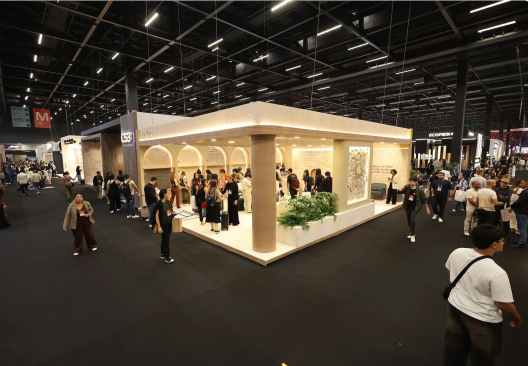
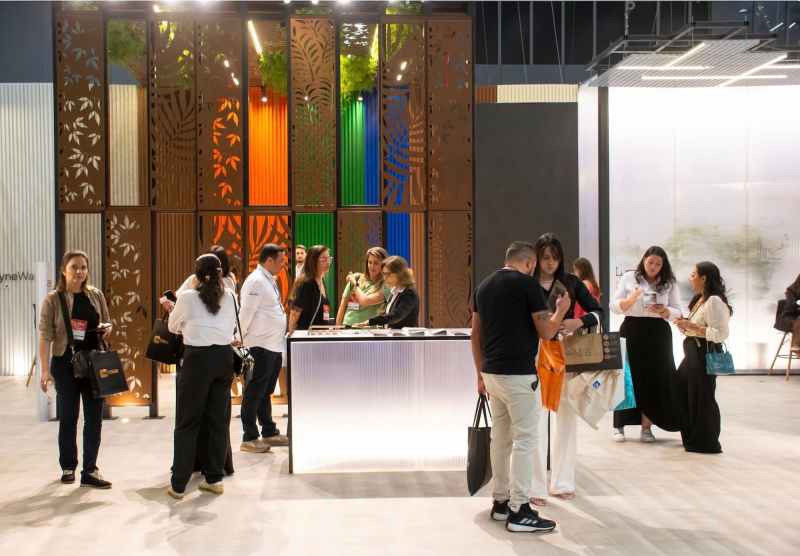
Held March 9–13, 2026, at the São Paulo Expo, the 2026 edition brought together more than 300 exhibiting brands and drew 72,000 visits across 65,000 square meters. The numbers alone made Revestir an impressive demonstration of industrial scale. But what mattered more was what those numbers concealed: an industry undergoing a significant transformation.
Brazilian manufacturers are no longer competing primarily through price or production capacity. Across the fair, companies were demonstrating increasingly sophisticated porcelain technologies, enormous architectural slabs, digitally printed surfaces, recycled materials, deeply textured ceramics, sculptural concrete products, and manufacturing systems capable of producing extraordinary volumes while shifting rapidly among formats and finishes.
The result was not simply another iteration of the international tile market. It was evidence of a distinctly Brazilian model of ceramic production—one that combines industrial scale, technological ambition, material experimentation, and an increasingly recognizable design culture.
And in certain areas, Brazil may no longer be following Europe. It may be moving ahead of it.
An Industry Built at Architectural Scale
Brazil has long ranked among the world’s major producers of ceramic tile, and ceramics occupy an unusually central place in the country’s building culture. They are not luxury finishes reserved for expensive kitchens and bathrooms. Tile is embedded throughout Brazilian construction, appearing in houses, apartment buildings, commercial interiors, public spaces, façades, swimming pools, landscapes, and infrastructure.
That enormous domestic appetite has helped create an industry capable of operating at a scale that can be difficult to appreciate from outside the country.
Production is concentrated particularly in two regions. Santa Catarina, in southern Brazil, has a mature ceramics industry supported by generations of technical expertise and strong export networks. Farther north, around Santa Gertrudes in the interior of São Paulo state, a remarkably dense manufacturing corridor has developed around large-volume ceramic production.
Those clusters have given manufacturers something increasingly valuable: the ability to combine scale with speed.
In European ceramic manufacturing, innovation has historically been closely connected to highly developed brand identities. Italian companies in particular have excelled at turning tile into a design product, often working with architects and designers to produce highly refined collections.
Brazil’s advantage is somewhat different.
Its manufacturers can introduce technologies into enormous production networks and rapidly move products into a vast domestic marketplace. That allows ideas to be tested, adjusted, manufactured, and commercialized at a pace that can blur the distinction between experimentation and mass production.
The factory itself becomes part of the innovation system.
One of the clearest examples could be found not in a finished tile but in the machinery behind it. Italian equipment manufacturer SACMI, which has operated in Brazil for decades, presented its Continua+ technology at Revestir. The system can produce more than 35,000 square meters of ceramic material per day while accommodating different sizes, thicknesses, and compositions. SACMI describes its latest configuration as capable of operating at up to 14 linear meters per minute.
There is an interesting irony here. Much of the underlying technology remains European. What Brazil has done particularly effectively is deploy that technology at enormous scale.
Brazil, in other words, does not necessarily have to invent the machine to transform what the machine makes possible.
When Mass Production Becomes Flexible
That distinction matters because industrial scale once implied repetition.
The traditional logic of ceramic manufacturing rewarded long production runs of identical products. The more standardized the tile, the more efficiently it could be produced.
Digital printing, continuous pressing, automated handling, and increasingly sophisticated firing technologies have disrupted that equation. A factory can now manufacture enormous quantities of ceramic material while introducing far greater variation in color, pattern, surface, thickness, and format.
At Revestir, the consequences were visible everywhere.
Large-format porcelain slabs continued their remarkable expansion. Some approached the scale of sheets of stone rather than conventional tile, allowing architects to cover walls, floors, counters, and façades with fewer joints and increasingly continuous surfaces.
The architectural implications are significant. Porcelain is no longer simply a finish applied to architecture. At these dimensions, it begins to behave more like an architectural material in its own right.
Yet one of the more interesting aspects of Revestir was that the fair did not suggest that the future belongs exclusively to ever-larger slabs.
At the opposite end of the spectrum, small-format ceramics were everywhere.
Brick-like pieces, mosaics, compact squares, cobogós, handmade-looking tiles, and irregular modules appeared alongside enormous porcelain sheets. Rather than converging around a single dominant format, the Brazilian industry seemed comfortable operating at both extremes.
That tension—between the monumental and the intimate, the industrial and the handmade—may be one of the things giving contemporary Brazilian ceramics its character.

Roca Boulevard Series
Roca Cerámica — is a strong example because Roca literally embodied the two extremes in the same collection. Its Stucco appeared as a small 7 × 30 cm brick, while Stucco 2 was offered as a monumental 120 × 250 cm slab. Roca’s Boulevard series also moved deliberately downward in scale for 2026, adding a 7.7 × 30.5 cm brick and 20 × 20 cm squares.
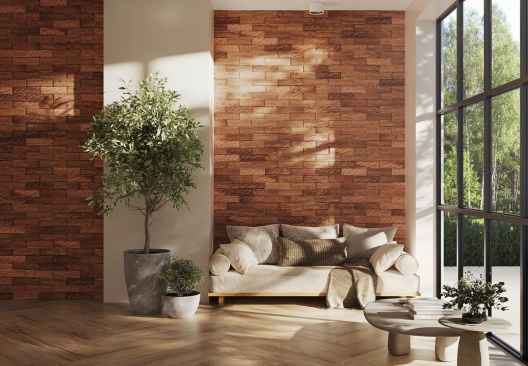
Studio Morandin Fatto a Mano.
Studio Morandin was perhaps the purest example of the handmade end of the spectrum. Its Fatto a Mano is just 27 × 7 cm, made piece by piece from red clay and inspired by ancient Roman construction. The company says each piece retains the artisan’s fingerprint, with natural tonal variations that create what it describes as a living mosaic. It was a 2026 Best in Show finalist.
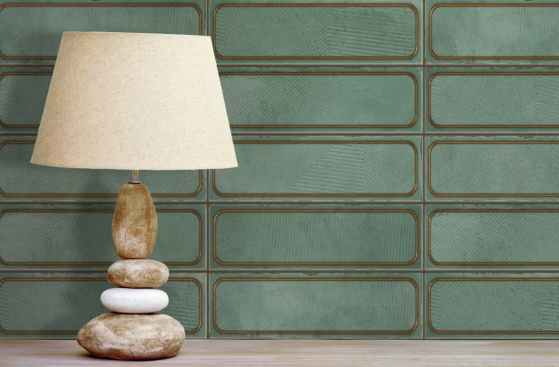
Gabriella Revestimentos Ceramicos Essencia.
Gabriella Revestimentos Cerâmicos — the company explicitly identifies small formats as a specialty and made them central to its Essência 2026 collection. The idea is precisely what you’re describing: smaller pieces allow designers to create varied layouts, details and patterns rather than treating the wall as one continuous image.
After the Fake Marble
For years, much of the global ceramic industry has been engaged in an extraordinary technical exercise: making tile look like something else.
Digital imaging has produced porcelain that can imitate Carrara marble, travertine, terrazzo, oak, concrete, granite, oxidized metal, and countless other materials with astonishing accuracy.
That technological achievement has fundamentally changed the market. But it has also created a peculiar aesthetic problem. Walk through enough international tile fairs and one eventually begins to wonder why an industry capable of doing almost anything remains so preoccupied with imitation.
At Revestir, there were signs that Brazilian manufacturers are beginning to move beyond that phase.
Natural materials remain an obvious source of inspiration, but some of the strongest products were less interested in reproducing a particular stone or wood species than in translating geological, botanical and atmospheric phenomena into new surfaces.
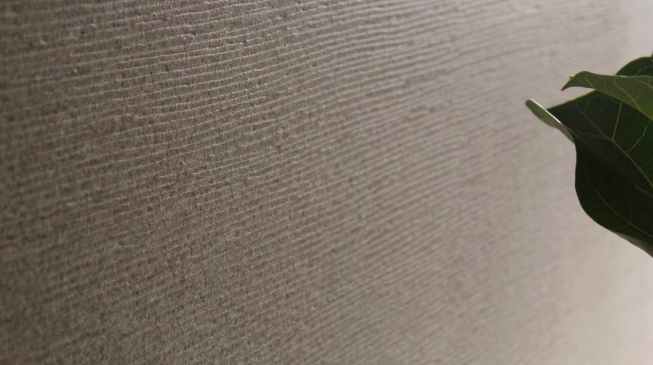
Villagres Lunar Tracos.
Villagres’s Lunar Traços, winner of the fair’s Design Brasil Porcelanato award, took as its starting point the Vale da Lua in Chapada dos Veadeiros, where water has spent millennia carving irregular paths through rock. Instead of simply reproducing the stone, the designers translated the action of erosion itself into subtle organic lines and reliefs that catch light and shadow across the porcelain surface.
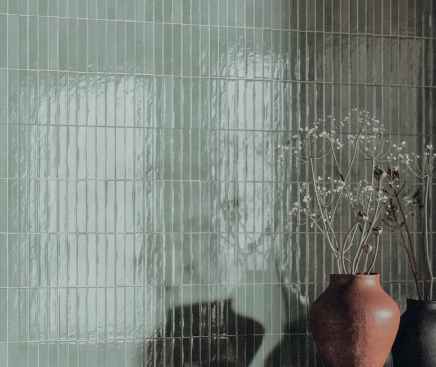
villegres paraiso collection
The company’s Paraíso collection pushed the idea further. Inspired by the waterfalls around Alto Paraíso, its deeply colored Safira and Esmeralda surfaces use relief and an almost wet visual effect to suggest water, movement and reflected light. It won a 2026 Trend Award from Peclers Paris.

Villagres Nazca Lines – Off white.
Villagres’s Nazca, which won Best Porcelain Tile at the fair, similarly distilled the Peruvian landscape into an abstract mineral field marked by traces of time and human intervention.
The distinction is subtle but important.
Instead of asking how convincingly porcelain can impersonate marble, designers are beginning to ask what ceramics can do that marble cannot.
That shift produces what might be called post-natural surfaces: materials that retain associations with geology, landscape, weathering, earth and vegetation without pretending to be literal reproductions of them. Color becomes less descriptive. Veining becomes more abstract. Relief becomes exaggerated. Surfaces acquire depth and shadow. Matte finishes absorb light rather than reflecting it.
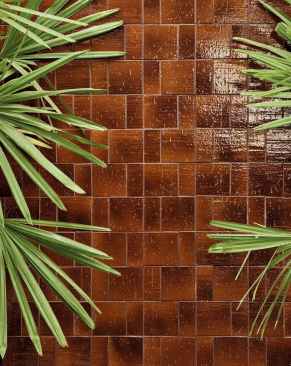
Portobello Matter Amber.
Elsewhere at the fair, Portobello’s award-winning Matter made another version of the same argument. Instead of trying to disguise ceramic as something else, Matter emphasizes ceramic’s own identity: color, slight irregularity, materiality and the appearance of handwork. Portobello describes the collection in terms of matter, craft and the human hand, and the Burgundy version turns the wall into a deeply colored ceramic field.
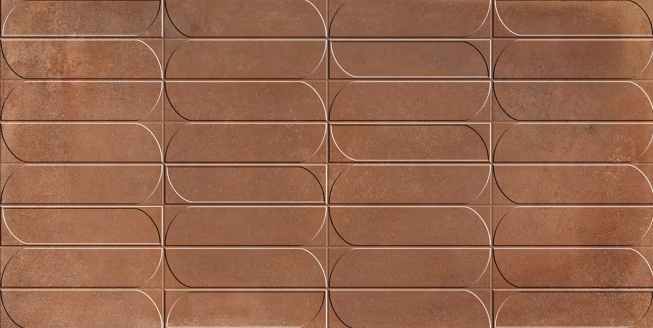
Embramaco Ceramics Brick Tratto.
Embramaco’s Brick Tratto uses variations in relief to create shadows and tactile irregularity, while Biancogres’s Sentir collection foregrounds deep relief, texture and the effects of light across the surface.
Not every manufacturer has abandoned simulation, nor is the Brazilian industry likely to stop producing convincing interpretations of marble, limestone and wood. But the more interesting development at Revestir was the emergence of another possibility: ceramic as an interpretive material rather than an imitative one.
The tile stops apologizing for being tile.
Brazil Rediscovers Texture
Texture was perhaps the most persistent aesthetic language across the fair.
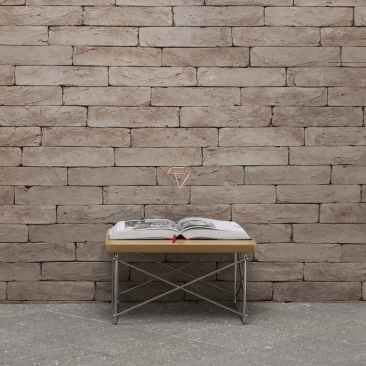
Leprinatura cappuccino.
Deep reliefs, ridged surfaces, irregular edges, three-dimensional patterns, matte glazes and tactile finishes appeared throughout Revestir. Villagres’s award-winning Lunar Traços transformed the erosional patterns of Brazil’s Vale da Lua into organic lines of relief that change with the light, while Lepri’s Olaria Natura Capuccino went in another direction, with texture applied manually to individual pieces.
These products stood in noticeable contrast to the seamless polished surfaces that have dominated so much international luxury design over the past decade. There is something distinctly architectural about that shift. A textured surface changes as light moves across it. It casts shadows. It registers touch. It can make an otherwise flat wall appear to possess depth and mass.
Brazil also has a particularly rich architectural precedent for this kind of thinking: the cobogó, the perforated masonry or ceramic screen that became one of the country’s most recognizable modern architectural devices.
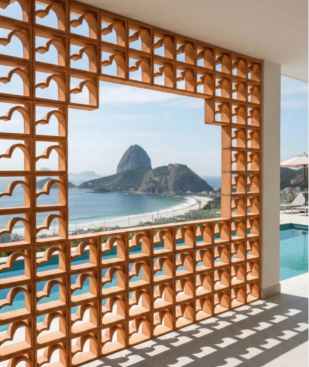
Lepri Cobogo Urca.
At Revestir, two products demonstrated just how contemporary that idea can still be. Lepri’s 15-by-15-centimeter Cobogó Urca, inspired by Rio de Janeiro’s Morro da Urca, uses its pattern of solids and voids to filter sunlight, encourage ventilation and generate shifting patterns of shadow.
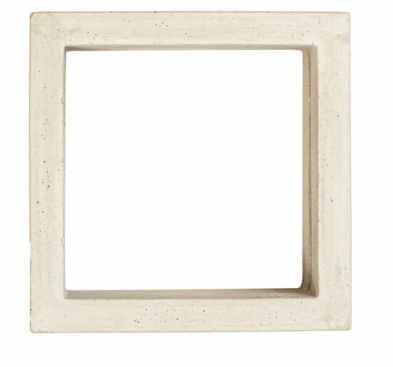
Nina Martinelli Cobogó Sopro Concreto by Marcos Lula
Nina Martinelli’s 20-by-20-centimeter Cobogó Sopro, designed by architect Marcos Lula, is even more explicit about environmental performance. Its internal plate is shifted laterally within the module, directing air through the screen while simultaneously creating shadow, movement and multiple possible patterns when the units are assembled.
The significance goes beyond appearance. The cobogó is essentially a piece of environmental technology disguised as architecture: it admits air without fully opening a building, tempers sunlight without eliminating it, provides degrees of privacy and transforms both daylight and ventilation into architectural effects.
That makes its revival particularly interesting now. As architects reconsider passive environmental strategies in response to heat, energy consumption and climate change, a building element once associated primarily with Brazilian modernism suddenly feels remarkably current.
And the cobogó fits into the larger material story unfolding at Revestir. Whether in the sculpted relief of Lunar Traços, the hand-worked surfaces of Lepri, the material irregularity of Portobello’s Matter or Nina Martinelli’s perforated screens, the surface is becoming active again. It catches light, produces shadow, moves air and invites touch.
Sometimes innovation means inventing something new. Sometimes it means realizing that a culture already invented what the rest of the world now needs.
Lepri’s Cobogó Urca is a strong choice for the architectural/environmental argument. The 15 × 15 cm ceramic cobogó filters sunlight and air while producing changing patterns of light and shadow. It connects contemporary Revestir directly to Brazil’s modernist tradition.
Sustainability Leaves the Marketing Department
An equally important transformation is taking place inside the material itself.
For much of the building-products industry, sustainability has existed as a parallel category: the recycled collection, the green product, the environmentally responsible alternative.
What was striking at Revestir was the degree to which that distinction is beginning to disappear.
Manufacturers are incorporating recycled aggregates, industrial byproducts, textile waste, and other recovered materials directly into commercial products. Lepri, for example, has experimented with recycled material streams, while other exhibitors presented products that treated waste less as an environmental liability than as another potential raw material.
That shift is significant because industrial sustainability becomes far more consequential when it stops depending on consumers choosing a special eco-product.
Waste reduction can lower material costs. Recycling water can reduce operating expenses. Recovering heat from kilns can decrease energy consumption. Reusing manufacturing scrap can reduce both disposal and raw-material requirements.
Environmental performance and industrial efficiency begin to reinforce one another.
That is a fundamentally different proposition from sustainability as branding.
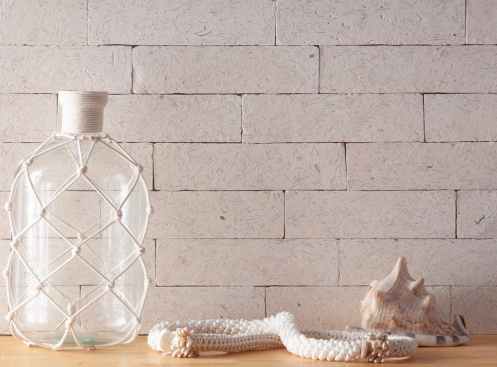
Lepri Brick Mare Bianco
Take Lepri’s Brick Mare Bianco, for example, Developed through LepriLab, the ceramic covering incorporates recycled glass from discarded lamps and plastic recovered from the ocean directly into the material, turning two waste streams into a commercially desirable surface. It won Best Special Covering at Revestir 2026.
Lepri’s Olaria Natura Capuccino is an even more provocative material story. The product incorporates recycled fluorescent lamps, television glass, ceramic waste and mud from the Mariana mining disaster into its production. The resulting material isn’t presented merely as recycled content—the recovered matter contributes to the appearance and manually applied texture of the finished tile. It was a finalist in Revestir’s new Sustainability category.
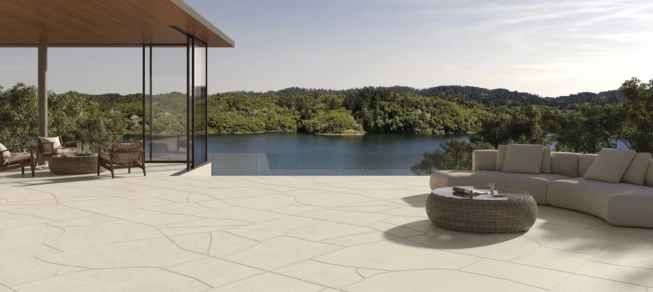
Portobello Kit Alea Patchwork
Portobello’s Kit Alea Patchwork collection shows a major industrial ceramic manufacturer treating its own existing material as a resource. The collection uses reclaimed/reused ceramic bases, which are redesigned into new irregular compositions rather than discarded, extending the material’s useful life. It was also a Sustainability finalist.
It also helps explain why some of the most interesting environmental advances in Brazilian manufacturing can emerge from economic pragmatism rather than ideology. In a competitive industry operating at enormous scale, wasting less material and energy simply makes industrial sense.
The result is a potentially powerful model: sustainability not as narrative, but as infrastructure.
Expo Revestir itself highlighted that shift through a Sustainability Circuit identifying products and companies addressing environmental performance, one of several programs that positioned sustainability alongside technology and design rather than outside them.
The Companies Rewriting the Category
No single manufacturer represents the transformation underway.
Portobello operates at a scale that makes it one of the country’s most visible ceramic brands, combining extensive industrial production with increasingly sophisticated design and retail strategies.
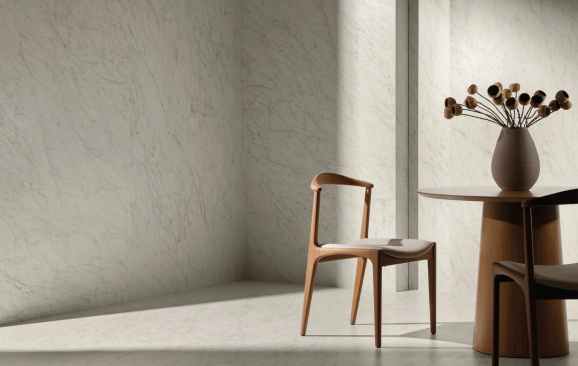
Portobello Carrara Icon Collection
Portobello’s Carrara Icon collection works well with the idea of Portobello moving from commodity tile toward a coordinated surface system. Carrara Icon is part of Portobello’s 2026 launches and is offered across 11 formats, allowing the same material language to move across different applications and scales. Portobello’s broader 2026 strategy explicitly emphasizes a “complete solution” for architecture and interiors.
At Revestir, its presence demonstrated how far Brazilian manufacturers have moved from commodity production toward the creation of complete surface systems.
Eliane represents another side of the industry’s evolution, combining decades of manufacturing experience with international reach and technical expertise. Eliane’s Sensoreal collection demonstrates the company’s movement toward sensory and tactile surface design, rather than simply another marble reproduction. The 2026 Sensoreal collection is organized around textures intended to evoke sensations, making it a useful example of an established industrial producer broadening what ceramic specification can mean.
Cerâmica Portinari has similarly developed products aimed increasingly at architects and designers rather than treating specification as secondary to retail.
Its Petra collection increasingly addressing architects and designers, with its large-format sintered-stone slabs manufactured in Brazil; in 2026 Portinari added a 158 × 158 cm format, extending the collection’s usefulness for floors and walls. The company operates a dedicated Industry 4.0 facility in Botucatu capable of producing slabs as large as 320 × 160 cm. Other companies occupy territory between industry and craft.
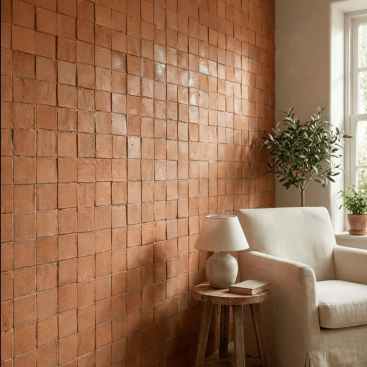
nnina martinelli flooring brazillian red
Lepri has explored recycled materials and unconventional compositions. Nina Martinelli works with the expressive possibilities of small-format ceramics and architectural elements. Castelatto expands the category through sculptural cementitious surfaces that operate somewhere between cladding, relief, and architectural ornament. Biancogres, meanwhile, represents the rapid growth and increasing sophistication of Brazil’s broader manufacturing base.
Taken together, these companies make it increasingly difficult to speak of a single Brazilian ceramic aesthetic.
That may be precisely the point.
Italy’s great achievement was turning ceramic tile into an internationally recognized design industry. Brazil’s emerging strength may lie in resisting a similarly codified identity.
Its design culture is more hybrid, borrowing freely from industrial technology, craft traditions, tropical landscapes, modern architecture, vernacular building, digital fabrication, and global visual culture.
The result can be uneven. It can also be remarkably inventive.
Why American Architects Should Pay Attention
For U.S. architects, these developments are more than an interesting regional story.
American practices have traditionally looked toward Italy and Spain when specifying high-design ceramic surfaces. Those countries remain extraordinarily important, particularly at the premium end of the market. But the conditions surrounding specification have changed.
Cost matters more. Lead times matter more. Supply-chain resilience matters more. Environmental performance matters more.
Brazil occupies an intriguing position within that new landscape.
Its industrial capacity allows manufacturers to produce technically sophisticated porcelain at prices that can make high-design surfaces accessible to project types that cannot support premium European products.
That matters particularly in multifamily housing, hospitality, retail, and mixed-use development, where architects continually negotiate the gap between design ambition and construction budgets.
Geography matters as well.
For the North American market, Brazil offers an alternative supply chain to Europe and Asia at a moment when architects and contractors have become acutely aware of the risks associated with relying too heavily on any single manufacturing region.
But the more compelling reason to pay attention may be aesthetic.
Brazilian ceramics increasingly offer something other than another version of international minimalism. Texture, relief, irregularity, strong color, small-format pieces, architectural screens, and material hybridity provide designers with a broader vocabulary.
That difference could prove increasingly valuable as architecture moves away from the frictionless global aesthetic that has made hotels, apartment lobbies, restaurants, and luxury residences look remarkably similar from Miami to Milan to Singapore.
Materials can once again communicate where they come from.
Is Brazil Really Outpacing Europe?
There is an obvious danger in declaring a new winner in a global design competition that does not actually exist.
Italy remains arguably the world’s most sophisticated ceramic design culture. Its manufacturers possess extraordinary technical knowledge, powerful brands, international distribution networks, and generations of experience working with architects and designers.
Spain remains an industrial powerhouse. Brazil does not invalidate either model.
What Revestir suggests instead is that the geography of innovation is becoming more complicated.
Brazil combines several advantages that rarely coexist: a huge domestic market, abundant manufacturing capacity, comparatively competitive production costs, access to advanced European machinery, strong ceramic traditions, and a design culture comfortable mixing industrial and artisanal approaches.
That combination makes experimentation less precious.
A new surface does not necessarily have to remain a prototype, limited edition, or luxury collection. It can potentially enter industrial production quickly and reach a large market.
That capacity may prove increasingly important as the building industry confronts a paradox: architects need materials to change faster environmentally while construction requires those materials to be available affordably and at enormous scale.
The most consequential innovation will therefore not necessarily be the most exotic material invented in a laboratory.
It may be the material that can actually be manufactured by the millions of square meters.
From Imitation to Invention
That is ultimately what made Expo Revestir 2026 feel important.
The story was not simply that Brazilian companies are making better tile. Nor was it that São Paulo is about to replace Milan or Valencia as the unquestioned capital of ceramic design.
Something more interesting is happening.
The category itself is expanding.
Ceramic tiles are becoming enormous architectural sheets and tiny tactile modules. They are functioning as floors, façades, screens, counters, furniture surfaces, and three-dimensional wall systems. Digital technologies allow mass-produced materials to incorporate extraordinary visual variation. Waste is becoming raw material. Industrial machinery is becoming flexible enough to accommodate customization.
And perhaps most significantly, manufacturers are beginning to ask what ceramics might become rather than simply what other materials they can imitate.
That is a subtle but profound change.
For much of the past two decades, the technical triumph of the tile industry was its ability to make porcelain look convincingly like marble, stone, concrete, or wood.
The next stage may be about allowing ceramics to look like nothing except themselves.
Expo Revestir offered a glimpse of what that future could look like: more tactile, more irregular, more architectural, more materially inventive, and increasingly shaped by environmental constraints.
The global ceramic industry is not abandoning Italy or Spain. But its center of gravity is becoming less fixed.
Some of the most consequential experiments in the next generation of architectural surfaces may emerge not from the traditional European capitals of ceramic design, but from São Paulo, Santa Catarina, Santa Gertrudes—and the enormous factories in between.
The Next Edition of Revestir in takes place February 22 to 26, 2027 at the São Paulo Expo, in São Paulo.