On London’s South Bank—where cultural gravitas meets relentless commercial pressure—a new office building is quietly challenging the assumptions that have long defined speculative workplace design.
Barge Crescent, a 4,200-square-meter project by Henley Halebrown, replaces a trio of early-1990s office buildings that had become emblematic of a now-obsolete model: sealed, over-serviced, and spatially inefficient. Their mechanical systems consumed an entire floor; their architecture shut out light and air. A feasibility study considered adaptation but ultimately deemed the structures beyond salvage.
What has been built in their place is not just a replacement, but a repositioning—one that aligns closely with the firm’s recently published monograph, Building for Society: Henley Halebrown Built 2010–2022. Released by Lund Humphries and edited by Tom Neville, the book frames the practice’s work as an ongoing investigation into architecture’s civic role: not as isolated object-making, but as a cultural act embedded in memory, place, and social life.
Barge Crescent reads less like a standalone project and more like a test case for those ideas.
A Building That Starts With What Already Exists
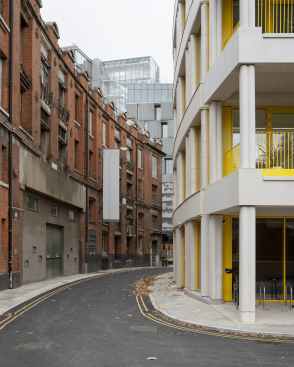
The project’s most consequential move is also its least visible: the complete retention and reuse of the existing substructure. In an industry still conditioned to equate demolition with progress, the decision signals a shift—not just toward lower embodied carbon, but toward continuity as a design value.
This approach reflects one of the book’s central concerns: the preservation and reinterpretation of familiar building types as a way to sustain meaning over time. Rather than erase the past, the project absorbs it—allowing old and new to coexist within the same structural logic.
From there, the building pivots toward a hybrid environmental strategy. Daylight, natural ventilation, and outdoor access replace the sealed-box logic of its predecessor. The result is not just an energy-efficient building, but a fundamentally different model of occupation—one that reconnects work to climate, air, and season.
From Façade to Threshold to City
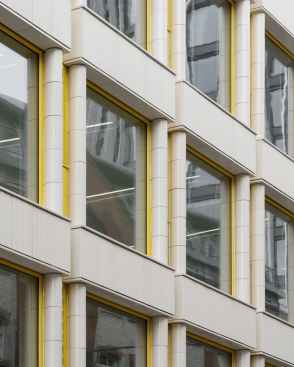
Formally, Barge Crescent is driven by its envelope—but not as surface. Instead, the façade operates as a thickened, active zone mediating between interior and exterior.
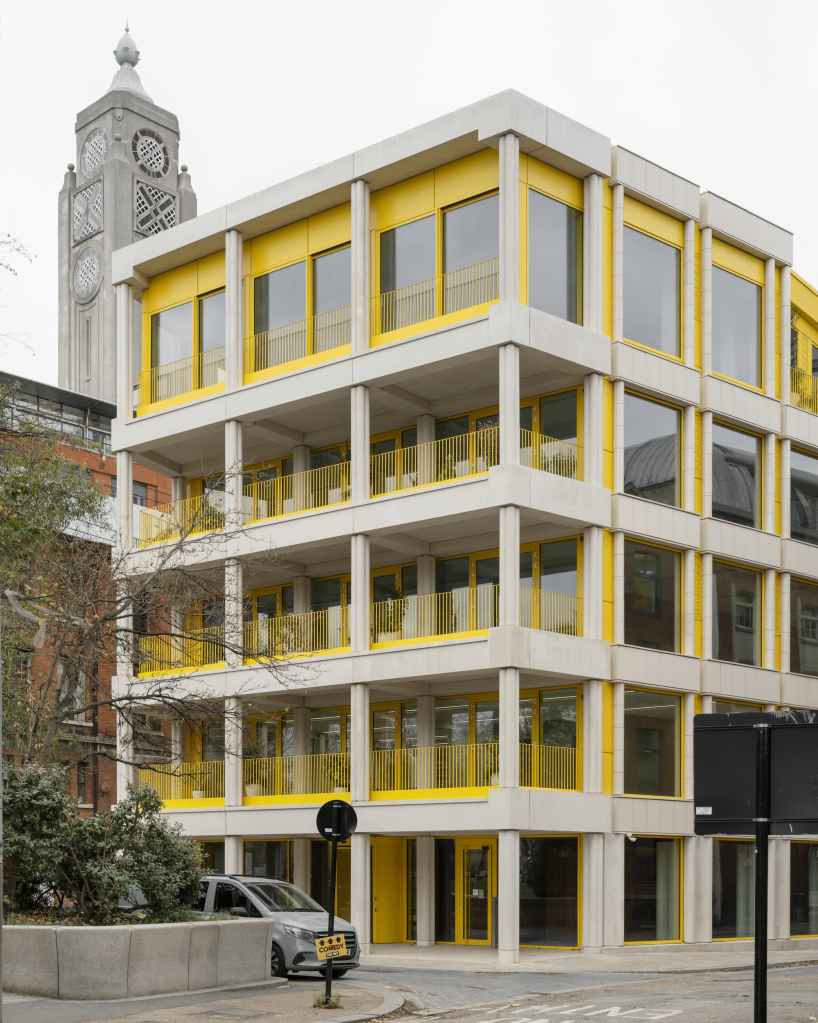
On the south elevation, an aedicular system—columns and beams framing each opening—organizes the façade into alternating glazed and ventilated modules. On the west, a deep loggia extends vertically across multiple levels, creating a layered threshold between building and city.
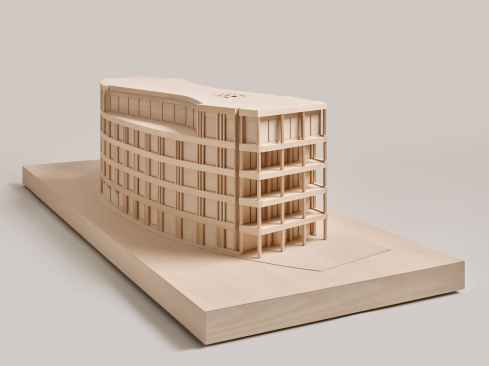
The north façade, by contrast, stretches horizontally along the curve of Barge Crescent Street, absorbing irregularities inherited from the retained substructure. The result is a subtle negotiation between old and new—order imposed on an inherited disorder.
“We are more used to encountering the concave side of a crescent,” notes Simon Henley, Principal of Henley Halebrown. “Here we experience the convex, but because of the older buildings on the north side of the street—also forming a crescent—the road is held between the two. It’s a very rare condition in urban design terms, reminiscent of the curve at the bottom of Regent Street as it sweeps toward Piccadilly Circus.”
These threshold conditions—neither fully inside nor outside—are not incidental. They align with another recurring theme in Building for Society: liminality as a critical architectural condition. Space is not just defined by enclosure, but by degrees of openness, permeability, and exchange.
From Book to Building
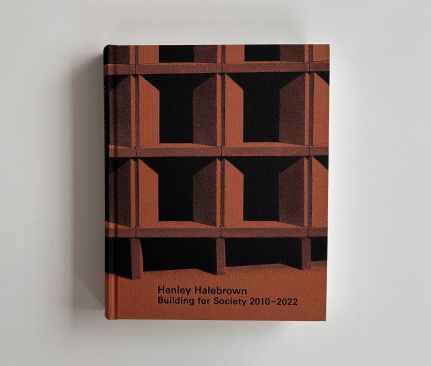
If Building for Society lays out the intellectual framework for Henley Halebrown’s work, Barge Crescent reads as a built index of its ideas. The themes outlined in the monograph—reuse, liminality, typological continuity, and architecture as a civic act—are not abstract positions. They are embedded directly in the project’s structure, façade, and spatial organization.
An Office Building—or a Civic Proposition?
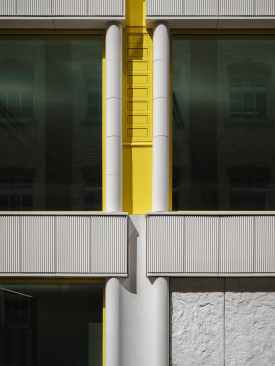
Materially, the building balances weight and lightness. Slender terracotta elements sit above a robust concrete plinth, while yellow-framed windows and operable louvres punctuate the façade—assertive head-on, recessive at an angle.
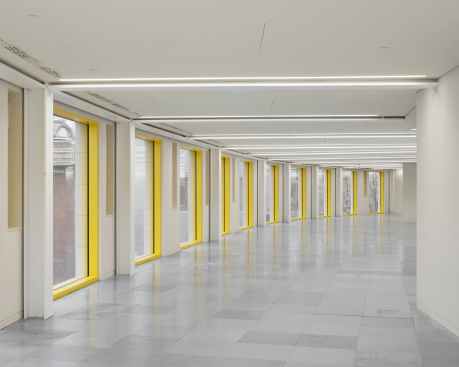
Inside, the retained structural grid generates open floorplates with generous ceiling heights. Exposed concrete and timber surfaces catch and modulate daylight, emphasizing a material clarity that aligns with the project’s environmental ambitions. The reception space, glazed on three sides, is anchored by bespoke Douglas fir furnishings set against a terrazzo floor, while circulation cores organize the plan without constraining flexibility.
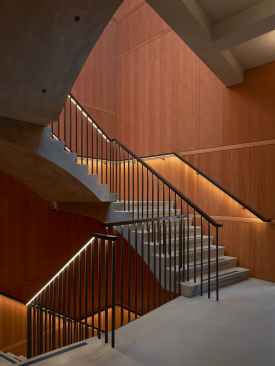
The top floor—constructed entirely in timber—extends outward to roof gardens overlooking the surrounding streets. Combined with the loggia terraces, the building offers outdoor access at every level above ground, reframing the office not as a sealed container but as a porous environment.
For developer Global Holdings Management Group, the project is positioned as a premium workplace within a competitive district.
“London’s South Bank continues to grow as a dynamic hub for businesses, and alongside our partners at Henley Halebrown, we have worked hard to ensure Barge Crescent provides best-in-class workspace designed with employee wellbeing in mind. The creation of this premium office space in a highly connected, sought-after location will create an environment where companies can thrive and attract the best talent,” said Josh Lawrence, Chief Executive of Global Holdings Management Group UK.
Yet the building’s significance extends beyond market positioning.
Gavin Hale-Brown, Principal of Henley Halebrown, summarizes the ambition more directly:
“Architecture is a practical art. Here, that principle means creating an appropriate, robust, and open architecture—sustainable, accessible, adaptable, and comfortable—while establishing a strong civic presence in this historic setting beside the River Thames.”
The Quiet Argument
If there is a provocation here, it is not formal but disciplinary.
Barge Crescent suggests that the future of office architecture will not be defined by spectacle or technological escalation, but by something more fundamental: how buildings engage the city, extend their lifespan, and create meaningful space between people and environment.
In that sense, the project is less a new building than a reframing.
The question it raises is simple—and difficult:
what if architecture’s primary role is not to produce objects, but to sustain society?
Project Credits
Design 2019 – 2021
Construction start 2022
Completion 2025
Size 4,200m2
Client Global Holdings
Architect Henley Halebrown
Project architect Jennifer Pirie
Project team
Gavin Hale-Brown, Simon Henley, Jieun Jun, Alessia Junco, Craig Linell, Lucy Norfield, Claudia Schenk, Elise Tinn
Planning Consultant DP9
Structural Engineer Waterman Group
Services Engineer Taylor Project Services
Building Control Swecco
Cost Consultant Norman Rourke Pryme
Fire engineering Warrington (To Stage 3), ALT Fire (Stage5)
Signage Henley Halebrown
Reception Furniture/ FF&E Lore Group
Main Contractor Blenheim House Construction (2022-2024), Hudson (2024-2025)