September 22, 2015
Don’t Blame This One on the Pope A Metro train in the District of Columbia lost power and stranded its passengers in the middle of a tunnel between stations on the rush hour ride home tonight, reports The Washington Post. The estimated 500 to 600 passengers who were aboard were hot and annoyed, but otherwise little the worse for wear, and a few impatient people decided to evacuate themselves before the authorities arrived and got the passengers to safety. This time, unlike the incident in January that took the life of one of the passengers, there were no signs of smoke or other reason for the train to just stop. It might have also helped that we had a nicely mild, even cool, day here in the District today. [The Washington Post]
Building a “Popechair” One does not simply buy a chair for the pope, the Washington Post reports. Instead, artisans along the East Coast are hand-crafting seats for the Roman Catholic Pontiff on the occasion of his visit to the U.S. this week. When he says an outdoor mass on Wednesday at the Basilica of the National Shrine of the Immaculate Conception at Catholic University, in Washington, D.C., he’ll sit in a high-backed chair characterized by graceful arches and designed by students from the university’s School of Architecture and Planning. He’ll be seated in a tall wooden armchair built by immigrant day laborers from the nonprofit Don Bosco Workers in Port Chester, N.Y., when he says mass at Madison Square Garden, in New York, on Friday. And for his speech at Philadelphia’s Independence Hall on Saturday, he’ll kick back in one of Maine-based Thos. Moser’s Windsor-style Catena armchairs. The chairs all share a similar minimalist style with graceful forms and ample locally sourced wood. [Washington Post]
Marking Your Underground Territory Apparently, drilling a set of geothermal wells is a lot more difficult than we expected and involves a lot more guesswork than we figured that it would. That is the first thing we learned from reading Shara Tonn’s article today in Wired. The next thing we learned was that could all change. See, when a geothermal engineering crew is drilling a set of wells, they have to drill the first set that pump water down deep into the earth and then a second set to tap that pumped water and harvest the heat that it circulating in it. Not being able to see underground, this second part can sometimes be reduced to pure guesswork. Sometimes teams use chemicals or other markers (think of the process you go through before going under the hood for an MRI) to track where the water is going. Oftentimes, this process is unpredictable and the chemical markers are hard to track. A geothermal engineer at Stanford, however, has a new solution. He has taken unique snippets of DNA and wrapped them around tiny balls made of silica (and then covered with a silica candy shell to protect it from the harsh conditions deep under the ground). When the engineer then drills a new set of wells, then, these unique DNA markers can tell them exactly where the water came from. [Wired]
I just realized looking at Emmy photos: Someone needs to cast Frances McDormand as an architecture critic. pic.twitter.com/a0OcIB3rcH
— Alexandra Lange (@LangeAlexandra) September 22, 2015
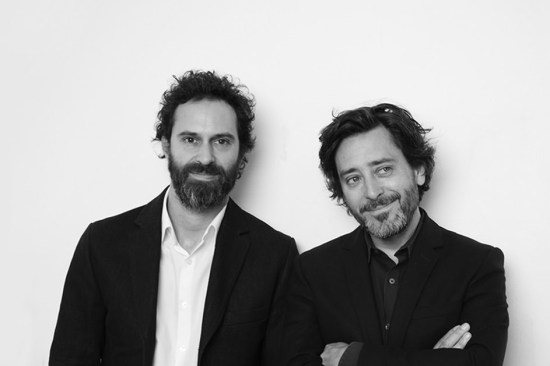
British Duo Receives One of the Design Industry’s Highest Accolades Londonn-based designers Edward Barber and Jay Osgerby won this year’s Panerai London Design Medal for their contributions to the industry. The 10 year-old award is one of the highest honors in the design world. Perhaps best known for their design of the Tip Ton chair, Barber and Osgerby are also responsible for the design of the London 2012 Olympic Torch, and a number of products and furniture for Vitra, B&B Italia, and Knoll. At this year’s London Design Festival, Barber and Osgerby are launching a book “One by One,” selection of sketches, prototypes, and development drawing of their projects from the past four years. Barber and Osgerby will also release a new range of paper lanterns manufactured by Ozeki in Japan, and an interactive shower control element with Axor. [The New York Times Style Magazine]
Construction-Worker Shortage Caused by Immigration Decline According to housing analysts, the residential and commercial construction sectors are suffering from a labor shortage due to the industry losing more than half a million Mexican-born workers since 2007. Many of those workers returned to their native country during the real estate crisis and have not returned since, because of stricter immigration policies and an increasing number of work opportunities abroad, as well as an improving economy in Mexico. The labor shortage has slowed production and is likely to drive up home prices. [The Wall Street Journal]
Dropout After a protracted battle that was highly publicized, Zaha Hadid Architects decided to stop pursuing the Tokyo Stadium for the Olympics in 2020. According to the firm’s press release, they teamed up with Tokyo-based Nikken Sekkei in renewing their bid earlier this month, but the competition rules require participants with construction capabilities—a component they were missing, forcing them to drop out. “It is disappointing that the two years of work and investment in the existing design for a new National Stadium for Japan cannot be further developed to meet the new brief through the new design competition,” said the firm in the press release. [ARCHITECT]
We’ve been covering this story for some time as it has developed. Here are highlights from that coverage, in order:
Aaron Betsky on Tokyo’s building boom despite its recession.
Zaha Hadid Architects win and the other contenders.
Zaha Hadid’s Olympic Stadium for Tokyo Is too big, says Fumihiko Maki.
Awards: Enter Now!
The AIA, the Association of Collegiate Schools of Architecture, and the Architects Foundation’s Design & Health Research Consortium is adding up to six new member organizations. Application materials are available on the AIA’s website. Deadline is Oct. 16.
The 63rd annual Progressive Architecture Awards program is now accepting submissions. The winners of our annual program honoring unbuilt designs are published in the February issue. Regular deadline is on Oct. 30, with the late deadline (and extra $50 per entry) on Nov. 4. Enter now!
The Graham Foundation’s Carter Manny Award recognizes doctoral students working on dissertation topics in architecture. Applications are available online now and due Nov. 15.
Bathroom products manufacturer Victoria + Albert is challenging designers to create a space that uses its products. Entry is free and submissions are due Dec. 20.
AIA|DC is accepting entries for the Sarah Booth Conroy Prize for Journalism and Architectural Criticism to reward excellent reporting of architecture and urbanism in Washington, D.C. The annual prize is $5,000. Deadline is Dec. 31.
For more news and views, sign up for the ARCHITECT Newswire, the best daily newsletter on architecture and architects.
Click “next” to read past days of the News Roundup.