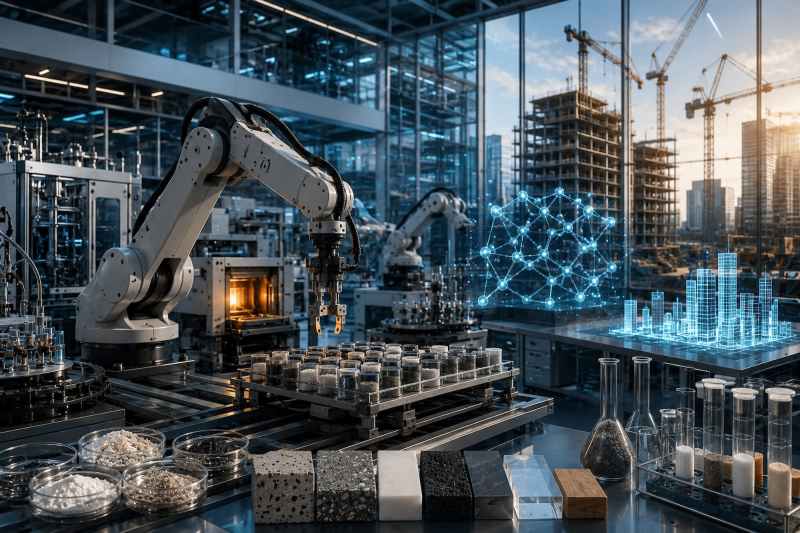
Inside a materials science lab at the Lawrence Berkeley National Laboratory, a flurry of activity is taking place: powders are weighed and mixed, samples are shuttled into furnaces, and the resulting crystalline compounds are analyzed with X-ray diffraction. The results are then interpreted and used to determine subsequent experiments, thus creating a continuously repeating cycle of experimentation and discovery.
This may sound like ordinary activity. However, what is unusual about this facility, called the A-Lab, is that AI-driven robots, not humans, do the work. In the autonomous laboratory, robots not only carry out routine tasks but also make decisions without human involvement. “The robots operate around the clock, freeing researchers up to spend more time designing experiments,” explains Lauren Biron in a Berkeley Lab press release.
The robots can reportedly process and evaluate up to 100 times more samples than human scientists, representing a radical increase in productivity. In this new paradigm of the self-driving laboratory (SDL), driven by the closed feedback loop of robotic experimentation and artificial intelligence, materials science is witnessing the automation of invention itself.
The A-Lab is just one example. Carnegie Mellon University’s Materials Innovation Cloud Lab (MICL) is a similarly automated research environment that integrates robotics and AI to accelerate the discovery of new alloys. Part of the institution’s AI Science Foundry, the MICL is designed to plan and conduct experiments with limited human input. According to CMU materials scientist Mohadeseh Taheri-Mousavi, “Robotic automation of this equipment enables us to go from an invention idea to a testable alloy in a fraction of the time it used to take.”
Texas A&M’s Autonomous Robotic Metallurgist Materials Innovation Platform (ARM-MIP) is another self-driven laboratory for alloy research. In this case, the environment is designed for open access by researchers across the United States. Like the A-Lab and MICL, the new facility at Texas A&M’s RELLIS Campus will relieve scientists of repetitive materials-testing tasks, enabling them to focus more on data interpretation and potential applications.
An emerging concept in self-driving laboratories is scale awareness. In traditional materials science, a discovery can occur without a clear connection to potential scalability, such as mass production. However, scale-aware SDLs incorporate recognition of industrial processes in the exploratory phase. This trend is particularly significant for building products, which typically require large-scale manufacturing to meet the volume demands of the construction industry.
A few early examples of such operations already exist. Project Ada, a collaboration between the University of British Columbia and the University of Toronto, was launched to automate the experimentation and discovery of high-performance thin-film coatings in solar cells. Capable of performing up to 100 cycles of experiments and analysis per day, Ada enabled measurable improvements in electronic performance and optimized conductivity in metallic coatings.
The University of Toronto’s SDL4:Polymers, one of 40 self-driving labs at the institution, is accelerating the development and commercialization of new polymers at ten times the traditional speed. Applications include more environmentally friendly plastics, paints, and coatings for consumer and construction markets.
Scale-aware SDLs can accelerate building product advances and, by extension, innovative construction techniques in ways previous methods could not due to the relative lack of speed and manufacturing integration. This closed-loop approach can benefit a variety of products, including high-performance alloys, sealants, adhesives, membranes, insulation, glazing films, concrete additives, and engineered wood binders.
Given the speed of SDL material discovery, one can imagine the traditional product development model shifting in palpable ways. The acceleration might lead to persistent product reformulations, driven by a continuously evolving material platform—similar to today’s frequent computer software updates. Rather than launching a revised product every five or ten years, a manufacturer with an autonomous system could continuously analyze novel feedstocks, recycled content, manufacturing specifications, emissions, and other parameters. Architects could also play a more central role in product development, shifting upstream to seed autonomous development platforms with desired material characteristics.
On this topic, finding new opportunities for human agency will be critical. As seen in other realms, such as driverless vehicles, self-driven laboratories raise questions about human control and intervention. SDLs may be touted as places that enable deeper thinking for researchers. However, because these autonomous facilities are empowered to make their own decisions, a clearer understanding of the robots’ and humans’ distinctive roles is needed.
The scale-aware SDLs may hold a key here. With building products, scaling requires knowledge of design preferences and construction methods that involve multiple building trades. Therefore, involving architects and contractors early in the material development process could be an advantageous way to optimize the role of human agency while maintaining the efficiencies of the closed-loop system.