
Project Description
FROM THE ARCHITECTS:
This project provides sheltered
housing for frail, elderly residents with a variety of disabilities. The
building comprises individual studio apartments, communal areas and medical
consultation rooms for residents and out-patients.
To understand the project
one must understand the history of the site at 232 Rue de Charenton in
south-eastern Paris, along the side of which runs a passage that can be found
on city plans as far back as 1789, at which time it led to cultivated fields.
Fraught with real-estate related tension due to the complex planning laws in
Paris and the Bercy neighborhood, the project took seven years to see the
light of day.
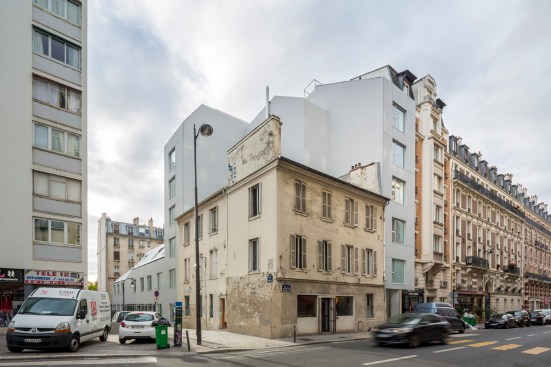
The site is surrounded by
high buildings that cast their shadows, and cramped by a house on the corner
whose owner refuses to sell. Nonetheless, the orientation is interesting and
planning laws are moving in the right direction. To the north, on the Rue de
Charenton, we were able to build to six storeys, to the south, at the heart of
the block, up to three storeys.
As with all historical
urban environments, planning regulations left no flexibility in terms of
defining the height, width and length of the building. The resulting volume
faithfully transcribes the layers of restrictions: the minimal access from the
Rue de Charenton, extending back into the block where it is calm and protected,
gives a position between street and garden with, above all, a large part of it
in full sun at the height of summer.
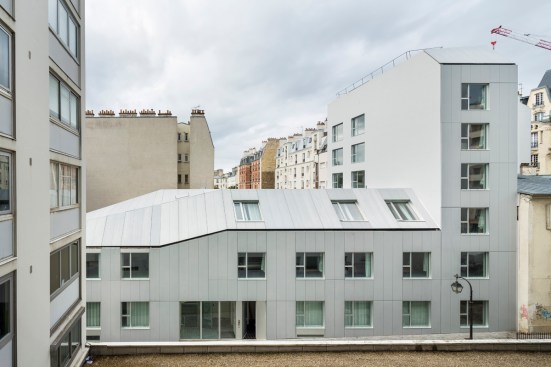
Shaped like a bayonet,
the site engaged us in an interesting architectural exercise. The urban
restrictions combined with the requirements of the brief led us to consider the
most efficient means of squeezing in the allocated 2,150 sq m. Following the
planning laws, the resulting volume slips like a living thing in between the
existing buildings – our pragmatic approach aimed to use every inch of
available space.
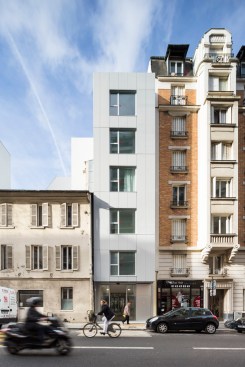
On the Rue de Charenton,
the generous height allowances and the shape of the site led us to design
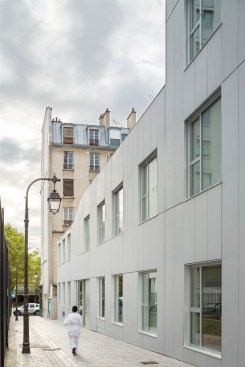
volumes of surprising proportions, which fold along the roofline. On the Ruelle
de la Planchette, the upper part of the aligning facade folds in, scrupulously
following the volumes permitted.
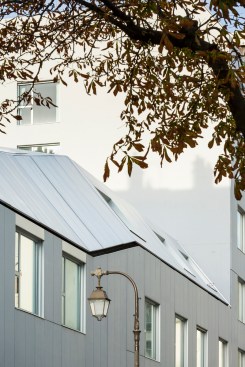
The smooth external skin
faces onto the city. Generously proportioned windows, almost square, provide
maximum light and transparency in all the internal spaces, a luxury in Paris.
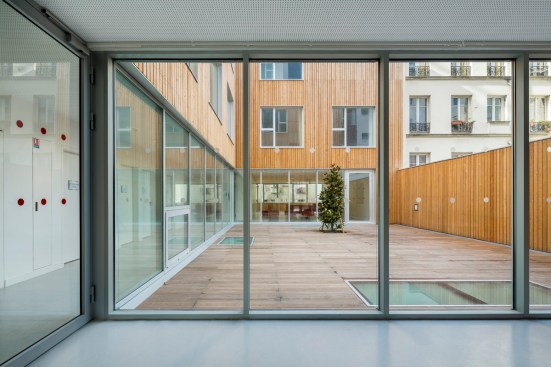
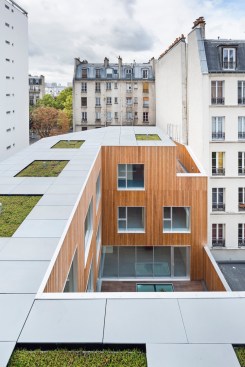
The day-rooms are
arranged around two patios; their proportions were reconsidered in order to
meet standards, as well as requirements for natural lighting. All the day-rooms
are naturally lit, as are the circulation spaces.
The height of the
neighboring buildings gives them plunging views over the site. With this in
mind, every detail of the building was carefully studied to ensure that they
fitted in and were pleasant to look at.
In both the design and
its realization, we opted for a building that is sober and adaptable, conceived
in terms of real-life usage over the long term. We took into account the
possibility of future extension in the event of acquiring the corner house.
In considering the
ensemble of issues with regards to health and thermal and acoustic comfort, we
gave great importance to user needs.
The first consideration
regarded contact with the outside world. The quality of the envelope and
exterior openings is essential in ensuring the quality of a building. Large
windows create a relationship between the internal spaces and the city and
neighborhood.
The second consideration
concerned opportunities for interaction within the building. We strove for
transparency at the heart of the site, for the quality of the communal and
circulation spaces, which are designed as largely glazed walkways providing
opportunities for residents to see, meet and interact with one another. These
circulation spaces are a determining factor in the quality of life in shared
accommodation.
The third consideration
took into account the layout of the different functions. The building houses
several different functions, as well as the private living units – communal
areas, easily accessible spaces for activity and leisure, and work areas for
the staff.
Finally, if the question
of energy is fundamental, so, obviously, are questions of well-being, comfort
and health.
The relationship between
the occupants and the city was one of our foremost concerns. On the ground
floor on Rue de Charenton is the entrance hall, on the Ruelle de la Planchette
is a service entrance, and between these two entrances, along the Ruelle de la
Planchette, administrative offices, family reception areas, and part of the paramedical
unit are located. Designing the circulation in bayonet formation enabled us to
place large spaces at the heart of the block and small offices along the side
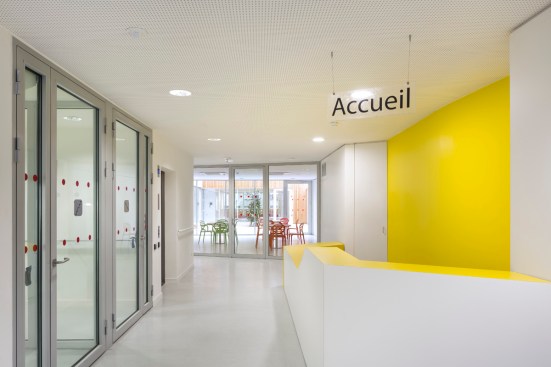
street. At the center, directly visible from the entrance hall, is the
multi-use room and the two large activity and reading rooms.
Large, central glazed
areas, including the main patio, which is itself an ‘outdoor room’, help to
maintain transparency throughout the ground floor.
At the semi-basement
level are the service areas, for maintenance, laundry and staff, lit by daylight.
In the central zone, three large activity rooms are organised around the
central patio, from which they receive natural daylight.
We identified the areas
where residents would spend the most time, such as the activity rooms and
circulation spaces, in order to prioritize natural light. Areas that are used
only occasionally, such as physio and psychomotor therapy rooms, are daylit
from the sub-basement level.
Repeating the same
configuration of circulation space for each floor of the building, we created
an efficient means of arranging the various areas. We distributed the 26
housing units on the upper floors, feeling that ground-floor bedrooms would not
be agreeable.
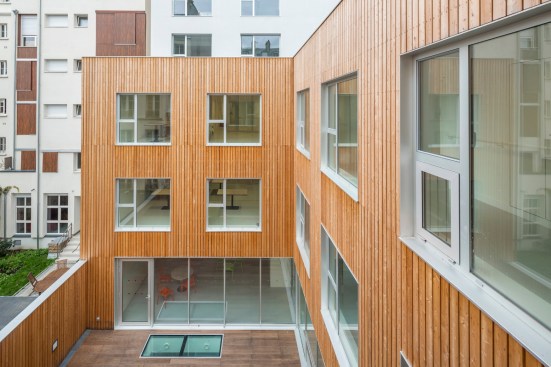
The patios are places for
contemplation, like Japanese patios. They are the points towards which views
from the communal living areas are directed.
Circulation ceases to be
a ‘corridor’, instead becoming a ‘route’. One passes from one point in the
building to another looking outside.
The architecture seeks a
duality in the choice and use of materials. On the city side, a neutral skin,
discrete and timeless, is achieved using an external facing in high-resistance
concrete, grey in color, dressing the edifice for urban life.
On the patio side,
larch-wood cladding, which requires no maintenance, provides a welcoming
appearance for the residents.