
Tom Bonner
Steven Ehrlich, founding partner of the eponymous Culver City, Calif., architecture firm, could easily boast about the diversity of his portfolio, amassed over 28 years in practice: libraries, apartment towers, a biotech research laboratory, and a slew of beautiful, high-end houses, including a 35,000-square-foot residence in the United Arab Emirates sheltered under a massive, cantilevered canopy. Yet when a potential client cold-called and requested a renovation and expansion of a modern warehouse—a new building type for Ehrlich and his colleagues—the firm initially balked at the commission.
“We told them that maybe they’d be happier with an architect specializing in industrial buildings,” says associate Mathew Chaney, “but they insisted.” He was surprised that the client was willing to take a risk on a first-time warehouse designer who would be learning the significant technical requirements on the go; he was equally surprised by the owner’s commitment to and investment in top-drawer architecture.
For the record, the client, a distribution company, is extremely private and wishes to remain anonymous. It seems paradoxical that such a client would actively engage a well-known architectural practice while avoiding publicity and remaining mum on its motives. A spokesperson would reveal only that the company’s mission was to create a nice working environment for its employees.
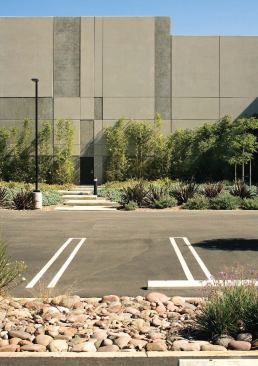
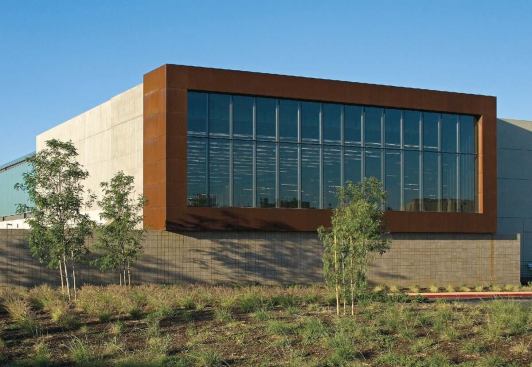
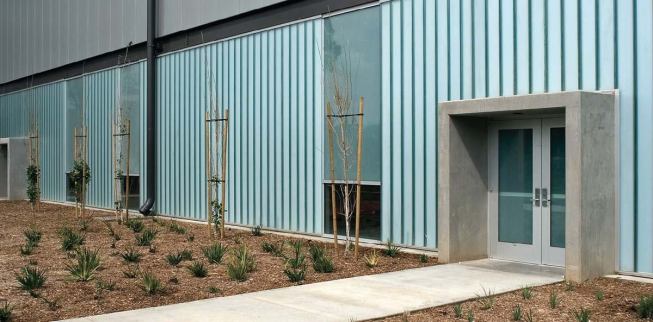
Ehrlich makes the most of this perplexing duality. The design doesn’t hold back, employing a bold palette of Cor-Ten steel, exposed concrete, and channel glass, materials that contrast with the building’s bland neighbors. But it is modest on its site. Well, as modest as a 300,000-square-foot addition to a similarly large structure can be. “The client didn’t want to be flamboyant or stand out too much,” explains Chaney. And at this scale, rejoins Ehrlich, “It is hard not to make an iconic building.”
The warehouse is located in an industrial suburb east of Los Angeles. Bordered by business parks, auto shops, and shipping facilities, it’s hidden in plain sight. A pinkish brick façade of a 1980s vintage greets visitors as they pull into the parking lot. This building is a bit of a decoy; fronted by coral trees and azalea beds, the banal structure draws attention away from the new construction.
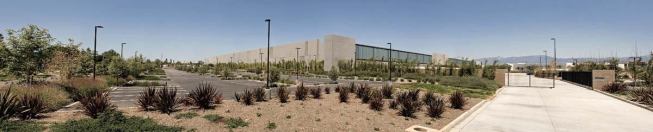
Still, it’s clear where the new design begins. “It is as if they suddenly stopped mowing the grass,” says Ehrlich. Conventional patches of lawn and sidewalk give way to rolling berms and a walking trail. Designed by landscape architect Pamela Burton, the gravel pathway encircles the 52-acre site and sweeps out and around the bioswale parking lot to the east.
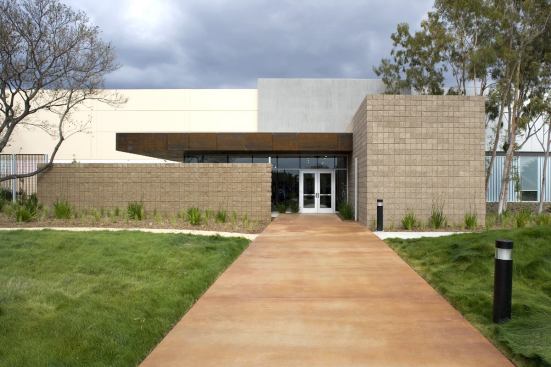
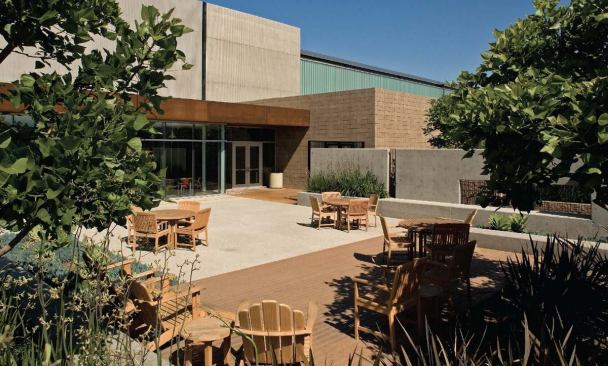
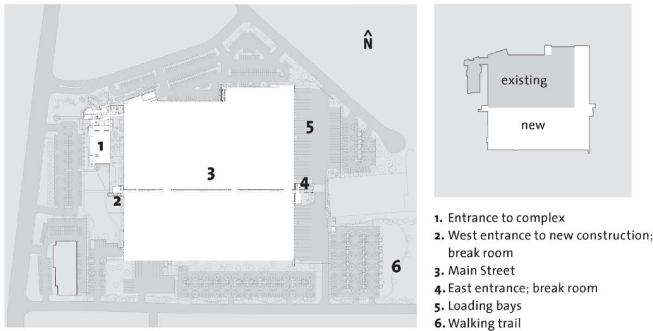
Approaching this, the west side, it is easy to underestimate the size of the structure. The softscape, composed of drought-resistant native grasses and bluegray ice plant, obscures the warehouse’s bulk, while a Cor-Ten steel canopy extends Prairie School–like from the façade, sheltering a glazed employee break room. The care taken in composing the various elements— plantings, terrazzo block, steel, and stained concrete—gives the entry sequence if not a monumental then a substantial scale. At the same time, it feels almost residential: The sliding roof and wall planes recall some of Ehrlich’s house designs. Once inside, there is a view onto a courtyard filled with patio furniture. You almost have to remind yourself that this is a distribution warehouse.
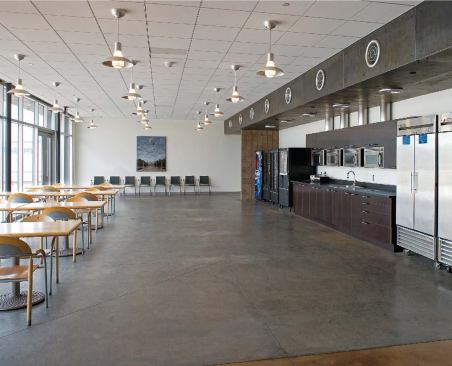
The break room is streamlined, but homey. Chaney notes that he incorporated details developed within the firm for custom kitchens. Only the telltale vending machines give away that this is a commercial environment. FinPly cabinets, stained a warm chocolate brown, hold the battery of stainless steel refrigerators, coffeemakers, and microwaves needed for lunch. A twin break room is located on the eastern side of the building and is the entry from the employee parking lot.
Ehrlich refers to these two gathering areas as “nodes.” They bookend a 777-foot-long expanse he calls “Main Street,” or, as the owner’s representative more dryly dubs it, the “raised pedestrian walkway.” Both descriptions hold true, capturing the architect’s community-building vision and the client’s need for operational safety. “The challenge is balancing these specific functions of the big box—its efficiency requirements—with what it takes to produce a spiritual environment,” says Chaney.
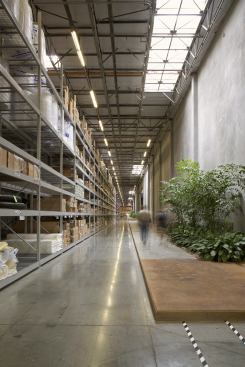
Running the entire length of the new addition, the main street brings humanity to the cavernous interior. The stained concrete walkway rises 6 inches above the floor, forming a curb that protects workers from the forklifts zipping cargo through the aisles. Industrial steel steps bridge the conveyor belts that stream in horizontal rows from the northern packing areas to shipping in the south. Bringing natural light deep into the warehouse, skylights track the length of the main pathway. Below, Zen-like planting beds with tall bamboo stalks and fishtail palms alternate with small seating arrangements and computer stations.