Thomas Webster Gedra
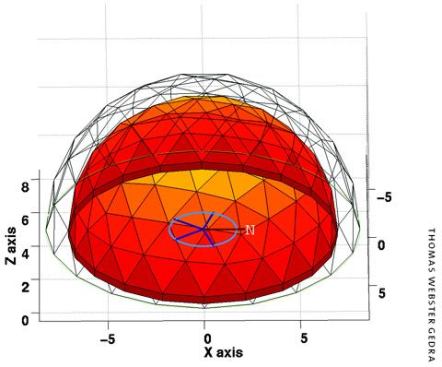
The sky dome's two domes, as seen from below.
AN ARTIFICIAL SKY is taking shape at Oklahoma State University (OSU). Designed to simulate both clear and cloudy weather, the sky dome will assist OSU students, practicing architects, and others in the research of day-lighting systems.
There are five people at work on it: the architectural engineering team of professor Steven O’Hara, assistant professor Khaled Mansy, and student Aaron Lewis; and the electrical and computer engineering team of associate professor Thomas Webster Gedra and student Qamar Arsalan. Given their various schedules, Mansy says, they are able to work only one day a week on the sky dome, which is expected to be finished next summer.
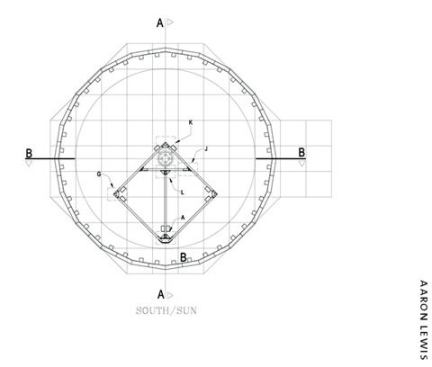
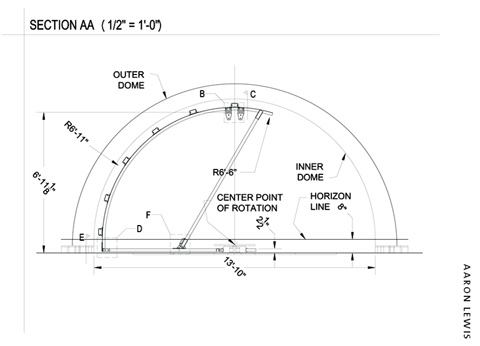
When complete, it will comprise two domes-an outer one, which will hold 341 incandescent halogen lamps; and an inner one, nearly 14 feet in diameter, made of translucent polycarbonate sheets-as well as the heliodon on which architectural models will sit. Mansy says the OSU sky dome will be best suited for models created at a halfinch scale.
It won’t be the only artificial sky available to architects, of course. “There are sky domes that can only simulate overcast skies, [and others that] simulate clear skies,” says Mansy. And then there is the one at the Welsh School of Architecture, Cardiff University, which simulates both clear and overcast skies, as OSU’s will.
Built in 1999 and almost twice the diameter of the one under construction in Stillwater, Okla., the Cardiff sky dome has a similar geodesic structure for holding lamps. But it suffers from what Mansy calls the “star effect”: When a light sensor is moved inside an architectural model sitting within the dome, it sometimes sees a different number of point-source lights, which causes incorrect jumps in illumination levels. Thus the translucent dome in the OSU structure, which will diff use the light to achieve a smoother, more accurate gradation of illumination.
So why build a sky dome when there are other tools-formulas, daylighting nomographs, and computer simulations-available? According to a technical paper about the OSU project given at the American Society for Engineering Education’s 2005 annual conference, Mansy, O’Hara, Gedra, and Arsalan say the first two “are not flexible enough to allow for innovation in the design of daylighting systems,” while computer programs “[do] not suit beginning undergraduate students as a learning tool.”
In 2003, Mansy received an $85,000 grant from the National Science Foundation for the construction of the sky dome, and OSU contributed about $37,000. It is being built at OSU’s Advanced Technology Research Center and will be moved to the school’s architecture building after renovations there are complete. Because the sky dome will consume a large amount of energy, says Mansy, users not affiliated with OSU will have to pay a fee. Until the structure is complete, however, he declines to speculate what the cost might be.