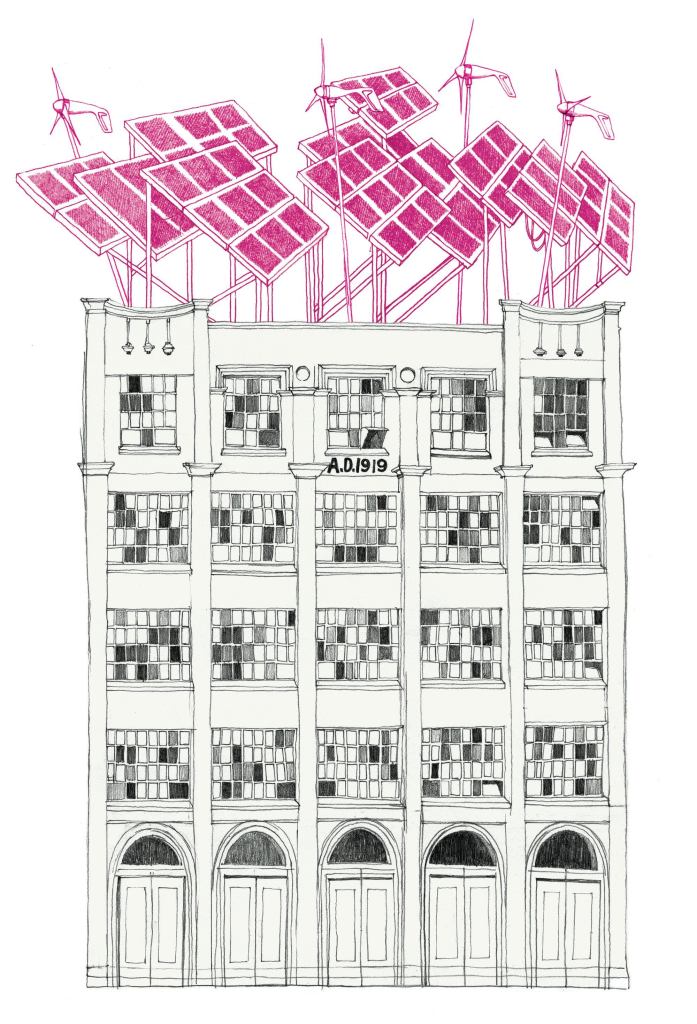
Sometime in the next few months, Richard Moe will retire as president of the National Trust for Historic Preservation, a job he has held since 1993. Moe, who is 72, announced his retirement in the fall but said he would wait for the group to name his successor. When he does depart, he will leave behind an organization, and a movement, that has completely transformed in the 17 years since he arrived in the captain’s quarters from a career in politics and the law.
A couple of big milestones helped to define Moe’s years at the National Trust. In the mid-1990s, he led the group to stop taking a large chunk of its annual budget from Congress; at the time, that was worth about $7 million, but, he said, the purse had too many political strings attached. The trust began raising funds in new ways, and since then, its yearly budget has nearly doubled, to $55 million, and its endowment has soared to around $200 million, up from $33 million. And in a fight that gained national headlines in the mid-1990s, the trust beat back an attempt by the Walt Disney Co. to build a theme park near Civil War battlefields in Virginia.
Other achievements have been slower and steadier. Observers credit Moe with taking preservation to the people by funneling money and encouragement toward state, regional, and local preservation groups, and building a solid network of activist affiliates in preservation. The National Trust’s mission changed not by drifting from its core imperatives of saving great old buildings, but by expanding what that core might plausibly include.
Gradually, preservation has grown from a relic-focused connoisseur’s concern to a multifaceted populist movement dedicated to preserving more ineffable forms of history and threatened ways of life. Its daily work now bleeds into a number of disparate fields where common causes are to be found, such as community development (a shift that began as early as the 1960s), environmental protection, public health, land conservation, and cultural heritage. It was never called merely the National Trust for Saving Historic Architecture, after all.
“The trust has tried really hard to connect preservation back to other dynamics in society without alienating its core constituency,” says Randall F. Mason, chairman of the graduate program in historic preservation at the University of Pennsylvania. “The more preservation engages with the other big, urgent questions in society and the built environment, the better.”
Mason believes that one reason Moe’s tenure has been so successful is that Moe came not from preservation, but from politics—that is, “some other energy center.” In a recent interview with ARCHITECT, Moe confessed that when he landed at the National Trust, “I knew nothing. I didn’t spend a day in preservation.” (He was, however, a history buff and had written a book on Civil War soliders.)
As for Moe’s successor, at press time, no names of candidates had been credibly leaked. But with the transition at the trust likely to happen before the end of spring, now is an interesting time to outline what kind of realities define the organization as it moves into the next decade. Most of them are so intertwined, however, that it is hard to consider them on their own.
Saving older, denser neighborhoods by opposing sprawl.
An endless mission, so far as anyone can see. The fight against the Disney park was aimed in large part at protecting sensitive battlefield sites, but it also helped to cement the group’s role in discouraging relentless expansion of subdivisions into the undeveloped edges of metropolitan areas. For the National Trust, fighting suburban sprawl has at least two major motives behind it: It helps prevent the further withering of older, denser city centers, and it helps reduce carbon emissions that may contribute to climate change. The trust’s Main Street Center, now at work in more than 1,600 cities and towns, began as a pilot in the late 1970s to try new approaches to revitalizing older business districts, some of which had been left for dead by interstates, malls, and industry abandonment. Success stories include the Federal Hill neighborhood of Baltimore, which has recaptured business lost to the city’s Inner Harbor development: organizers claim 270 net jobs created, 84 new businesses, and a vacancy rate of 4 percent, down from 20 percent. Likewise, Emporia, Kan., counts $40 million in new investment in its downtown, about $33 for every Main Street dollar spent.For the National Trust, the key was to take not just a building preservation angle but to look at land-use practices in a broader context. “You can revitalize and rehab buildings, and do marketing events out the wazoo,” says Kennedy Smith, a preservation and planning consultant in Arlington, Va., who ran the Main Street program for 13 years until 2004. “But if a community isn’t changing its planning and land use, it really doesn’t matter.”
The trust’s work for older districts and against sprawl takes numerous angles. Royce Yeater, the director of the group’s Midwest office, is helping to direct a campaign called Helping Johnny Walk to School, which encourages municipalities to renovate older school buildings and to plan new schools in the centers of communities, rather than at their edges. The grant-making program helps retain existing schools; promotes closely knit neighborhoods and physical activity among kids; and also helps fight sprawl.
“Once you get into it, it’s amazing how unified these issues become,” Yeater says. “We’re solving multiple problems at once.”
Promoting building reuse as a means of fighting climate change.
People who work in preservation like to say that reusing an existing or historic building is inherently more sustainable than building from scratch, regardless of whether demolition is involved. There is a lot of frustration, however, about the importance accorded to preservation in the dominant third-party sustainability rating system, the U.S. Green Building Council’s (USGBC) LEED certification. In interviews, a number of preservation professionals lamented that for most of LEED’s existence, reusing an extant structure got a project one point toward its final score, the same amount given, many observed, for using recycled carpets. Barbara Campagna, a staff architect for the National Trust who oversees its historic sites, has been working for the past three years with the USGBC. She notes that the newest version of LEED raises the possible points for retaining a structure to four, and there’s another gain for historic buildings under the category Sustainable Sites, which can be worth up to six points. For now, that’s about as good as it gets because there are a number of problems to work out.“One of the basic issues is that there is very little data on existing buildings” and the environmental impacts they show over time, Campagna says. “There is a lot of data on new buildings in the past 10 years. So while preservationists go around saying, ‘Our buildings are the greenest,’ there is no data to support it.”
Arguments in existing buildings’ favor are largely anecdotal—and LEED is a science-based rating system. The trust hopes to use lifecycle assessments of existing buildings to determine their long-term impacts. Most of a building’s environmental effects occur during its operation and maintenance, not during construction; so the first challenge is to figure out what impacts can be measured empirically, such as resource use and carbon emissions. There are other challenges, such as whether to measure “squishy” factors (e.g., Is there a psychological benefit to living in historic surroundings?).
Once a consensus can form around ways to measure preservation’s environmental impacts, then the trick will be coming up with defensible data that may—or may not—show preservation’s inherent benefits for the planet.