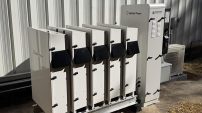
Scandinavian furniture giant IKEA has partnered up with solar panel manufacturer Solarcentury in order to provide its customers with solar panels and home battery storage in its stores across the U.K. The panels and battery package have the capacity to collect and retain 80 percent of the solar power it has gathered throughout the day. In contrast, an average solar-powered home only consumes about 40 percent of the power it generates, while the remaining 60 percent is sold back into the electrical grid for a fraction of the cost, resulting in a loss for homeowners. The solar power packages are currently being sold for about $3,970. [The Verge]
Futuristic startup Hyperloop One reported that on July 28, their Hyperloop test pod successfully completed nearly the full length of the 500-meter (1,640-foot) test track in Nevada, reaching a top speed of 192 mph. In an earlier mid-July test run, the pod achieved a top speed of 70 mph, and was only able to travel 315 feet. The magnet-based transportation system still has a long way to go before reaching the masses, but this milestone signifies consistent progress for the technology. [Business Insider]
A team of researchers at the École Polytechnique Fédérale de Lausanne (EPFL) in Lausanne, Switzerland, have developed a robot that can detect sources of water contamination without endangering marine life. Envirobot, a modular robotic eel that measures approximately 5 feet in length, utilizes its chemical, physical, and biological sensors to analyze water samples, and remotely transmit data to a computer. The robot can define its route autonomously or be programmed to follow a predetermined path. Its modular design allows for easy assembly, and the electric motors incorporated into each of its components help with its smooth movement in water. To date, the team has only used Envirobot’s chemical and physical sensors to detect the water’s conductivity and temperature in Lake Geneva—where the robot is frequently tested—by using salt as a contamination simulator. “We obviously can’t contaminate a lake like we do the test water in our lab,” says project coordinator Jan Roelof van der Meer. “For now, we will continue using salt as the contaminant until the robot can easily find the source of the contamination.” The team hopes that by the end of this summer, the robot will be able to detect heavy metal pollutants such as mercury by using bacteria, crustaceans, and fish cells as biological sensors. [EPFL]
French company Ciel & Terre—producers of floating solar panels equipped with the company’s proprietary Hydrelio technology—is developing a large floating solar panel for the Balbina Dam on the Uatumã River in Brazil’s Amazon rainforest, set to be “the size of five football fields and … 4.9 megawatts overall when complete,” according to a Fast Company article. The Balbina is a hydroelectric dam and power station that has been a controversial subject of environmental debates since its construction in the late 1980s, due to the irreversible impact it has had on the country’s rain forest and its indigenous communities. Additionally, “because of decomposing plant matter in the lake, Balbina may emit enough methane that its climate profile is no better than a coal plant,” explains Ben Schiller for Fast Company. “With too little water to run its five giant turbines, it operates at a fifth of its 250-megawatt capacity.” Despite the controversy, Ciel & Terre thinks that the dam presents an opportunity to take advantage of solar energy, as the panels can provide energy at peak hours, and reduce water evaporation. The company claims that these panels are UV and corrosion resistant, can withstand extreme windy climates, are easy to assemble and maintain, and are compliant with drinking water. According to Ciel & Terre, industries such as fish farms, mining companies, waste-water treatment plants, and water agencies can also benefit from the same technology. [Fast Company]
A team of researchers from Rice University in Houston succeeded in turning wood into an electrical conductor by blackening the surface with a laser, which resulted in a layor of graphene.“ It’s a union of the archaic with the newest nanomaterial into a single composite structure,” Rice chemist James Tour said in a press release. In an oxygen-free environment, the laser did not burn pine samples—deemed best for the experiment because of their cross-linked lignocellulose microstructure—but instead created “wrinkled flakes of graphene foam bound to the wood surface,” called laser-induced graphene. This effect was previously achieved using plastic as a base material, but wood provides a more sustainable and abundant alternative. The researchers believe the material could be applied to solar cell innovations as well as biodegradable electronics. [Rice News]
Researchers at Penn State University in University Park, Pa., have created a new energy-storing composite material for flexible electronics and electric vehicle applications. The team sandwiched high-performance polymers between hexagonal boron nitride films to create a soft, ultra-thin material that can store energy at operating temperatures more than 392 F. (Current commercial polymers lose efficiency at 176 F.) “This is the first robust experiment in which a soft polymeric material and a hard 2D crystalline material have come together to create a functional dielectric device,” said assistant professor of materials science and engineering Nasim Alem. [Penn State News]
Alla Sheffer, a computer science professor at the University of British Columbia, in collaboration with Washington University in St. Louis and Adobe Research, has created a program called FlowRep—a software that can create design sketches of objects using an algorithm. Sheffer’s research comes from previous algorithms she developed, which were inspired by Gestalt psychology—a movement in experimental psychology that explores how humans understand visual content and depth in two dimensions. The algorithm works best with manmade shapes, but Sheffer hopes to build on the technology and enable it to produce accurate sketches of natural shapes as well. FlowRep was debuted yesterday at SIGGRAPH 2017, the largest computer graphics and interactive techniques conference in the world. [UBC News]