In the acclaimed 1962 novel The Woman in the Dunes (Vintage, 1991), an amateur scientist takes shelter in a house constantly threatened by encroaching sand. In this haunting story, author Kobo Abe employs sand as a metaphor for humanity’s loss of control over the environment.
In recent years, our relationship with sand has taken an unexpected turn: instead of it threatening our existence, the material itself has become threatened. In the article “The End of Sand: Confronting One of the Greatest Environmental Challenges of the New Millennium,” Northeastern University researchers David Wesley and Sheila Puffer address the ecological threat posed by the global annual mining of 15 billion tons of sand. According to the authors, “sand is a finite resource and the depletion of alluvial sand used in construction is destroying the ecosystem of riverbeds, sea beds, and coastal beaches, and is contributing seriously to climate change.” This significant shift parallels the evolution of many architects’ missions from one of creating buildings that endure within their environments to one where we must emphasize the longevity of the environment itself.
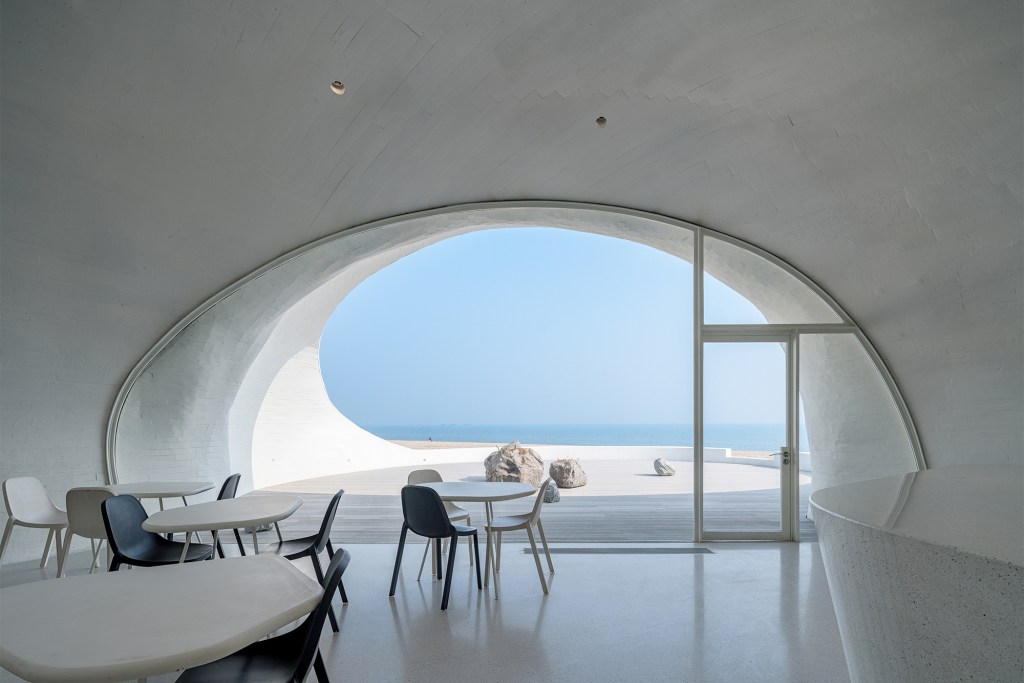
Such an aspiration motivated architects Li Hu and Huang Wenjing, AIA, principals of Beijing-based Open Architecture, in their design of the UCCA Dune Art Museum. Completed last year along the coast of Northern China, the 3,000-square-foot structure is buried within an existing line of dunes, which rise several meters above sea level. I recently had the opportunity to visit the museum, which the architects claim was inspired children digging sand—a process that “creates a series of interconnected, organically shaped spaces which, enveloped by sand, resemble caves—the primeval home of man, whose walls were once a canvas for some of humanity’s earliest works of art,” they explain. The strategy to embed the building within the dune ecosystem enabled its preservation, which is especially critical given its location within a fast-developing resort community of multistory condominium towers.
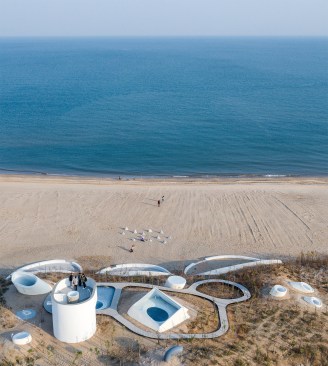
Photo by Qingshan Wu
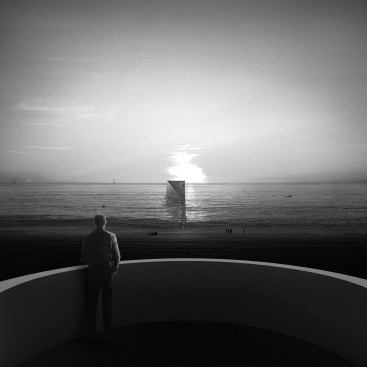
Hired by the independent Ullens Center for Contemporary Art (UCCA), Open Architecture was given the opportunity to decide the museum’s exact location along the Bohai Bay shoreline. According to Li, the firm’s first site visit inspired the idea to situate the building within dunes in a particular way. “A building [should] not be simply ‘placed’ on any site, as often done,” he says. “But rather, it needs to establish a special relationship—a deep dialogue, in this case—to a special place.” The Dune Art Museum is the first phase of a two-part commission, the second of which will be the Sea Art Museum, a counterpart structure to be located in the water. Resembling a monolithic, occupiable staircase descending into the bay, this future edifice will be connected to the Dune Art Museum by a long walkway. “The museum in the dune and museum in the sea are conceptually born together and work together to form a complete whole,” Li says. Construction on the Sea Art Museum will begin next year.
Open Architecture
Sea Art Museum rendering
Practically speaking, building the Dune Art Museum necessitated the destruction of the section of dunes it occupies. However, once the structure was completed, the architect and contractor made painstaking efforts to restore the original topography and planting of the dunes. The sand displaced by the new building remained on-site, either added to the beachside as a grading improvement or returned to the top of the structure after construction to restore the original ecology of the dune. A vegetation expert supervised this restoration process, bringing local plants from neighboring dunes and nearby farms. Today, the foliage appears to be growing successfully, although the architect admits that such a restoration effort is inherently experimental.
Regarding environmental performance, the Dune Art Museum’s design features several benefits. The layer of sand and plants comprising the roof serve as an effective insulating layer. The indoor climate is further regulated by the exposed cast-in-place concrete structure that provides advantageous thermal mass; a deeply recessed glass façade that is inherently protected from heat gain; and a ground-source heat pump that utilizes the site’s underground water flow to moderate interior temperature, eliminating the need for a site-disruptive cooling tower. Additionally, natural light enters most of the museum’s galleries via skylights, thus reducing the energy required for electric lighting. These skylights represent a fundamental design feature of the museum, as their formal and orientational variety imparts a specific atmospheric character to each space they illuminate.
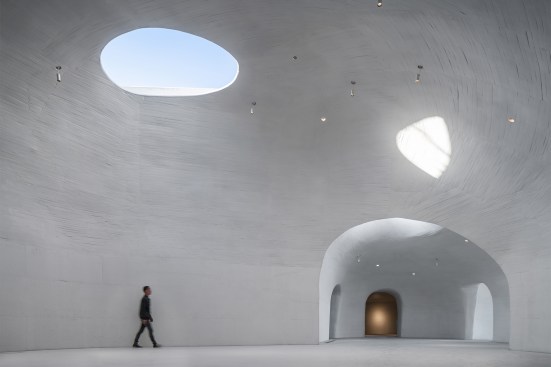
Photo by Qingshan Wu
Materially, the Dune Art Museum’s exposed concrete is palpably rugged. During the design phase, Open Architecture explored many formwork approaches with the structural consultant, including ice, sand, steel frame, and shotcrete technology. In the end, the general contractor decided on conventional wood formwork, particularly since much of the labor force consisted of local boatbuilders. At first, the architects were not eager to embrace the particular aesthetic of board-formed concrete. However, they were pleasantly surprised by the outcome, as the interior volumes’ complex sculptural geometries required a heterogeneous and idiosyncratic combination of localized formwork strategies, which they decided to express. “The result of the formwork is not perfect in any sense,” Li says. “But it is beautiful because it is truly authentic creation, and in a way, it even records the struggles that the builders [endured] to construct these difficult forms.” Although local dune sand was not used in the concrete mix for technical reasons, the museum’s raw, aggregate-filled surfaces provide a material connection between the building and its immediate environment.
Ultimately, the Dune Art Museum’s most significant environmental contribution may not be the result of any specific strategy used in the building itself, but rather the influence the project is likely to have on the broader public. The museum’s site is located within the Aranya resort, an exclusive, gated community targeting affluent vacationers. Given the neighborhood’s inaccessibility to much of Chinese society, the ecologically harmful construction practices of its prior shoreline developments have remained largely outside public scrutiny. Yet the Dune Art Museum, which is operated by an independent institution, is open to anyone able to pay a small entry fee. “UCCA’s reputation and the quality of exhibitions draw visitors from Beijing and other surrounding cities, much like the journey of an art pilgrim,” Li says. “Whoever can afford the museum’s modest priced admission can visit this museum within the Aranya complex, and in this way, the museum makes the complex more open to the public.” In attracting an outsized population of art and ecology enthusiasts, the Dune Art Museum’s thoughtful and adept design is likely to serve as an example for many future projects in this region and beyond.