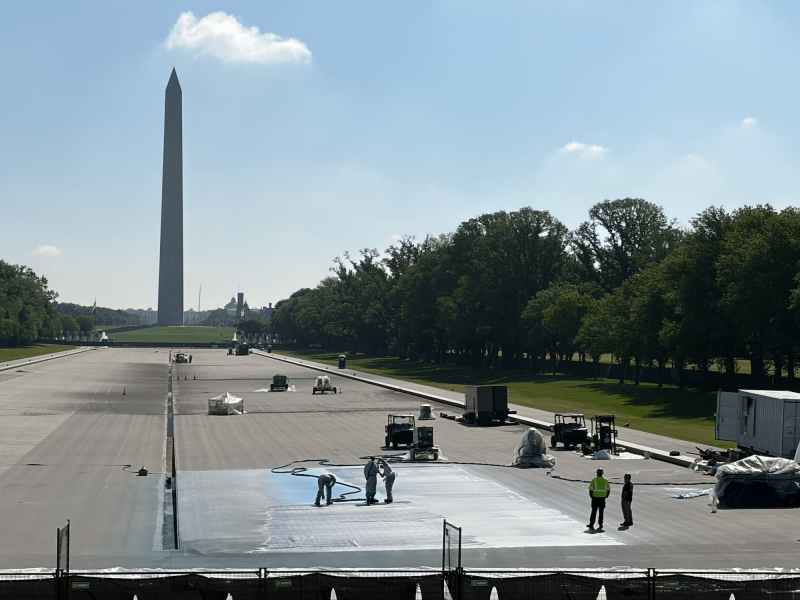
One of the most recognizable and symbolically charged landscapes in the United States has become the center of an escalating legal and cultural battle in Washington, D.C.
The Cultural Landscape Foundation (TCLF), the influential nonprofit advocacy organization dedicated to protecting historic landscapes, has filed a lawsuit against the U.S. Department of the Interior over the controversial repainting of the Reflecting Pool on the National Mall. At the center of the dispute is a deceptively simple but visually dramatic alteration: the application of blue paint to the basin of the century-old Reflecting Pool stretching between the Lincoln Memorial and the Washington Monument.
To critics, the move is not merely cosmetic. It represents a fundamental transformation of one of the nation’s most sacred civic spaces—and, TCLF argues, a violation of federal preservation law.
Filed on May 11 in federal court and represented by the Washington Litigation Group, the lawsuit seeks a temporary restraining order and preliminary injunction to halt the work immediately. The complaint alleges that the National Park Service, which manages the Reflecting Pool as part of the Department of the Interior, failed to conduct legally required historic preservation reviews before altering what TCLF describes as a “character-defining feature” of the landmarked site.
The Reflecting Pool, completed in 1924 as part of Henry Bacon’s design for the Lincoln Memorial grounds, has long functioned less as an object and more as an atmospheric device—a subdued horizontal plane designed to amplify reflection, symmetry, and solemnity. Its muted gray-black basin was intentionally conceived to deepen visual reflections and reinforce the monumental axis connecting Lincoln and the Washington Monument.
According to a 1999 National Park Service Cultural Landscape Report cited in the lawsuit, the basin historically consisted “of an asphalt coated membrane, slate, and concrete tile. The dark color of the tile created the illusion of greater depth and a more profound reflection.”
For preservationists, that detail is not incidental. It is central to the design intent.
“The Reflecting Pool should not be viewed in isolation; it is part of the larger ensemble of designed landscapes that comprise the National Mall,” said Charles A. Birnbaum, TCLF’s President and CEO. “The design intent, to create a reflective surface that is subordinate, is fundamental to the solemn and hallowed visual and spatial connection between the Washington Monument and the Lincoln Memorial.”
Birnbaum did not mince words about the implications of the redesign.
“A blue-tinted basin is more appropriate to a resort or theme park,” he added.
The case immediately raises larger questions about how historic civic landscapes are managed in an era increasingly defined by spectacle, branding, and visual optimization. The National Mall has always operated as a symbolic landscape—part memorial, part stage set, part democratic commons. But critics of the project argue that altering the visual language of the Reflecting Pool risks aestheticizing one of America’s most solemn public spaces into something closer to entertainment architecture.
For landscape architects and preservationists, the controversy also touches a deeper professional anxiety: the erosion of process.
Because the National Mall is listed on the National Register of Historic Places, significant alterations typically require review under Section 106 of the National Historic Preservation Act of 1966. That process is designed to ensure that changes to historic sites are evaluated for their impact on cultural and architectural integrity. TCLF argues that no such review occurred before work began.
The lawsuit notes that previous interventions involving the Reflecting Pool, Lincoln Memorial grounds, and adjacent National Mall landscapes were all subject to Section 106 review as well as oversight by the U.S. Commission of Fine Arts.
The absence of those reviews, TCLF argues, is not procedural trivia—it is the central issue.
Birnbaum, notably, is not merely an outside critic. Before founding TCLF in 1998, he spent fifteen years at the National Park Service as Coordinator of the Historic Landscape Initiative. During that tenure, he authored The Secretary of the Interior’s Standards for the Treatment of Historic Properties with Guidelines for the Treatment of Cultural Landscapes (1996), one of the foundational documents shaping preservation review practices nationwide.
That history gives the lawsuit unusual weight inside preservation and landscape architecture circles. This is not simply advocacy rhetoric; it is a direct challenge from one of the field’s most influential preservation figures against the federal agency where he once helped define policy.
“We are grateful to the Washington Litigation Group, and especially Alexander Kristofcak, Counsel, and Joseph Mead, Senior Counsel, for taking on this case,” Birnbaum said. “The National Mall and other treasured examples of our nation’s shared patrimony are safeguarded by the rule of law, which we believe should be enforced.”
The timing of the lawsuit is also significant. Washington’s monumental core is entering a period of renewed ideological and architectural contestation. TCLF is currently involved as a consulting party in multiple Section 106 reviews involving high-profile federal landscapes, including the White House Visitor Center, Lafayette Park, and Pennsylvania Avenue. The organization has also requested consulting-party status for proposed interventions including the National Garden of American Heroes, a proposed triumphal arch, and a new golf course at East Potomac Park.
In that context, the Reflecting Pool dispute may be less an isolated preservation skirmish than an early flashpoint in a broader battle over the future visual identity of America’s civic landscape.
Founded only last year, the Washington Litigation Group—the nonprofit boutique law firm representing TCLF—has positioned itself as a defender against government overreach and a guardian of institutional accountability. Its involvement signals that the case may evolve beyond design criticism into a larger constitutional and procedural debate about federal authority and preservation law.
Meanwhile, the visual transformation itself has already triggered intense reaction among architects, landscape architects, preservationists, and Washington observers online, many of whom see the Reflecting Pool as one of the few remaining examples of restraint within the increasingly image-driven culture of public space design.
At stake is more than a paint color.
The Reflecting Pool has long operated as a spatial instrument of reflection in both the literal and civic sense—a quiet void amplifying memory, protest, mourning, ceremony, and national identity. From Marian Anderson’s 1939 performance to Martin Luther King Jr.’s “I Have a Dream” speech, its power has always derived from its ability to disappear visually while intensifying collective experience.