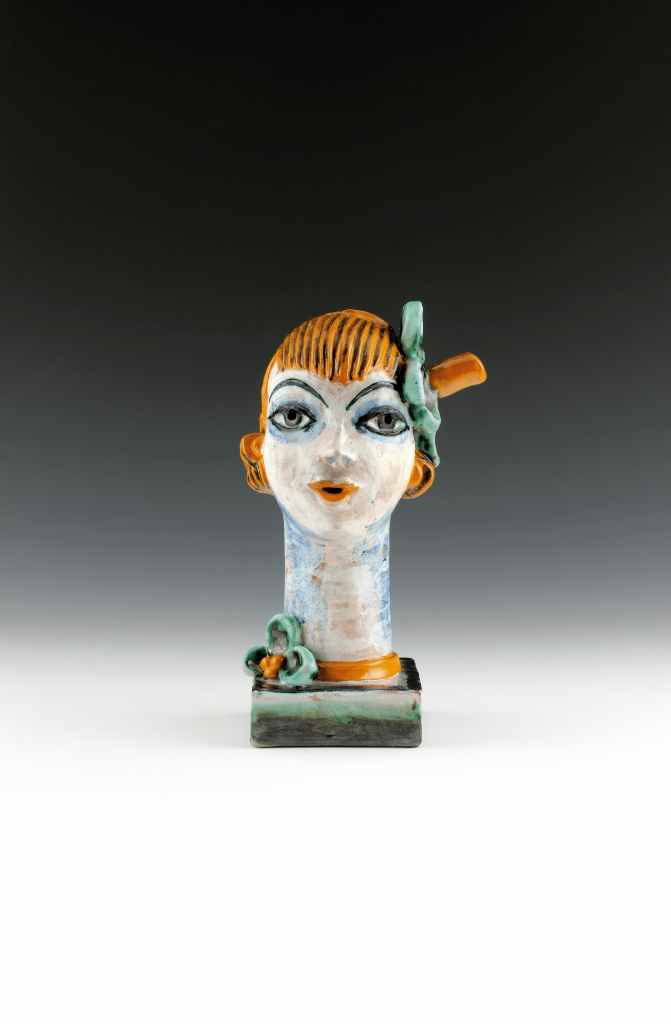
Modernism has often told a story about subtraction.
It has favored the stripped-down object, the heroic male architect, the clean line, the industrial future, the liberation of design from ornament. But in early 20th-century Vienna, another version of modernity was taking shape—one made from textiles, ceramics, fashion, graphic design, interiors, social networks, and opulent surfaces. It was modernity not as austerity, but as atmosphere. Not as rejection of decoration, but as its radical reinvention.
This summer, the Jewish Museum in New York is placing that alternative history at the center of the story.
Opening July 17 and on view through November 15, 2026, Modernity and Opulence: Women of the Wiener Werkstätte brings together more than 200 objects by some 30 Jewish women artists connected to the Wiener Werkstätte, the influential Viennese design collective active from 1903 to 1932. Presented in cooperation with the MAK–Museum of Applied Arts, Vienna, the exhibition argues that women were not peripheral to the Werkstätte’s development. They were central to its artistic production, its commercial success, and its public image.
The show focuses in particular on Jewish women—artists, designers, patrons, clients, and cultural intermediaries—whose roles have long been underrecognized in histories of modern design.
“Modernity and Opulence: Women of the Wiener Werkstätte brings together art, design, fashion, and Jewish history to illuminate the central role Jewish women played in shaping modernity, both as visionary makers and as influential patrons,” said James S. Snyder, Helen Goldsmith Menschel Director of the Jewish Museum. “Building on the Museum’s long-standing history of presenting design exhibitions that challenge traditional art-historical narratives, this exhibition reflects our commitment to foregrounding Jewish artistic traditions in ways that resonate across world cultures.”
Modernism Was Never as Minimal as We Pretended
Founded by architect Josef Hoffmann, artist Koloman Moser, and industrialist and collector Fritz Waerndorfer, the Wiener Werkstätte was conceived as both a multidisciplinary collective and a commercial enterprise. Its ambition was sweeping: to dissolve the boundary between art and life through the idea of the gesamtkunstwerk, or total work of art.
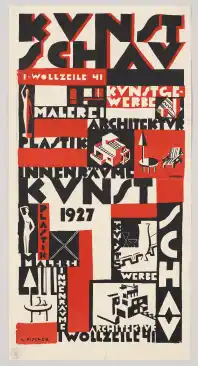
Alice Fischer and Mea Angerer, Poster for Kunstschau 1927, 1927. Lithograph on paper. MAK – Museum of Applied Arts, Vienna, PI 33. Photo: MAK / Christian Mendez
Furniture, textiles, ceramics, jewelry, fashion, glassware, stationery, and interiors were all understood as part of a larger aesthetic universe. The Werkstätte did not merely produce objects. It produced a way of living.
That project emerged from the Vienna Secession, the progressive art movement formed in 1897 by figures including Gustav Klimt, Hoffmann, Moser, Wilhelm List, and Joseph Maria Olbrich. Meeting in the salon of journalist and socialite Berta Zuckerkandl, the Secessionists rejected the conservative art establishment under the motto “to every age its art, to art its freedom.”
The Wiener Werkstätte extended those ideas into daily life. It absorbed lessons from the international Arts and Crafts movement and promoted the belief that revived artisan production and intentional design could help modernize society.
Yet the story of the Werkstätte has often been told through its male founders and its famous affiliations. The Jewish Museum’s exhibition shifts attention toward the women who entered the enterprise through education, workshop labor, commercial design, patronage, and social influence.
“The Wiener Werkstätte is often celebrated for its role in shaping conceptions of modernism, yet these discourses have presented a complicated relationship to gender, craft, and ornamentation, which has, in turn, neglected a more complete picture of the Werkstätte’s output,” said Kristina Parsons, Leon Levy Assistant Curator. “In bringing together highlights from the remarkable body of work made by Jewish women for the Werkstätte, this exhibition spotlights their creativity, ambition, and influence, while inviting visitors to explore a group of artists who embraced decoration as a central expression of modernity.”
The Workshop Became a Door Women Could Open
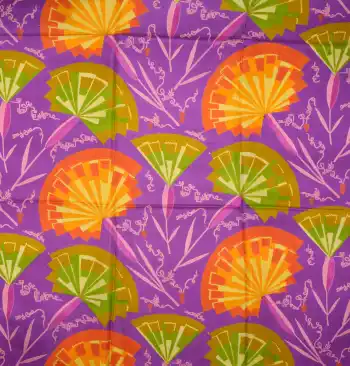
Felice Rix-Ueno, Purpurnelke (textile sample), August 1924. Printed plainweave silk. MAK – Museum of Applied Arts, Vienna. Donation, 1955, WWS 595. Photo: MAK / Branislav Djordjevic
For women in Vienna at the turn of the century, artistic opportunity was shaped by exclusion. Women were not admitted to fine arts academies until the 1920s. The applied arts, however, were considered more socially acceptable because of their perceived proximity to domestic life.
That distinction created an opening.
At the Kunstgewerbeschule, or School of Applied Arts, Hoffmann and Moser taught many women who later became essential to the Wiener Werkstätte. Their training in textiles, ceramics, graphics, fashion, and decorative arts gave them access to a professional design world that the fine arts establishment had largely denied them.
The Künstler-Werkstätte, or Artists’ Workshops, founded within the Wiener Werkstätte in 1916, became especially important. It served as an experimental studio and a professional pipeline for women artists, while also helping the organization address labor shortages during World War I.
The atmosphere was one of access, experimentation, and unusual freedom. The artist Vally Wieselthier later recalled in her memoirs: “We had a huge studio, each of us got a key, and we had all the workshops imaginable at our disposal. We also had the best-trained foremen and workers, and all the time and materials we desired. We simply did as we pleased, and whenever the Wiener Werkstätte sold one of our products, the lucky winner always threw a big party.”
That sense of license mattered. It allowed women artists to move beyond surface decoration into more expressive and experimental work. The objects they produced were not secondary embellishments to architecture or painting. They were part of the Werkstätte’s larger claim that modern life itself could be designed.
The “New Woman” Designed Herself
The exhibition also places the Wiener Werkstätte within a period of rapid social change. In early 20th-century Vienna, women occupied a paradoxical position. The city was a center of avant-garde art and design, but its cultural reforms often excluded women from full participation.
World War I accelerated social transformation. With the collapse of Austria-Hungary and the establishment of the Austrian First Republic, Viennese women gained the right to vote in 1918. Education, economic independence, and professional opportunity became central concerns for middle-class women seeking specialized training as artists, designers, and teachers.
The figure of the “new woman” emerged from this context: confident, autonomous, professionally ambitious, and publicly visible. Popular culture caricatured her as a short-haired decorative artist who smoked cigarettes and dressed fashionably. The stereotype was meant to trivialize women’s independence. But artists of the Wiener Werkstätte turned such imagery into a language of self-possession.
Fashion became one of the clearest vehicles for this transformation.
The Werkstätte’s textile department was founded in 1910, followed by its fashion department in 1911, thanks to the Jewish artist Marianne Zels, who held the dressmaking certification required to register the business. The textile operation became one of the organization’s most prolific and financially significant branches. By some estimates, more than 500 new patterns were designed and released between 1910 and 1917 alone.
The fashion department created a rare opportunity for women to design for women. Its reform dresses rejected tight-laced corsets in favor of looser, freer silhouettes. Clothing became a declaration of modern values: bodily freedom, artistic individuality, and social mobility.
For the Werkstätte’s clients and artists alike, dress was not merely decorative. It was ideological.
Vally Wieselthier Turned Clay Into Theater
Among the exhibition’s central figures is Vally Wieselthier, who joined the Wiener Werkstätte in 1917 and became one of its most prominent artists. Trained at the Kunstgewerbeschule, she pursued an artistic career with unusual determination. Her father supported her ambitions and, defying convention, did not pressure her to marry.
Wieselthier is best known for ceramics that are humorous, theatrical, sensual, and strange. Her work resists the idea that modernism must be cool, restrained, or impersonal. Figures bend, gesture, pose, and perform. Ornament becomes animated.
From 1922 to 1927, she ran an independent ceramics workshop, later selling it to the Wiener Werkstätte and becoming head of its ceramics department. Her creative range extended well beyond clay. She designed glass vessels, children’s toys, advertising posters, textiles, and fashion accessories.
She was also one of the few Wiener Werkstätte artists to achieve significant success abroad. After her work appeared in a major ceramics exhibition at the Metropolitan Museum of Art in 1928, Wieselthier came to New York and built a career in the United States. She joined the modernist design association Contempora with Paul Poiret and others, designed department store window displays, created relief murals, and produced increasingly ambitious ceramic sculpture.
Her career complicates the usual geography of European modernism. Vienna was not the endpoint. For Wieselthier, it was the beginning of a transatlantic design life.
Felice Rix-Ueno Made Pattern Into a Global Language
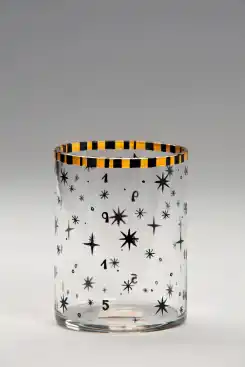
Decorative design: Felice Rix-Ueno, Form design: Josef Hoffmann, Manufacturer: Johann Oertel & Co., Nový Bor / Haida, Kriegsglas beaker, 1915. Mold-blown glass, enamel, paint. MAK – Museum of Applied Arts. Vienna. GL 273
If Wieselthier expanded the possibilities of ceramics, Felice Rix—later Felice Rix-Ueno—did the same for surface, pattern, and textile design.
Over her many years with the Wiener Werkstätte, Rix produced hundreds of designs, including more than 100 for fabric alone. Her earliest work adorned patriotic glassware designed by Hoffmann, but she soon moved into toys, tableware, window displays, fashion accessories, posters, wallpaper, pillows, and textiles.
Her work is playful but rigorous, abstract but emotionally alive. Motifs, colors, and patterns move between whimsy and discipline.
After marrying Japanese architect Isaburo Ueno, a colleague in Josef Hoffmann’s studio, in 1925, Rix relocated to Japan. Their Star Bar, completed in 1931, was featured in MoMA’s landmark Modern Architecture: International Exhibition the following year. But although Rix designed the bar’s interiors, the museum credited the project solely to Isaburo—a telling example of how women’s contributions to modernism were often overlooked.
The move to Japan shaped her later work, though Japanese artistic traditions had already influenced her aesthetic imagination. From abroad, she continued to create designs for the Wiener Werkstätte until 1930.
Her family’s commitment to artistic independence was striking. Her sisters Edith, Gertrude Ilse, and Kitty also pursued creative paths. Kitty Rix worked for the Wiener Werkstätte primarily in ceramics, producing playful works that often incorporated animal and human figures.
Through Rix-Ueno, the exhibition also expands the story of the Werkstätte beyond Vienna, showing how modern design traveled, transformed, and absorbed cross-cultural influences.
Patrons Were Not Passive
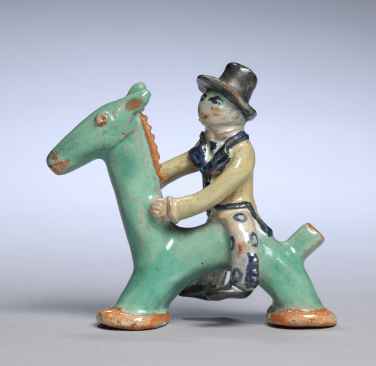
Kitty Rix, Boy on a Horse, c. 1920s. Hand- modeled ceramic, glazed. Cleveland Museum of Art. Educational Purchase Fund, 1929.681.
The exhibition’s most important argument may be that patronage itself was a creative act.
Jewish women played a vital role in the success of the Wiener Werkstätte not only by making work but also by commissioning, wearing, using, displaying, and promoting it. These women included Adele Bloch-Bauer, Berta Zuckerkandl, Broncia Koller-Pinell, Friederike Maria Beer-Monti, and Magda Mautner von Markhof.
They commissioned furniture and interiors. They wore Werkstätte fashions and jewelry. They used its stationery. They turned its objects into instruments of self-fashioning.
A drawing of Bloch-Bauer by Gustav Klimt from the Jewish Museum’s collection anchors this world of overlapping artistic and social circles. So does a portrait of Broncia Koller-Pinell, one of the few women artists affiliated with Klimt’s Kunstschau group, depicted wearing a reform-style dress and Werkstätte necklace.
These patrons did more than consume modern design. They staged it. They gave it visibility, legitimacy, and social currency. They helped make the avant-garde desirable.
Friederike Maria Beer-Monti, a socialite and patron, famously styled herself as a “walking advertisement for the Wiener Werkstätte.” The phrase captures the porous boundary between body, fashion, interior, and public persona. To live with Werkstätte design was to perform modernity.
Vienna Went to Hollywood
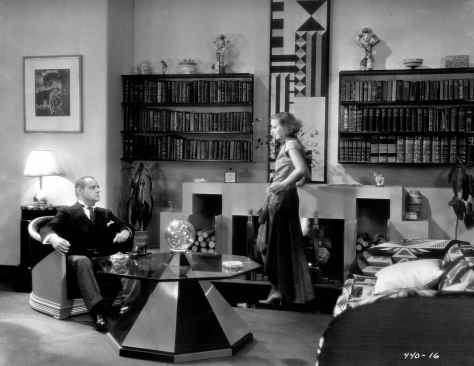
Still from The Kiss, 1929, directed by Jacques Feyder. Shown from left: Anders Randolph, Greta Garbo. Courtesy MGM / Photofest. © MGM
Although rooted in Vienna, the Wiener Werkstätte had international ambitions from early on. It opened or attempted to open branches in Berlin, Karlsbad, Marienbad, Zurich, and New York. The Jewish architect Joseph Urban, who had immigrated to the United States from Vienna in 1911, supported the creation of the New York outpost, which opened in autumn 1922 and sold Werkstätte products along with work by Klimt and Egon Schiele.
The Werkstätte also participated regularly in European trade exhibitions. Its most famous appearance came at the 1925 Exposition Internationale des Arts Décoratifs et Industriels Modernes in Paris, the event that helped give Art Deco its name. Hoffmann designed Austria’s national pavilion and filled it with Werkstätte textiles, glassware, ceramics, and other objects by artists including Lotte Calm, Mizi Friedmann, Felice Rix, and Vally Wieselthier. Several women won awards, including Rix, who received a bronze medal.
The exhibition also traces the Werkstätte’s unlikely relationship with Hollywood. Films such as The Kiss from 1929, starring Greta Garbo; Five and Ten from 1931, starring Marion Davies; and Enemies of Women from 1923 featured Werkstätte ceramics. The objects migrated from salons and showrooms into cinematic fantasies of glamour.
By then, the Werkstätte’s aesthetic had become more than a Viennese design language. It was an image of modern sophistication.
The Glamour Could Not Save the Enterprise
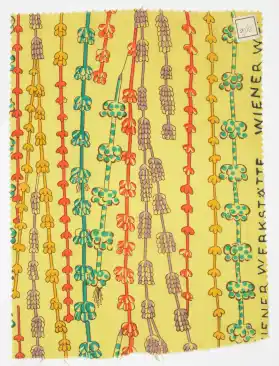
Felice Rix-Ueno, Tarantella, 1929. Printed plain- weave silk. MAK – Museum of Applied Arts, Vienna. Donation, 1955, WWS 758. Photo © MAK/Branislav Djordjevic
Despite its artistic influence and international visibility, the Wiener Werkstätte was financially fragile. Its commitment to handcrafted production, expensive materials, and total design made it culturally powerful but economically precarious.
After World War I, Vienna entered a new political and economic reality. The collapse of the Austro-Hungarian Empire made the realization of large-scale total works of art increasingly difficult. Individual objects—ceramics, textiles, fashion, stationery, and accessories—became the more viable means through which the Werkstätte continued its project of aestheticizing modern life.
The 1929 stock market crash and the economic fallout that followed further weakened the enterprise and its patron base. After nearly 30 years, the Wiener Werkstätte closed in 1932.
But its legacy endured, not only in the history of design but in the unresolved questions it left behind. Who gets credited with modernism? Which mediums count as serious? Why has ornament so often been feminized and then dismissed? What happens when the decorative arts are understood not as secondary, but as central to cultural change?
Ornament Was the Revolution
Modernity and Opulence arrives at a moment when museums are increasingly reconsidering the margins of canonical modernism. In this case, the margins turn out to be a fiction. Women were not incidental to the Wiener Werkstätte. Jewish women, in particular, helped shape its production, market, social networks, and aesthetic identity.
The exhibition does not simply add women into an existing story. It changes the story.
It suggests that modernism was never only about machines, manifestos, and white walls. It was also about embroidered surfaces, ceramic bodies, printed textiles, reform dresses, decorated stationery, fashionable salons, and patrons who understood that taste could be a form of power.
The women of the Wiener Werkstätte did not reject ornament to become modern. They used ornament to make modernity visible.
And more than a century later, that may be the most radical lesson of all.