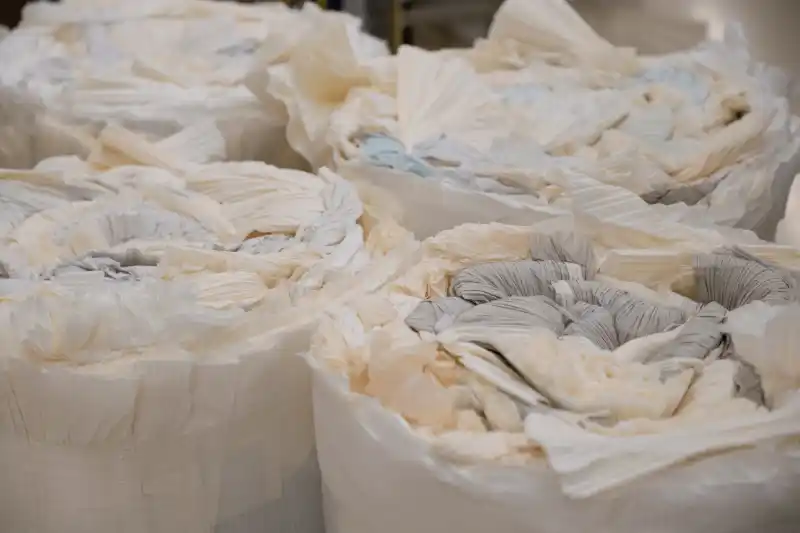
The most intriguing new material in Issey Miyake’s design laboratory was not invented. It was already there, sitting on the factory floor.
For decades, the house’s distinctive pleating process has relied on wafer-thin sheets of paper that sandwich garments as they pass through pleating machines. The paper protects the fabric and helps translate pressure into the permanent folds that have become one of the most recognizable signatures in contemporary fashion. Once its job is finished, however, the paper is removed, compressed into dense cylindrical rolls and prepared for disposal or recycling.
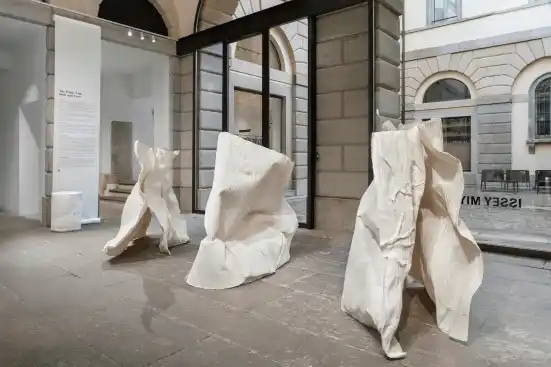
Paper log Shell on display at ISSEY MIYAKE / Milan. Courtesy Issey Miyake.
Issey Miyake calls those rolls “Paper Logs.” And now the company is asking a deceptively simple question: What if they are not waste at all?
That question drives The Paper Log: Shell and Core, an experimental collaboration between MIYAKE DESIGN STUDIO and the Spanish architecture practice Ensamble Studio, which opened this week at the 21_21 DESIGN SIGHT Gallery 3 in Tokyo. On view through September 13, the exhibition brings to Japan a site-specific iteration of a project first presented during Milan Design Week, transforming a residue of fashion manufacturing into objects that hover between furniture, sculpture and architecture.
At a moment when nearly every design industry is talking about circularity, reuse and material efficiency, the project offers a more provocative proposition. Instead of asking simply how a discarded material might be recycled, Paper Log asks whether it might contain qualities its original makers had never intended to exploit.
“The Paper Log project is about finding value by looking at what was considered secondary or peripheral through new perspectives. By presenting the research and development we have done, we hope to inspire further interest and discussions from different creative disciplines. Through this project—reappropriating the byproduct of the pleating process—we aim to create something beyond recycling, for the ease and poetry of everyday life, as Miyake intended when he first created PLEATS PLEASE ISSEY MIYAKE,” says Satoshi Kondo, design director at MIYAKE DESIGN STUDIO.
A Waste Product That Looks Like a Tree
The Paper Log is an unexpectedly evocative object even before anybody begins designing with it.
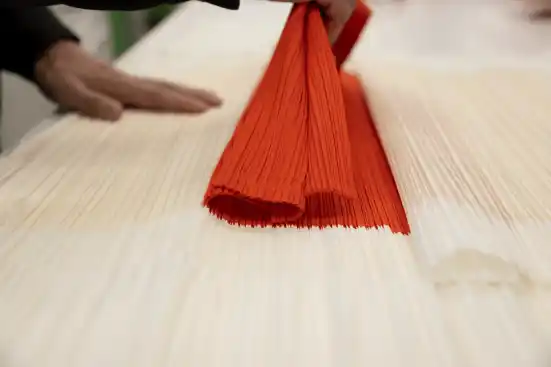
Removing a farment from the sheets after pleating.
After the pleating paper is removed from a garment, its extremely thin sheets are compressed into rolls for transportation and recycling. Seen in section, the accumulated layers create circular patterns resembling the growth rings of a tree, which gave the material its name.
The resemblance is more than visual. Like timber, the Paper Log can be cut, carved and sawn. But unlike a conventional log, it can also be peeled apart and unrolled back into sheets.
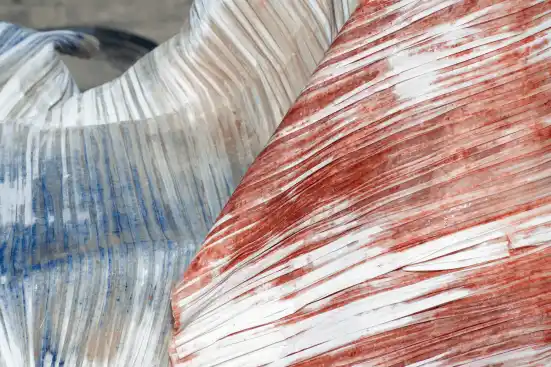
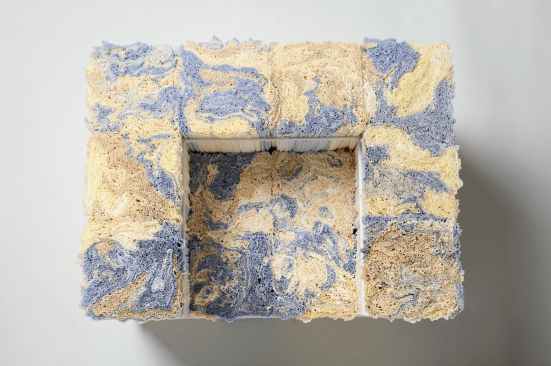
Closeup of Shell, colored and crystallized.
It is absorbent, too. Wax, glue, pigments, hardening agents and other treatments can radically alter its structural and tactile characteristics. Something that begins as fragile paper can become dense, rigid or almost mineral-like.
There is another crucial difference between this material and an ordinary industrial leftover: the paper has already been designed by another process.
It has been compressed, folded and pleated while performing its original function. The waste therefore contains a physical record of the garment that created it.
In that sense, the Paper Log is not merely recycled material. It is an archive.
From Pleated Garments to Furniture
Kondo was among the first to recognize that potential.
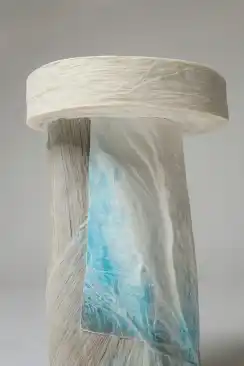
Paper log Core.
He began by cutting the compressed logs crosswise to create stools. The resulting objects were subsequently used as seating and as part of the installation for the ISSEY MIYAKE Spring Summer 2025 show in Paris.
What could easily have remained a clever exercise in reuse instead became the beginning of a broader investigation.
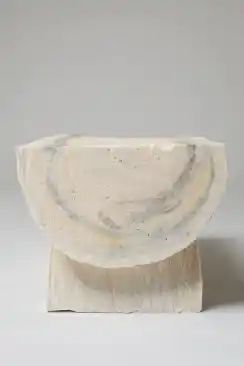
Paper Log Core.
As the MIYAKE DESIGN STUDIO team experimented with the material, Kondo invited Ensamble Studio to join the project. Founded in 2000 and led by Antón García-Abril and Débora Mesa, the architecture practice has built its reputation around treating materials and construction processes as generators of architecture rather than merely tools for executing a predetermined form.
That approach made the studio an unusually compatible partner for Miyake.
Fashion and architecture work at radically different scales, but both practices share an interest in discovering form through making. Rather than forcing the Paper Log to imitate an existing material, the collaborators began by testing what it already wanted—or was able—to do.
The resulting exhibition is divided conceptually into two bodies of work: Shell and Core.
Shell: When Paper Remembers
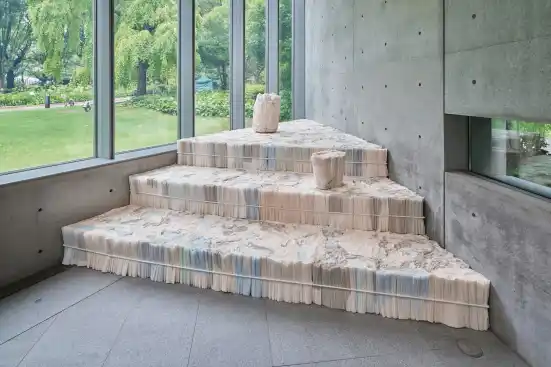
Paper Log at 21_21 Design Sight Gallery 3.
Ensamble Studio’s contribution, Shell, begins by reversing the Paper Log’s compression.
Sheets are peeled away from the rolls and used to envelop existing objects or form new volumes. Hardening agents then crystallize the paper, preserving its pleats, wrinkles and creases.
The resulting pieces are described as “objects of memory.”
That phrase gets to the heart of the experiment. The paper has already spent part of its existence pressed against clothing. Instead of erasing that history, Ensamble Studio treats those traces as useful information.
“Material retains memory,” the architects write in their concept statement.
“The paper used in the pleating process of ISSEY MIYAKE garments carries the trace of pressure, rhythm, and form. Though typically discarded, it is not exhausted, and remains materially valuable: light, translucent, and structurally trained through folding. And remembers what it has been.”
That idea creates a compelling connection between fashion and architecture. Clothing forms a kind of temporary architecture around the body; walls and shells create larger envelopes around bodies in space. Both manipulate distance, volume, structure and skin.
“This project begins by listening to that memory. We explore the material’s capacity to hold shape, to create volume, and to exist between softness and structure. From ISSEY MIYAKE’s approach to clothing, we learn how garments act as spatial layers—outer skins that do not simply cover the body but create distance, air, and autonomy between fabric and flesh.”
In Shell, the pleated paper effectively becomes another skin. Once treated, its apparently temporary folds become permanent.
“The pleated paper becomes a second skin, wrapping familiar forms and allowing them to acquire a new presence. Through hardening agents, the paper is fixed—petrified—so that its folds endure. What was temporary becomes lasting.”
Core: Building With the Log Itself
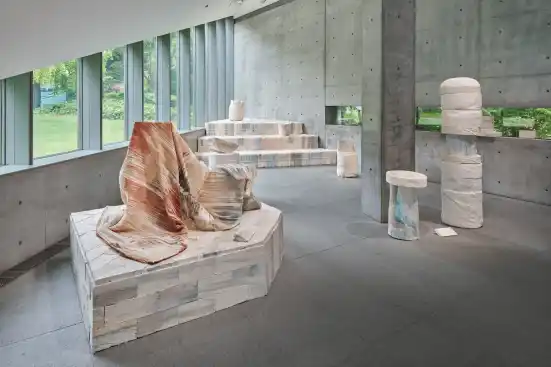
Paper Log at 21_21 Design Sight Gallery 3.
If Shell expands the Paper Log outward, Core concentrates on what happens when the compressed cylinder itself becomes a construction material.
Developed by the ISSEY MIYAKE project team, Core includes furniture prototypes such as stools, chairs and tables. The designers subject the logs to different treatments—soaking them in wax, painting them with glue and binding them into bundles—to investigate how their density, strength and surface can change.
The distinction between the two approaches is deliberately sharp.
Shell is thin, translucent and delicate. Core is compressed, substantial and robust. One treats the material almost as fabric; the other approaches it more like lumber or masonry.
Placed together, they expose a remarkable range of possibilities contained within the same waste stream.
The Tokyo installation emphasizes those oppositions, pairing the ephemeral with the concrete and the delicate with the heavy. A documentary accompanying the exhibition reveals the experiments and conversations behind the objects, making the process of discovery part of the work itself.
That emphasis is important. Paper Log is less a finished collection than an ongoing material investigation.
Beyond Recycling
Paper Log Core chair.
The collaboration also complicates the familiar language of sustainable design.
Recycling generally begins with the assumption that waste must be broken down so that its constituent material can reenter production. Paper is pulped. Metal is melted. Plastic is processed. The original object—and often the evidence of its former use—disappears.
Paper Log proposes almost the opposite.
Its previous life is precisely what gives the material its character.
The pressure of the pleating machine, the repetition of folds and even the compression required for disposal have already altered it. Rather than returning the paper to an anonymous raw state, the designers retain those transformations and build upon them.
As Ensamble Studio explains, “The material carries traces of its previous life as formwork for clothing while adapting to a new body, scale, and function. Memory is not erased but transformed. Value emerges through continuity, giving rise to works that exist between fashion and architecture, softness and permanence, past and future.”
That makes Paper Log particularly relevant to a broader debate within architecture and design. The environmental challenge facing designers is no longer simply how to specify “sustainable” materials. Increasingly, it is how to recognize value in the enormous quantities of material already circulating through buildings, factories, products and supply chains.
What designers call waste is often simply material whose next use has not yet been imagined.
When Fashion Meets Architecture
The collaboration between Miyake and Ensamble Studio is also notable because neither discipline is asked to disappear into the other.
Rather than architects designing a fashion object or fashion designers making a miniature building, the two teams worked in parallel, bringing different methods to the same material.
“The collaboration with Issey Miyake emerged from an initial conversation and a shared provocation: how can a material already shaped by design be allowed a second life without losing its intelligence?” Ensamble Studio writes.
“Rather than a linear transfer of knowledge, the project developed through parallel work. Each side approached the same material from its own discipline—fashion design and architecture—bringing distinct sensibilities, tools, and questions. Through moments of exchange, observation, and testing, the collaboration became a space for mutual learning and complementarity.”
Miyake’s decades of experimentation with pleating, layering and the relationship between fabric and the human body informed Ensamble Studio’s thinking about structure and spatial presence. Architecture, meanwhile, introduced techniques of stabilization, fixation and changes in scale.
The outcome occupies an intentionally ambiguous territory.
“At the intersection of design and architecture, the project operates as a form of art: not defined by discipline, but by process. It proposes a shared territory where material experimentation, memory, and transformation become the common language.”
The Material Was There All Along
There is something fitting about this experiment emerging from Issey Miyake.
Since founding MIYAKE DESIGN STUDIO in 1970, Miyake repeatedly challenged the assumption that fashion innovation begins with silhouette. His enduring idea of “a piece of cloth” shifted attention toward the relationship among material, manufacturing process and body. Pleating became not simply decoration but a technology capable of determining how clothing moved, stretched, collapsed and occupied space.
Paper Log takes that logic one step further.
The material that helped create the garment becomes a design subject in its own right.
What was once peripheral moves to the center. What was temporary becomes permanent. What was meant to be discarded becomes furniture, sculpture and potentially something that has not yet been invented.
That may ultimately be the most consequential idea inside The Paper Log: Shell and Core. Sustainable design is often framed as a search for new materials capable of replacing environmentally damaging ones. But perhaps some of the most useful materials of the future do not need to be invented at all.
They may already be accumulating around us, carrying the physical memory of everything we have already made.
The Paper Log: Shell and Core—An ISSEY MIYAKE project in collaboration with Ensamble Studio is on view until September 13, 2026, at 21_21 DESIGN SIGHT Gallery 3, Tokyo.