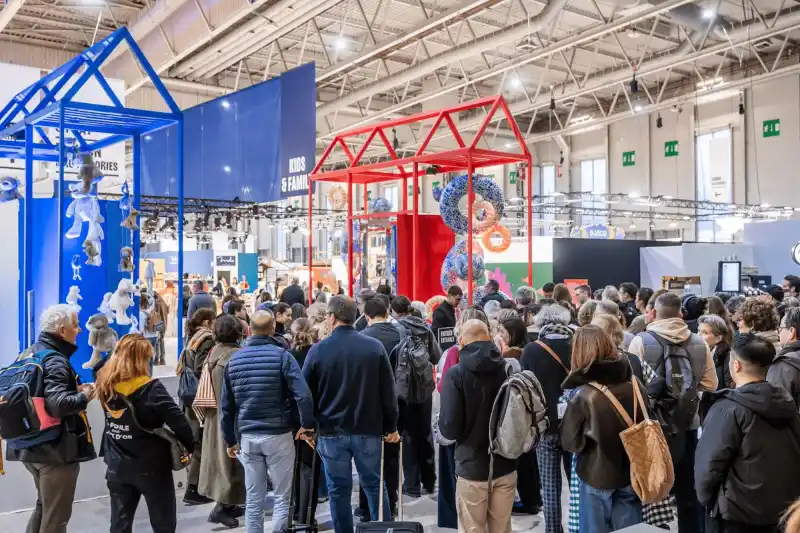
For decades, the design trade fair operated according to a relatively straightforward proposition: put furniture, lighting, textiles, accessories, and the people who buy them under one very large roof.
Maison&Objet’s September 2026 edition suggests that model is no longer enough.
When the fair returns to Paris Nord Villepinte from September 10 to 14, it will organize its sprawling marketplace around seven sectors—Cook & Share, Decor & Design, Fine Craft–métiers d’art, Wellness & Beauty, Fragrance & Ambiance, Fashion & Accessories, and Gift & Play—in an effort to make the fair easier to navigate while acknowledging how broadly the definition of interior design has expanded.
Under the title Maison&Objet Pulse, the fall edition positions design less as a collection of objects than as an ecosystem of experiences: what people eat, smell, wear, touch, give, collect, and increasingly expect from hotels, restaurants, stores, and homes.
That shift may be the most revealing thing about the fair.
Maison&Objet has long occupied the territory between a traditional furniture fair and a lifestyle marketplace. But the September program pushes further into categories that once might have seemed peripheral to the design profession. Fragrance becomes part of interior identity. Cosmetics and wellness become questions of hospitality. Food presentation becomes design. Pet accessories and collectible toys enter the same conversation as handmade rugs and limited-edition furniture.
The message is difficult to miss: interiors are no longer simply furnished. They are programmed.
The Table Becomes a Design Laboratory
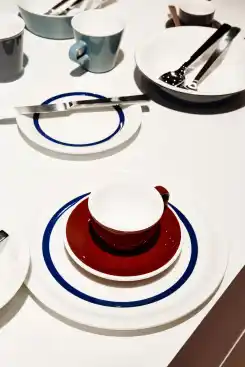
Cook & Share, Hall 4, Maison & Objet, Photo courtesy Elodie Dupuis.
Perhaps nowhere is that transformation clearer than in Cook & Share, which takes over Hall 4 as what organizers describe as a “show within the show.”
The sector covers everything from food preparation to tabletop, but Maison&Objet is pushing the category beyond product displays. Chefs will stage demonstrations with participating brands, installations will explore contemporary dining rituals, and French artist Sarah Espeute will bring her particular approach to embroidered table linens to the fair.
Espeute’s work—which often turns apparently ordinary tablecloths into playful, illusionistic compositions—fits neatly into the fair’s larger argument. The dining table is no longer merely a platform for plates and cutlery; it has become a stage for storytelling, craft, and social experience.
A conference program organized with La Filière France further reinforces the sector’s professional ambitions, bringing together organizations representing tableware, ceramics, cutlery, glass, porcelain, and household equipment.
For interior designers working in hospitality, the relevance is obvious. Restaurants increasingly compete not simply through menus but through a carefully orchestrated combination of materials, graphics, lighting, table settings, uniforms, sound, and presentation. Cook & Share reflects a market in which the boundaries between food culture and design culture are steadily disappearing.
Decoration Still Holds the Center
For all the expansion into lifestyle, Maison&Objet has not abandoned its traditional core.
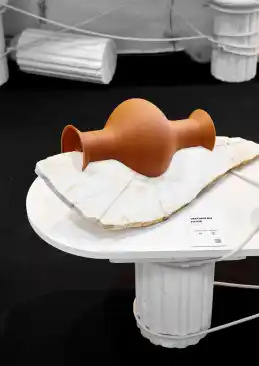
Design & Decor, Maison & Objet, Photo courtesy Julie Mallet.
Decor & Design remains the fair’s largest and most recognizable territory, spread across Halls 5A and 6. Within it, visitors will find furniture and decorative objects alongside increasingly specialized environments including Studio Signature, Rug Square, Home Linen, and Pattern Lab.
But the most closely watched area will likely be the Design District, Maison&Objet’s incubator for younger studios and experimental work.
Here the fair collects several of its talent-development initiatives—including Future On Stage and the Rising Talent Awards—alongside new materials research and smaller brands attempting to move from independent experimentation into commercial production.
This year’s Rising Talent Awards turn their attention to South Africa, highlighting seven emerging designers from the country. The choice follows a larger shift in the international design circuit, where attention has increasingly moved beyond the traditional European capitals toward creative communities in Africa, Latin America, the Middle East, and Asia.
Rather than presenting design history as a one-way flow outward from Milan, Paris, London, or Copenhagen, fairs are increasingly being forced to acknowledge a far more complicated geography of influence.
Craft Refuses to Disappear
That internationalism exists alongside another powerful movement within contemporary interiors: the renewed fascination with making.
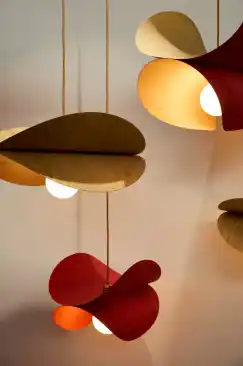
Morgane Binet Ebeniste, Hall 5A, FineCraft, Maison & Objet. Photo courtesy: Francis Amiand.
The Fine Craft–métiers d’art sector in Hall 5A focuses on limited-production and bespoke work, emphasizing makers whose practices depend on specialized skills rather than industrial scale.
At its center will be In Materia, an immersive installation conceived by trend forecaster and curator Elizabeth Leriche. The exhibition foregrounds materials and processes, with additional makers selected by Ateliers d’Art de France.
The prominence given to craft is hardly accidental.
After years in which digital visualization, rapid manufacturing, and globalized production promised increasingly frictionless design, the market has developed an equally strong appetite for the opposite: visible labor, irregularity, provenance, and objects that reveal how they were made.
The result is not a rejection of technology so much as a search for distinction in a world overflowing with products.
Now Your Interior Needs a Scent
Maison&Objet’s Fragrance & Ambiance sector makes another formerly invisible layer of interior design explicit.

Fragrance & Ambiance sectionm, Ladenac Milano, Hall 6, Maison et Objet, Photo courtesy Anne-Emmanuelle Thion.
Located in Hall 5A, the category treats home fragrance as what organizers call a “sensory language,” extending design beyond visual composition into olfactory identity.
Luxury hotels and retailers have understood this for years. Signature scents have become part of branding strategies intended to make spaces recognizable before visitors consciously identify what they are experiencing.
Maison&Objet now treats that practice as part of the mainstream interiors market.
The same expansion is visible in Wellness & Beauty, located in Hall 7, where cosmetics, personal-care products, workshops, and new retail concepts enter the fair’s orbit.
Wellness has become one of the most persistent forces reshaping hospitality and residential design. Bathrooms increasingly borrow from spas; gyms look like boutique hotels; hotels sell sleep programs; offices experiment with meditation spaces and biophilic environments. Maison&Objet’s new organization acknowledges that design clients are buying not simply products but rituals.
Fashion, Toys—and Pets
The loosening of traditional categories becomes even more conspicuous in Hall 7.
Fashion & Accessories mixes jewelry, textiles, and leather goods with the broader idea of lifestyle, while Gift & Play embraces the increasingly profitable territory of collectibles, novelty objects, and design-driven gifts.
Two subsections push that logic even further.
Kidult focuses on products that blur childhood nostalgia and adult collecting, reflecting the extraordinary commercial growth of toys, characters, and pop-culture objects marketed to grown-ups.
Pet Square, meanwhile, acknowledges another booming interiors category: products for animals designed to coexist with carefully considered homes.
Once hidden in utility closets and pet stores, bowls, beds, carriers, scratching posts, and feeding stations are now regularly treated as furniture.
It would be easy to dismiss such categories as lifestyle creep. But they reveal something fundamental about the contemporary design market: almost no object entering the home is exempt from aesthetic scrutiny anymore.
Retail Becomes Theater
Linking the seven sectors is What’s New? In Retail, designed by Pauline Glaizal, which examines changing approaches to shops and customer experience.
Its presence is particularly timely.
As online purchasing has made conventional transactional retail less necessary, physical stores have been forced to justify themselves as destinations. The most successful increasingly behave like galleries, clubs, restaurants, installations, or stages.
Maison&Objet’s emphasis on “sensory and narrative experiences” reflects that shift. Retail design is becoming less about putting merchandise on shelves than creating an environment memorable enough to persuade customers to show up at all.
That same principle increasingly applies across the fair.
Maison&Objet is still a place to source a chair, lamp, rug, plate, or vase. But its seven-sector strategy suggests that the industry it serves has grown much harder to compartmentalize.
A restaurant is design and food. A hotel is furniture and fragrance. A store is architecture and theater. A home may now incorporate spa rituals, collectible toys, bespoke ceramics, fashion accessories, and furniture designed for the dog.
Maison&Objet’s September edition may call itself Pulse.
What it is really measuring is the expanding heartbeat of the interior itself.