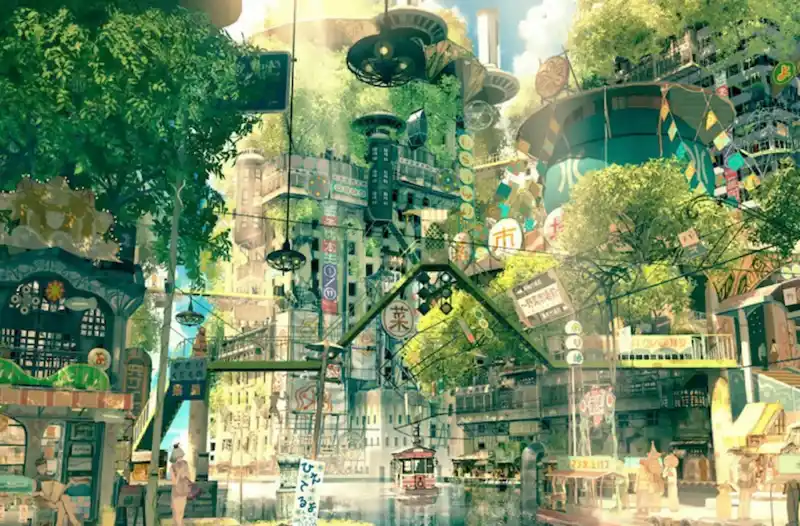
Cruising around my socials, I often come upon beguiling images of a green future where buildings are trees, landscape covers everything, and dirigibles hover in the sky. Of course, the future will never be what we imagine it today, but that has never stopped anyone, especially architects, from dreaming up utopias, dystopias, and everything in-between.
The theoretical or notional (one critic has coined the phrase “subjunctive imagery”) visions based on an extrapolation of what already exists, twisted and contorted to account for what current tendencies may produce have always been the most ones to me. These days they are easy to produce using AI programs that, after all, only know what already exists. In a time where we are facing imminent doom due to our destruction of our planet, making a harmonious future has never seemed easier.
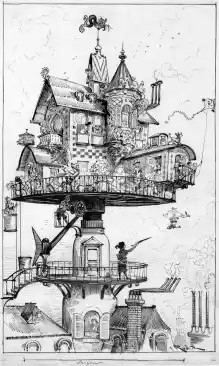
"Maison tournante aérienne" (aerial rotating house) by Albert Robida for his book Le Vingtième siècle. La vie électrique, a 19th-century conception of life in the 20th century. Wikipedia
The eco-futures that keep catching my eyes are versions of solarpunk. A version of –or antidote to– the steampunk images of what reality might have become if the industrial revolution had developed slight differently, solarpunk is, as one of its gurus, Yogi Hale Hendlin, says, “the edgy but sincere cultural movement joining technology with nature – reimagining technologies based on conceptions of science that coax rather than torture.”
It is the style, according to Hendlin, of “‘the “Symbiocene’: the era after the Anthropocene, in which human technologies take their cues from living systems and work in partnership rather than through dominance.” In solarpunk, buildings grow rather than being erected, agriculture and industry merge, as does structure and form, and a kind of New Jerusalem emerges in “England’s green and pleasant lands” and elsewhere.
The images can be compelling. Sunlight washes across terraces overflowing with vegetation; wind turbines turn above buildings whose curves suggest leaves, shells, or something halfway between a greenhouse and a cathedral; people bicycle, garden, and apparently have time to talk.
Somewhere, discreetly out of view, the sewage is being processed. Looking at these images, I find myself wanting to enter that world, even as I wonder who keeps all those plants alive and why the future so often looks like an expensive resort.
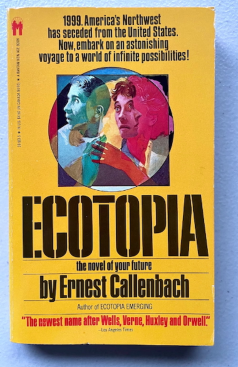
Ecotopia by Ernst Callenbach.
The look is cottage core gone sci-fi, but also rooted in the dreams of organic architecture exemplified by Frank Lloyd Wright’s Usonia and even more by the dreams of his semi-disciples Bruce Goff and Paolo Soleri, and developed into urban and even state visions in Northern Califonia by the likes of Ernst Callenbach (Ecotopia, 1975) and Christopher Alexander. It is also has appeared to us in movies, ranging from Black Panther’s Wakanda to the planet/head at the end of Guardians of the Galaxy II.
There is also some serious, or at least hopeful, theory here. Solarpunk’s manifestos reach beyond environmental decoration toward shared resources, inclusive communities, and technologies placed in the service of ecological balance. Architecture would make those relationships visible and pleasurable. That is an ambition worth taking seriously, especially when so much architectural production remains devoted to packaging consumption and managing security.
The problem for me is exactly in the alternate packaging. In much solarpunk imagery, nature supplies a catalogue of shapes. Towers swell like seedpods, roofs become petals, columns branch, windows ripple, and everything acquires the sinuous outlines of an Art Nouveau illustration. Cliches proliferate like the vines climbing up every available surface. Much of it is greenwashing as an architectural vision, and the idea that we can stay forever in a womb of endlessly repeated and badly composed curves makes me feel smothered.
I am especially wary of that assumption that curves carry ecological virtue. Contrary to an oft-repeated mantra, nature does produce straight edges, repetitive structures, awkward collisions, and considerable mess. It also creates decay. The smooth biomorphic envelopes edit all that out, presenting life as a continuous, reassuring surface. It gives us an image of belonging without requiring us to negotiate our actual dependencies. Solarpunk becomes another finish in your render library and can be selectively applied to satisfy an eco-conscious developer.
What interests me more is solarpunk’s capacity to make strange combinations seem desirable by working with the remains and ruins of what is already all around us. Solarpunk as a kluge is more believable than biophilia as utopia. Its kinship with steampunk matters more than is evident in most images.
The latter’s brass fittings, exposed gears, leather straps, and improbable engines turn machinery into a clunky piece of beauty that is never complete and never pure. Pieces salvaged from different worlds acquire new uses through assembly. There is something liberating about a machine whose joints remain legible, whose operation invites curiosity, and whose future appears open to tinkering. One illustrator, about whom I have written before, begins to combine both.
Both aesthetics promise the possibility of a more productive and revealing encounter between the organic and the mechanical. In some images a vine threads itself through a metal grille or a salvaged wheel drives a pump; what’s left of an old factory frame supports a greenhouse; the distressed surfaces of rusted galvanized metal or corroded concrete harmonize with dirt, rocks, and rammed earth. Looking at these pictures, you can imagine that nature and technology might become intertwined not because one mimics the other, but because they grow out of and adapt to each other
There are examples of this already around the world. A shopping mall I saw in Bangkok hosts a fish farm. Openings that had appeared in the roof through the decks admitted light and caused luxurious growth. In other places parking garages are hosting not only parties, but also urban farms.
At the edge of many cities, where factories or warehouses are not in use, plants appear and then sometimes, as in the Zollverein in Essen, Germany, a proto-Solarpunk of farms, urban entertainment, arts spaces and cultural facilities sprouts in and through the sheds, the stacks, and the coal ramps.
What is missing from this organically appearing Solarpunk is the social vision underlying the movement’s utopian tendencies. There are few shared workshops and accessible technologies and no collective stewardship to give the aesthetic consequences beyond tasteful amelioration. In our current social and economic system, solarpunk forms appear only where things fall apart and those forms are quickly appropriated to make money. It is exactly that lack of an ideal that makes real solarpunk so appealing and the imagined one too close to the elvish realm of Lord of the Rings.
I wish more solarpunk could let the concrete show and keep the clumsy junction between the old beam and the new solar canopy. I would like to see plants growing unevenly, and to see the tools and machinery that make it all work. There is more hope in an awkward structure being cared for than in a flawless tower pretending to be a tree.
Perhaps that might also mean more anarchy and less socialism, or more acceptance of a hybrid and not fully just social reality. If solarpunk can let us see that reality already taking root and winding its way around our too-slick and wasteful surfaces and forms, then it could help us envision how to build that better, if not perfect, world.