What I remember most of all is the sheer expanse. As a young man growing up in the Netherlands serious travel for me started and ended at Schiphol Airport, where I experienced an openness that once made the act of taking off seem as if it was part of a larger liberation in a way I soon found out few other airports offered.
There was a minimal theatricality to the glass, metal, and linoleum-lined place, marked by small moments: two steps down from customs clearance area to a long hall whose floor-to-ceiling glass gave views of the airplanes and the horizon; the same descent when you arrived back from your trip and into the baggage claim, where the prospect was of those waiting to greet you behind double-height panes of glass, so that for a moment you were on stage; in-between, the measured unfolding of perspectives and panoramas, the careful positioning of places to sit, and the sense of flow. The airport offered a stage on which we could imagine ourselves entering the modern world.
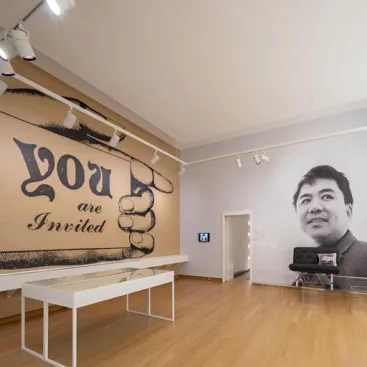
Installation view Kho Liang Ie – Mid-Century Modernist , 2026, Stedelijk Museum Amsterdam. Photo: Peter Tijhuis.
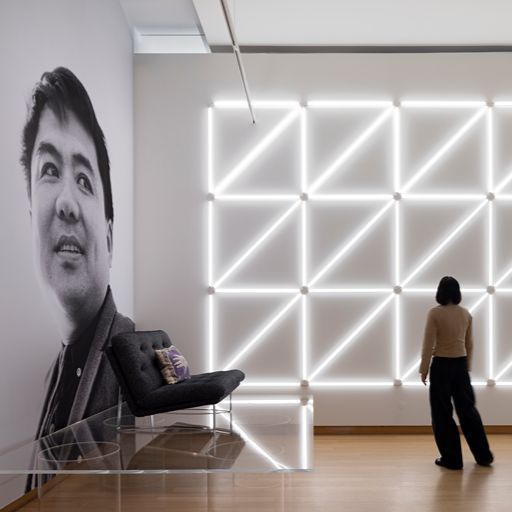
The man who was mostly responsible for that enscenement was someone who was long unknown beyond the country where he worked: Kho Liang Ie. Born in what was then the Dutch colony of Indonesia and educated in Amsterdam, he became a furniture and interior designer, sometimes and architect, and sometimes a graphic designer (often working with the estimable Wim Crouwel).
Above all else, he was a collaborator: with other designers specialized in different fields, and with manufacturers. He had no signature beyond reductive forms and expressed connections.
For those reasons and, no doubt, because of a bit of racism and a bias against those focusing on interiors, he did not gain the same amount of fame as many of his midcentury modern peers.
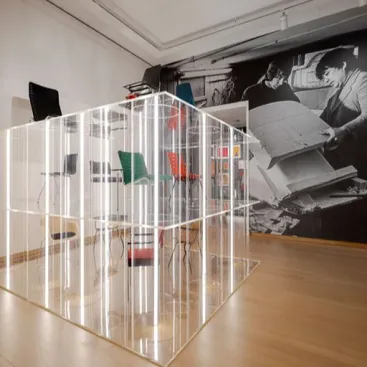
Installation view Kho Liang Ie – Mid-Century Modernist , 2026, Stedelijk Museum Amsterdam. Photo: Peter Tijhuis.
Now Amsterdam’s Stedelijk Museum’s retrospective, Kho Liang Ie—Mid-Century Modernist, has given a name to furniture that, when I saw it on the exhibit’s (a bit over the top) Plexiglas pedestals, made me realize that they had populated the living rooms of my parents’ wealthier, more tasteful friends, the chicer offices I saw, public spaces, and, of course, the acres of Schiphol that were so open until they were crammed full of the kind of retail establishments that have turned every transit hub into a crowded mall.
There was nothing particularly original about Kho’s work. It took principles developed at the Bauhaus and honed at Ulm, added the kind of functionalism inherent in Dutch esthetics, and gave it a modern gloss by using the synthetic materials and curved metal that became readily available in the 1960s.
There was none of the Eames’ or Eero Saarinen’s –let alone Verner Panton’s– daring swoops and curves, nor did the designer stretch proportions the way Florence Knoll might or highlight details in the manner of Carlo Scarpa.
Instead, what you got was proportions that were just right, but always generous, especially in their horizontal dimensions, attached with connections handled beautifully and displayed clearly, and environments that had a sense of natural and completely undefinable flow.
As such Kho was one of the best designers to bring a reductivist modernism into homes, offices, and public interiors without draining those places of life. His economy of means heightened the presence of simple materials.
A surface could establish a room’s character; a frame could make its construction legible; a seat could give the body a place within an otherwise abstract order. The pleasure came from proportion, texture, and the interval between things. Simplicity allowed you to notice more.
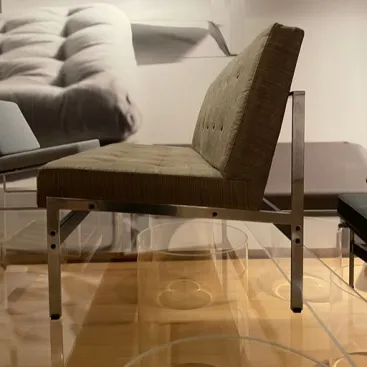
His connection with Goed Wonen (“Good Living”), the Dutch foundation promoting modern domestic furnishing, gave his efforts an explicitly reformist background. He used the position to argue for good design in everything and showed the way with his own work. His later position as design director at Artifort, a Dutch furniture manufacturer, expanded his reach further.
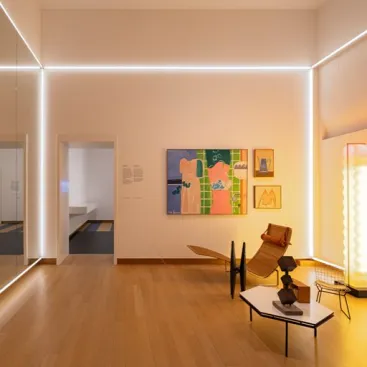
Installation view Kho Liang Ie – Mid-Century Modernist , 2026, Stedelijk Museum Amsterdam. Photo: Peter Tijhuis.
Like George Nelson at Herman Miller, he created furniture for the company while helping shape its aesthetic direction, contributing to a culture larger than his individual production. The retrospective’s attention to his international collaborations gives lie to the usual image of the solitary master. His achievement included recognizing possibilities in the work of others and creating settings in which those possibilities could flourish.
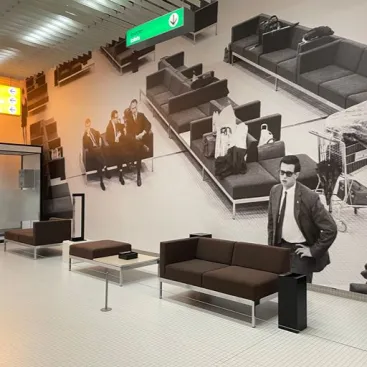
But his most visible impact was at Schiphol, which quickly grew into one of the largest airports in Europe. The original terminal, which opened in 1967, brought together architecture, interiors, graphics, and art in an environment intended to calm and orient travelers. Kho worked with Benno Wissing on its signage.
He coordinated and designed some of the seating, counters, and ceilings, emphasizing daylight, views of aircraft, and warm wood where people lingered, comfort when needed and, above all, that sense that you could keep moving forever
The aluminum ceiling system is particularly telling. Its repeated slats gathered lighting and signage into an overhead order whose appearance shifted as you moved. Here was an industrial material doing several jobs while producing a restrained spatial pleasure. It did not require a sculptural roof to announce the importance of flight.
Repetition, perspective, and light were enough. His approach reminds us how much architecture can happen within the thickness of a ceiling, below the level at which architectural history usually directs its gaze.
While the exhibition does show how good, if how restrained, a designer Kho was, it also falls into the trap inherent in such displays: the objects take center stage, the stage itself is gone, and we peer at the remains of a design that was in its essence ephemeral.
Those Plexiglas boxes help to make the objects float, but that is not enough, while piping in the sound of airport announcements in the Schiphol section only makes you realize what is missing.
The catalog makes up for much of what is lacking. I would like to think of the exhibition as an anchor for a revival of Kho Liang Ie’s work that is furthered by this volume.
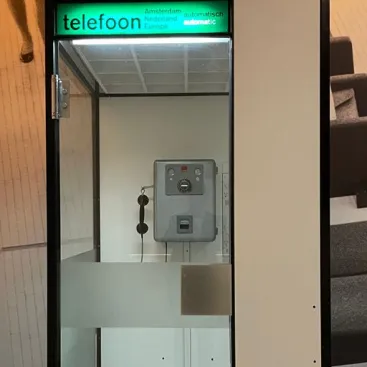
We cannot recover that world simply by reinstalling its furniture. Nor should we want to reproduce all its assumptions. But we should take seriously its belief that ordinary surroundings deserved intelligence, beauty, and care; that industrial production should serve shared pleasure; and that a public interior should offer dignity without demanding a purchase.
Kho Liang Ie gave those beliefs material form. As I worm my way through the crowded maze that Schiphol has become today and plunk myself down on one of its now mostly generic chairs I can only wish that not just these kind of places, but all public spaces might regain that sense of being an open stage on which we are free to perform together.