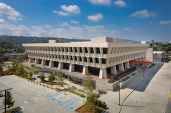
Few performance venues are asked to accommodate the Chicago Symphony Orchestra one night and a major pop act the next. For decades, that range has defined Ravinia—a historic outdoor music festival in Highland Park, Illinois, just north of Chicago—and it helped drive the just-completed transformation of its largest venue, the Hunter Pavilion.
The pavilion reopened partway through the 2026 summer season after two seasons of design and construction, then quickly began demonstrating its newfound flexibility. The Chicago Symphony Orchestra closed its 90th summer residency in mid-August with an all-Tchaikovsky program culminating in the 1812 Overture with cannons. Last week, Erykah Badu, De La Soul, and The Alchemist took over the same stage.
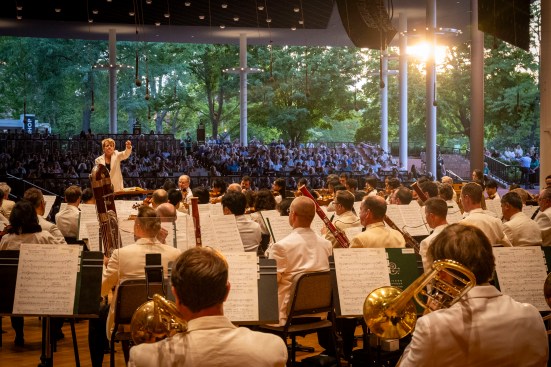
The Chicago Symphony Orchestra with Ravinia Chief Conductor Marin Alsop, performing Mahler at the renovated pavilion in July. Photo by Ravinia Festival/Kyle Dunleavy.
Accommodating that range was central to the redesign. Chicago-based Lohan Architecture, led by principal architect Michael Barnes, retained the pavilion’s recognizable roofline while creating a larger stage and a new acoustic shell that can transform for different types of performances. New seating, lighting, production infrastructure, accessibility improvements, and renovated backstage facilities complete the overhaul, part of a larger multiyear renewal of Ravinia’s 36-acre campus, which dates to 1904.
For Barnes, who has worked on projects at Ravinia for roughly two decades, the project involved what he describes as “two paths that needed to converge,” with technical and functional upgrades alongside architecture closely connected to the history and character of the park.
Jeffrey Haydon, Ravinia’s president and CEO, put the mandate simply: “When we walk in, we still need to feel like it’s Ravinia, but with all the bells and whistles and comforts of today.”
Preserving an Experience
“The building dates back to the 1950s and was added onto a couple times and renovated in between,” Barnes says. “So it needed a lot of functional, technical, and programmatic updates, because the kinds of performances that occur here now are very different than they were back in the ’50s when the building was built.”
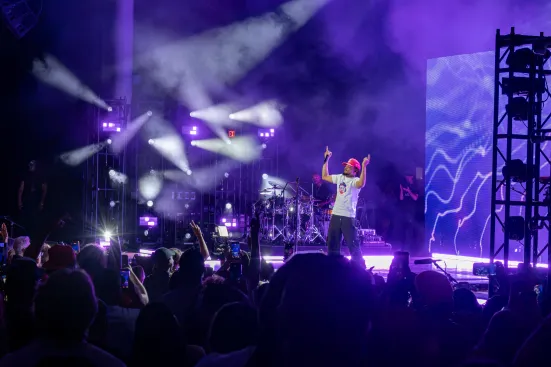
Chance the Rapper performing at Ravinia in August. Photo by Ravinia Festival/Ryan Duleavy.
Even as the pavilion required extensive changes, the familiar experience of the venue—its roofline, openness, lighting, and relationship to the surrounding lawn—remained important to generations of concertgoers. Barnes understood that attachment personally. His children grew up attending concerts at Ravinia.
“The feeling of arriving and being in the pavilion or being just outside if you’re watching and attending the concert on the lawn and picnicking … all of those things were characteristics that needed to be maintained,” Barnes says.
Inside, however, the transformation is extensive. Barnes says essentially everything visible except the columns is new. The stage extends seven feet farther into the audience, providing the depth needed for both large orchestral performances and contemporary touring productions. Wider, cushioned seats replace narrow seating that dated back decades, while raised wheelchair platforms improve sightlines even when other audience members stand.

The renovated Hunter Pavilion stage at Ravinia, designed by Lohan Architecture. Photo by Ravinia Festival/Dave Burk.
Some of the pavilion’s greatest limitations had been backstage. Spaces originally conceived for orchestras and groups of dancers had been divided into makeshift dressing rooms. Touring productions arrived with semitrucks full of equipment cases that could spill into corridors and mechanical rooms. AV crews worked from improvised spaces.
The design team excavated beneath seating near the stage to create storage and added additional space near an enlarged loading dock. Dedicated audio and video control rooms replace makeshift production areas.
“There are a lot of things that are beyond what you see in the house that got changed for the better,” Barnes says.
Architecture That Changes With the Music
The most visible expression of the renovation is the acoustic shell framing the stage. Its appearance reaches back to two earlier chapters of Ravinia’s architectural history.
“The geometric shapes that you see on stage with the walls and the ceiling—they’re all inspired by art glass windows that are in the Martin Theatre,” Barnes says, referring to the only performance structure remaining from Ravinia’s opening year. “That geometry and that Arts and Crafts-style window inspired the shapes that you now see on the walls and the ceiling of the stage.”
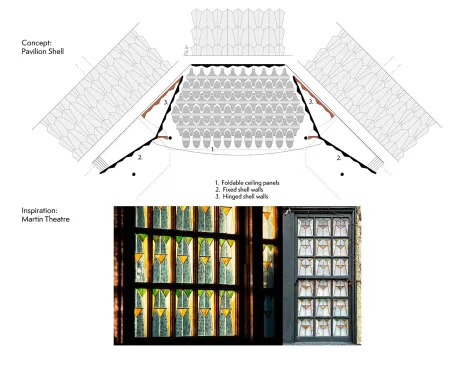
The Martin Theatre’s art glass windows that inspired the design of the acoustic shell.
The shell’s wood look reaches further back, referencing Ravinia’s original 1904 pavilion, which was constructed of wood and later destroyed by fire.
For orchestral performances, the sculptural walls and ceiling of that shell—made of steel tubing, urethane foam, exterior-grade plywood, and a vinyl architectural finish—direct and diffuse sound. For a rock or pop production, the architecture changes. Ceiling elements fold and rise into the overhead structure, and sidewalls mounted on large hinges swing out of the way.
The enlarged stage is part of that adaptability. In the past, large orchestral and choral performances often required temporary platforms extending into the audience, while contemporary touring acts tended to want more stage depth. Pushing the stage seven feet forward addressed both needs.
That kind of problem-solving required a large group of specialists. Barnes says roughly two dozen people representing nine firms participated in the design process, including acoustic, AV, theater-planning, and engineering consultants.
“I don’t pretend to know what they know,” Barnes says of the specialists. “My job was to lead the team from an aesthetic standpoint and to listen to them and understand what their needs were functionally and technically.”
Shaping the Sound
“The biggest challenge here was the available ceiling height,” says Scott Pfeiffer, a partner with Chicago-based Threshold Acoustics, the project’s acoustician. “Ravinia was committed to not making a bigger building out of the pavilion—to be cognizant of the neighborhood they’re in.”

The renovated Hunter Pavilion stage at Ravinia, designed by Lohan Architecture. Photo by Dave Burk
The consultants studied Ravinia alongside other venues, including Tanglewood in Massachusetts and the Aspen Music Tent in Colorado, then created a digital acoustic model of the existing stage. Measurements taken in the pavilion helped verify that the model behaved like the actual space before the team began digitally testing potential changes.
The technology also allowed the team and musicians to hear approximations of proposed designs rather than relying only on measurements and graphs.
“At the end of the day, it’s about an experience,” says John Strong, a principal with Threshold. “And if you can give people something approximating the experience, that’s a million times more valuable than the best graph you could ever put together.”
The shell design emerged through repeated exchanges between the architect and the acousticians. Barnes would propose geometries, and Pfeiffer and Strong would model how they affected reflection, diffusion, and loudness.
“[Barnes] would come with ideas and say, ‘How about this? What about this one? What if we did this?’” Pfeiffer recalls. “And we would say, ‘OK, well, this isn’t deep enough. This needs to be deeper. This needs to be more open.’”

Brandi Carlile performing at Ravinia in August. Photo by Ravinia Festival/Ryan Dunleavy.
The resulting sidewalls remain relatively smooth near the musicians. The goal, Strong says, was for musicians to hear sound reflected from the wall “as true as it would be as if you’re looking in a mirror without distortion.” Higher up, the walls become increasingly articulated to diffuse sound traveling greater distances and prevent those later reflections from becoming distinct echoes. Openings between the ceiling elements allow some sound to escape upward, while the solid surfaces return acoustic energy to the musicians below.
The real test came when the Chicago Symphony Orchestra moved in.
Ravinia Chief Conductor Marin Alsop met with the acoustics team before rehearsal to understand which elements could be adjusted. The orchestra played Mahler to test the pavilion with a large ensemble, then Beethoven to hear something more delicate. After Alsop heard areas where the volume was still concentrating too heavily, the team adjusted openings in the ceiling.
“It was fantastic,” Alsop says. “It made a big difference.”
The orchestra was also moved closer to the shell, and a soloist tried different locations to evaluate projection. Rather than using every possible combination of adjustable elements, Alsop sees the potential for a small number of repeatable configurations based on the music being performed.
“I think this is ideal,” she says. “At least in my opinion, maybe there are three options. It’s not like 17.”
For Alsop, excessive volume had been one of the pavilion’s fundamental acoustic shortcomings before the renovation. “Loud is great—I love loud,” she says. “But there’s a pain threshold that it can cross if the acoustic is too harsh. I think it’s really managed well now.”
Beyond the Stage
The renovation also addresses what happens before musicians ever step in front of an audience. The Negaunee Foundation Artist Center includes renovated dressing rooms and artist areas, two new warm-up rooms, production offices, expanded loading infrastructure, and broadcast facilities.
For Chicago Symphony Orchestra flutist and piccolo player Jennifer Gunn, those changes address conditions she knew intimately. During the orchestra’s six-week Ravinia residency, musicians can spend much of the day on campus between rehearsals and performances.
“We have a big break usually from rehearsal to concert, and I’d practice in the boiler room with the boiler kicking on and off,” Gunn says of the old facilities. “But now we have dedicated practice spaces that we can use.”
Gunn also participated in the acoustic testing process before construction and returned to a stage that looked—and sounded—markedly different.
“I walked on that stage and my breath was taken away by the beauty, not even knowing what it would sound like yet, but the beauty of the stage,” she says.
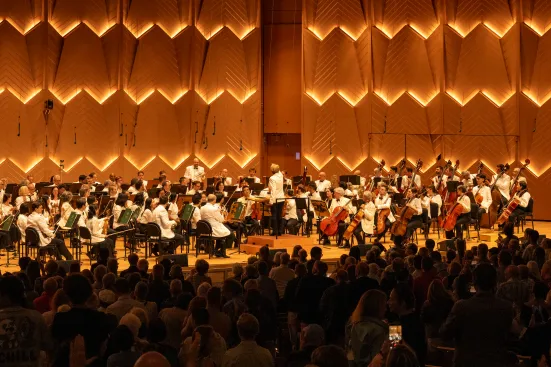
The Chicago Symphony Orchestra with Ravinia Chief Conductor Marin Alsop performing Mahler in July. Photo by Ravinia Festival/Kyle Dunleavy.
The previous environment, she recalls, could become “pretty deafening” when the full orchestra reached its loudest passages. During acoustic rehearsals in the new pavilion, she noticed something different from her position in the orchestra: Cellos and basses that had previously been difficult for her to hear were coming through more clearly.
“I just thought there was a complete balance of sound in a way that I don’t remember last year having,” Gunn says.
Alsop expects the acoustic fine-tuning to continue, particularly as the team explores ways to improve how musicians hear one another from the front to the back of the stage. She describes that process as “a longer term work in progress” and notes that the challenge is hardly unique to Ravinia.
“This is something that I could probably say about every single hall in the world,” Alsop says. “The musicians will say they have trouble hearing.”
Past Meets Future
Daniela O’Leary-Gill, chair of Ravinia’s Board of Trustees, points to a much smaller discovery made during the renovation. A chandelier dating to 1905 had remained covered and inoperable for years above Gate 4 until Ravinia trustee Elizabeth Crown brought it to the project team’s attention.

The renovated Hunter Pavilion stage at Ravinia, showing the refurbished 1905 chandelier. Photo by Ravinia Festival/Dave Burk.
“The team was able to pull it down and totally refurbish and fix it,” O’Leary-Gill says. “And now it’s alight again for the first time in, no one knows, but for a very long time.”
The chandelier is a symbol of sorts, she says. “It was very important for the past and is now shining brightly for the future.”