EcoHome’s Rich Binsacca reports from the Lower Ninth Ward of New Orleans, where he finds a better approach to creating successful, sustainable neighborhoods.
Triumph From Tragedy
As of mid-2011, Make It Right has built 75…
Triumph From Tragedy
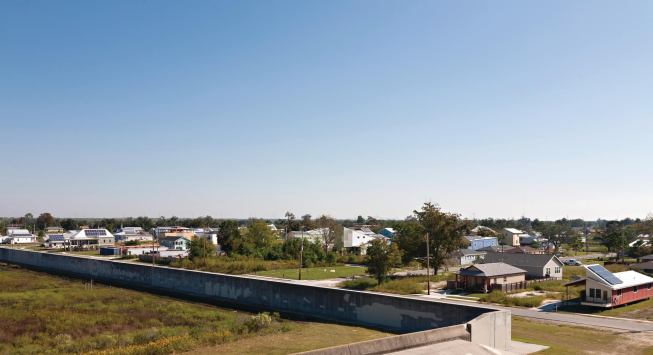
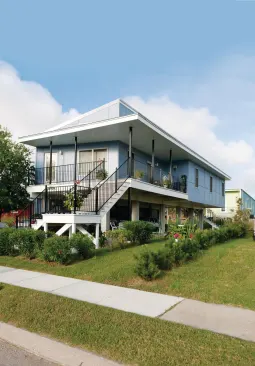
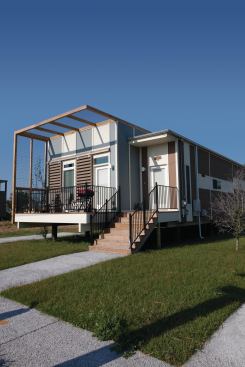
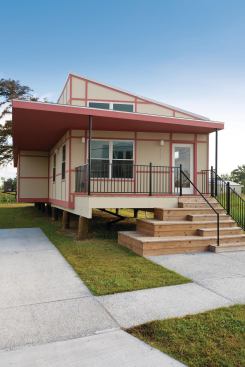
As of mid-2011, Make It Right has built 75 new high-performance homes within a 16-block area of the Lower Ninth Ward, restoring a section of this historic and vibrant neighborhood for returning residents after floodwaters from Hurricane Katrina wiped it away. Dedicated to working exclusively with existing Lower Ninth homeowners, Make It Right has succeeded in building not only homes, but also the dignity of families abandoned after the storm.
Sara Essex Bradley
Stadium Stoop
To address concern that the neighborhood would sa…
Stadium Stoop
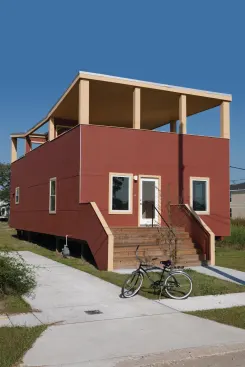
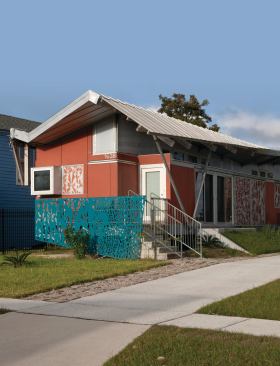
To address concern that the neighborhood would sacrifice its front-porch culture in the name of raised foundations for flood control, many of the new homes feature a wider and deeper section of seating adjacent to the steps to the front door that encourages interaction at street level. Design by Adjaye Associates, Berlin and London.
Sara Essex Bradley
Mini-Duct Air Distribution
The high-velocity conditioned air di…
Mini-Duct Air Distribution
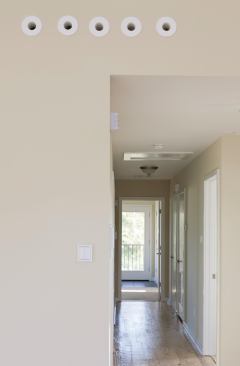
The high-velocity conditioned air distribution system employs 3.5- or 4-inch-outside-diameter flexible supply tubes powered by compact modular heating/cooling air handlers to deliver conditioned air more efficiently. Supply tubes and 7- to 10-inch diameter plenums can be woven through the structure without the need to frame chases and feature subtle, wall-mounted outlet covers instead of grill registers. Fewer system connections reduce air and heat loss. Air handlers can be paired with a variety of equipment, including geothermal heat pumps. 800.527.0896. www.unicosystem.com.
Sara Essex Bradley
Hurricane Fabric
The AstroGuard Hurricane Fabric system feature…
Hurricane Fabric
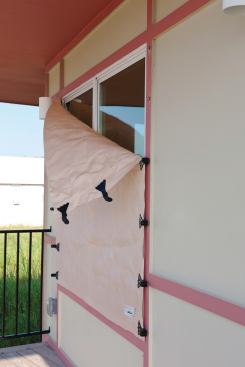
The AstroGuard Hurricane Fabric system features a high-strength, high-tenacity ballistic nylon that attaches to pre-installed anchors. The system alleviates the premium cost of impact-resistant laminated windows and/or wind-rated shutters, while the lightweight fabric features a high burst strength rating that resists wind, water, and flying debris in a Category 5 hurricane and folds up for easy storage. “It’s much easier than trying to nail or screw in panels of plywood over your windows,” product coordinator Cesar Rodriguez says. 855.336.6040. www.hurricaneprotection.net.
Sara Essex Bradley
Designed by Thom Mayne at Morphosis Architects in Los Angeles, i…
Designed by Thom Mayne at Morphosis Architects in Los Angeles, in collaboration with the UCLA Architecture and Urban Design graduate program, the FLOAT House sits at ground level thanks to its innovative prefabricated polystyrene foam-and-shotcrete chassis.
Sara Essex Bradley
Solar Panels
Make It Right sources its solar panels from a wide…
Solar Panels
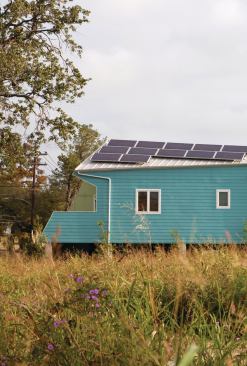
Make It Right sources its solar panels from a wide range of manufacturers through local distribution channels, in part to spread the wealth but also to effectively test systems and report results back to the suppliers and the local utility. The foundation also established a for-profit solar division to optimize state and federal tax credits and other financial incentives and act as a knowledge base and liaison for other builders and developers.
Sara Essex Bradley
Pervious Street Paving
Hydromedia allows storm runoff to rapidl…
Pervious Street Paving
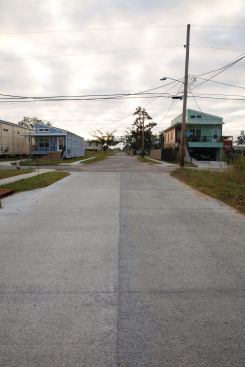
Hydromedia allows storm runoff to rapidly filter back into the groundwater while providing the durability necessary for residential streets, driveways, and parking lots. The material experiences minimal compaction and does away with street drainage systems to minimize municipal road maintenance costs and enable narrower streets for a more efficient use of land. It also eliminates standing water and ice formation for greater safety and durability. “It helps change the perception of water from a negative into a positive in this neighborhood,” Rodriguez says. 703.480.3600. www.lafargenorthamerica.com.
Sara Essex Bradley
Wireless Lighting Controls
The Verve system features hard-wired…
Wireless Lighting Controls
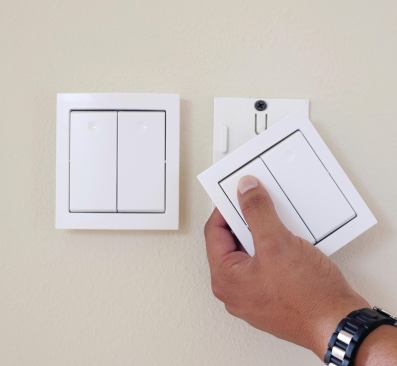
The Verve system features hard-wired central panels that can control up to 10 wireless and battery-less light switches and/or receptacles from as far away as 300 feet to serve multiple areas of the house. “It really cuts down on the electrician’s labor and the potential for running wire to the wrong location, especially for a house built using SIPs,” Rodriguez says. The wireless and dimmable switches are clipped into wall-mounted brackets to enable mobility. “And if you don’t like where the switch is or what it does, you can move it and reprogram it at the controller,” Rodriguez adds. 877.874.8774. www.vervelivingsystems.com.
Sara Essex Bradley
Treated Lumber
EnviroGuard is a waterproof sealant, applied to …
Treated Lumber
EnviroGuard is a waterproof sealant, applied to dimensional lumber prior to installation, that provides protection against moisture intrusion, mold growth, pests, and rot. The water-based liquid silicon rubber coating offers a non-toxic solution. Applied at the distributor or lumber supplier or on-site with a sprayer, roller, or brush, it’s guaranteed to protect any porous surface, including concrete and masonry, for 10 years, the manufacturer says. www.enviroguard.co.nz. House design by Billes Architecture, New Orleans, La.
Sara Essex Bradley
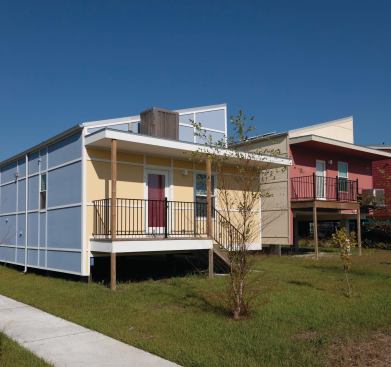
House design by Trahan Architects, Baton Rouge, La.
Sara Essex Bradley
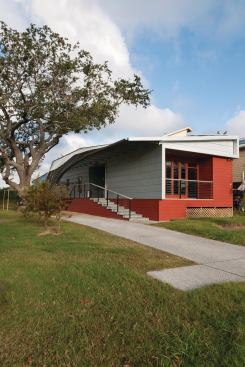
House design by Make it Right, New Orleans.
Sara Essex Bradley
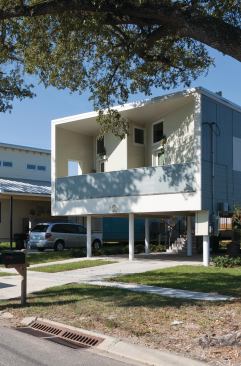
House design by Make it Right, New Orleans.
Sara Essex Bradley
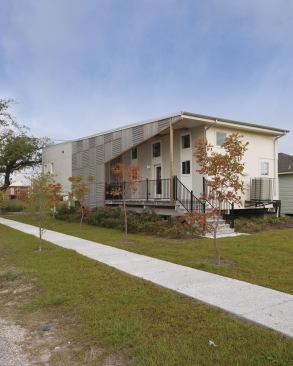
House design by Billes Architecture, New Orleans, La.
Sara Essex Bradley
House design by KieranTimberlake, Philadelphia.
Sara Essex Bradley
House design by Billes Architecture, New Orleans, La.
Cost Control
After rushing to complete the six prototype homes by the third anniversary of Katrina, less than a year after Pitt formally pulled the trigger on the project, Make It Right got serious about cost control.
Despite taking its team of general contractors and their crews and subs out of their comfort zone of conventional building materials and methods—a recipe for budget-busting estimates—MIR negotiated fair-market pricing in exchange for walking contractors through the learning curves of advanced framing, SIPs, and modular building systems, among other new practices and products.
Meanwhile, Howell enlisted a team of engineers to redesign the elevated foundation systems of the prototypes, which everyone agreed were overbuilt (and overpriced), even for an area located 3 feet below sea level. The result cut the number of pilings and support columns in half and the cost from about $30,000 per foundation to less than $15,000 without sacrificing MIR’s structural integrity goals.
The value-engineering continued with standardized room sizes and window openings on two-foot modules, sets of plans with every detail drawn out, and on-site training by building science experts and product suppliers regarding proper installation practices. “To build as affordably as possible, we’ve optimized the designs to work with a certain type of building system,” whether advanced-framed, modular, or panelized, Howell says.
Meanwhile, systems such as mini-duct air distribution and wireless lighting controls also reduced errors and extra costs in the field. “They’re just easier to run through the framing, with fewer and easier connections,” Rodriguez says. “It’s hard to do it wrong and easier to catch and fix mistakes.”
Howell recalls resistance as she oversaw the early months of construction, especially from old-school journeymen set in their ways. “But once that journeyman got on board, he was my greatest ally because he would get all of his crews and subs to follow,” she says.
As contractors crested their learning curves, they also contributed ideas to further streamline and troubleshoot the building process, suggesting the best way to connect foundation columns to the floor framing beams and lobbying for sets of construction drawings that followed the logical sequence of construction, thus saving time and mitigating mistakes. “Once they understood it, they took off,” Rodriguez says.
By the time MIR reached the halfway point of its 150-house goal earlier this year, it had honed its costs, including soft costs such as LEED certification and the value of donations, to a competitive $130 per square foot.
“It depends on the formula you apply,” Darden says of the different ways to calculate that number. “But there’s no question that a for-profit builder could apply the same strategies and achieve the same results.”
Collins Footes moved to a house on Tennessee Street in 1968, when some residents of the Lower Ninth Ward were moving out after a disastrous flood caused by Hurricane Betsy in 1965.
Forty years later, as Katrina loomed, Footes evacuated to his sister’s house in Alabama, about 140 miles away. “When I first heard about [Make It Right], I was already planning to rebuild on my property and had contacted other builders about that,” he says. “I just wanted a regular house, but I’m glad I signed on [with MIR] because some of that stuff I might not have been able to afford, like solar panels.”
PROFILE: Brad Pitt/Founder
As a film actor, Brad Pitt often plays characters who break form to achieve their goals. In A River Runs Through It, his young fly-fisherman Paul Maclean invents “shadow casting” that turns against the conventional rituals taught by his father; in his latest film Moneyball, Pitt’s brash baseball GM Billy Beane conjures a new way to evaluate players that literally changes the game going forward.
And while both of those characters are replicas of real-life people, Pitt’s not playing with Make It Right. Genuinely passionate and impressively self-educated about architecture and the environmental impact of the built world, Pitt saw a need in his adopted city of New Orleans and dove in head-first and hands-on to solve the problem in ways that challenged conventional wisdom.
“We had to start over,” he said in a CNN interview in September 2010 about the effort. “We thought we could do it better [and] give the families who live here a better life,” a directive borne from uncompromising standards that would not only restore a section of the Lower Ninth Ward, but also the dignity of its residents.
As a result, the Make It Right model makes a far greater impact than simply building better homes or even reviving a neighborhood that was left for dead. “This to me is a social-justice issue,” he was quoted as saying in a 2008 Metropolis article. “And to create something that’s equitable and fair and has respect and provides dignity for the family within is absolutely essential to rebuilding here.” –R.B.