Proponents of building prefabrication and offsite construction may fondly recall the central thesis of Stephen Kieran and James Timberlake’s Refabricating Architecture (McGraw-Hill, 2003), in which the architects argued that architecture had lost ground to other industries by maintaining age-old, site-constrained methods rather than adopting industrialized production’s inherent efficiencies. The authors claimed that the lighter, more precise, and more controlled nature of offsite construction would result in higher quality, lower costs, tighter schedules, and better environmental performance.
Over two decades later, this vision has been gaining traction—and in some cases, at significant scale. An example is contemporary airport construction, in which whole building segments are built offsite and transported across active airfields. These projects take Kieran and Timberlake’s proposal to an entirely new level that they may not have fully anticipated, and with unexpected consequences.
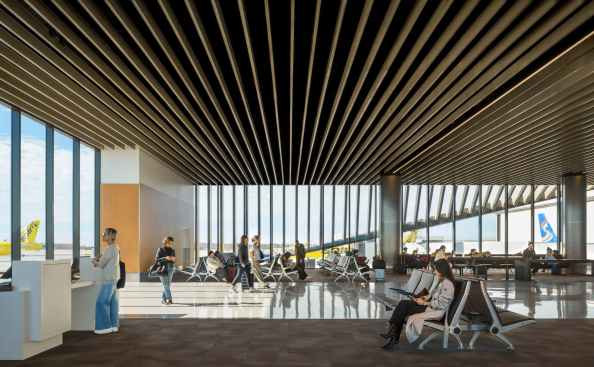
Photo by Jason O'Rear.
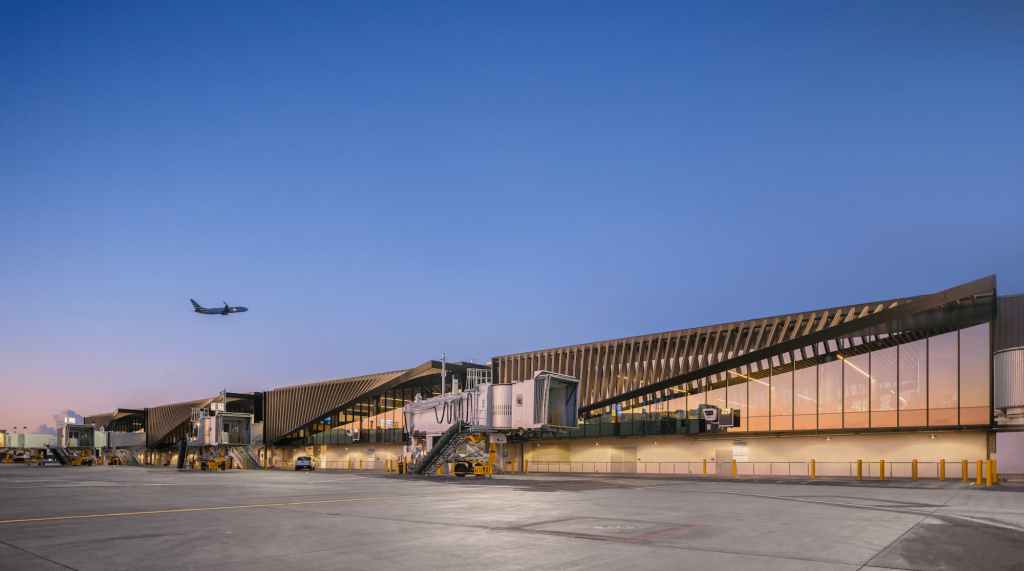
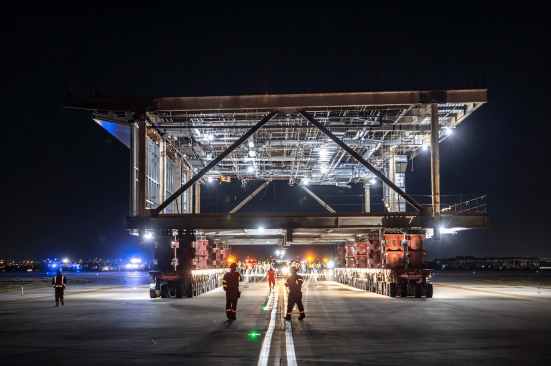
The recently completed Midfield Satellite Concourse South (MSC South) at the Los Angeles International Airport is a case in point. Designed by Woods Bagot, the project is a model of Offsite Construction and Relocation (OCR), an approach that can shave months off the timeline of a large on-site construction project. In the case of MSC South, nine modular building components were built offsite and transported nearly two miles across the tarmac for final assembly.
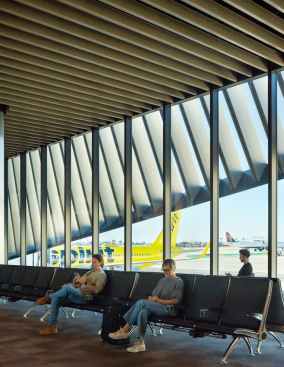
Photo by Jason O'Rear.
This new concourse added roughly 150,000 square feet and eight gates while minimizing disruption to the operations of one of the world’s busiest airports.
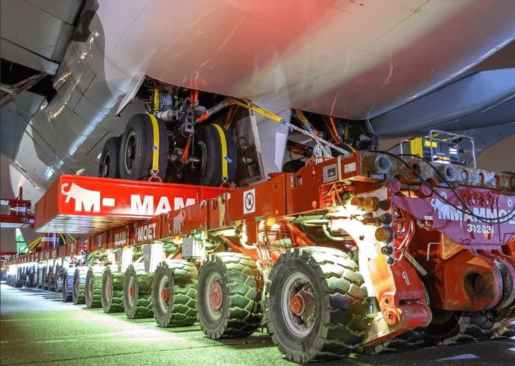
Self-Propelled Modular Transporter (SPMT)
On-site installation required carefully timed runway closures, overnight operations, Self-Propelled Modular Transporters (SPMT), and highly coordinated utility connections. While such an intricately planned endeavor exemplifies the kind of fully integrated process promoted in Refabricating Architecture, the burgeoning scale and scope of OCR projects raise new questions.
For example, Kieran and Timberlake imagined lightweight materials and efficient installation. However, the construction and relocation of outsized building segments are not trivial procedures. OCR requires complex logistics, specialized equipment, and carefully staged operations. The approach routinely involves transporting oversized loads that exceed the limits of typical road infrastructure. Even within the confines of a controlled environment such as an airport, these operations demand substantial energy and coordination.
Outside such domains, and especially when longer transport distances are required, the challenges of increased transportation energy use and costs, as well as safety concerns, multiply. In short, how large and remote do building projects need to be before the advantages of prefabrication begin to yield diminishing returns?
Airports are the new testing grounds for this question. Because the value of uninterrupted airport operations is so high, the demands associated with relocating massive building components are justified.
Dallas Fort Worth International Airport (DFW) has completed a major milestone in its ongoing $3 billion plan to overhaul and expand Terminal C, successfully moving six megastructure modules across the airfield and into place at the site of the expansion that will welcome nine new gates in 2026.
Recent terminal expansions at Dallas-Fort Worth International Airport (DFW) have involved relocating megastructural modules across the tarmac to install new gates. Atlanta’s Hartsfield-Jackson Airport has also been the focus of OCR activity, with modular building components constructed offsite and installed overnight to expand its D concourse. Similarly, prefabricated interim corridors were transported across the airfield of San Francisco International Airport during multiple overnight shifts, enabling the modernization of Terminal 3 West with minimal passenger disruption.
OCR’s spatio-temporal decoupling—fabricating in one location, installing in another, and doing so as rapidly as possible—is ideal for airports and any facilities with minimal tolerance for disruption. Other building programs benefiting from this strategy include hospitals, emergency management centers, energy and water treatment facilities, data centers, defense facilities, and any critical infrastructure or high-stakes, mission-critical sites.
As the operational continuity benefits of large, offsite airport construction projects become increasingly evident, OCR adoption is likely to expand across many types of critical infrastructure.
This trend certainly represents positive changes, as Kieran and Timberlake previously argued, including increased quality, efficiency, and speed—but within limits. For example, although offsite construction can reduce a project’s overall carbon footprint, transporting buildings can significantly increase emissions. I
n extreme cases, the carbon cost of moving sizable modules over sufficiently large distances offsets any gains achieved through offsite fabrication. Additionally, although worker safety can be maintained more reliably in factory environments, the transportation and installation of mega-scaled building components introduce new risks, such as heavy lifting operations and intricate staging procedures.
All of which is to say: it is indeed inspiring to witness the realization of Kieran and Timberlake’s dream of prefabrication. OCR is demonstrating the many advantages the authors have long championed and will likely become increasingly commonplace in operationally sensitive building programs. However, architects should remain mindful of construction’s inherent tipping points—concerning energy, emissions, economics, and safety—to avoid unintended negative consequences that extreme approaches might manifest.