Thomas Heatherwick’s buildings have the uncanny ability to embed some of the catchiest moments in contemporary architecture in a spread of bulbous forms that remind me of nothing so much as Fernando Botero’s paintings of obese people and a detailing that follows the “why be subtle if you can use a sledgehammer” dictum.
From the dual sweep of London’s Coal Drop Yard to the blossoming pylons of Little Island in New York, the question for me is always whether I can look past the plodding heaviness around the Big Gesture.
A Monument Caught Between Industry and Tourism
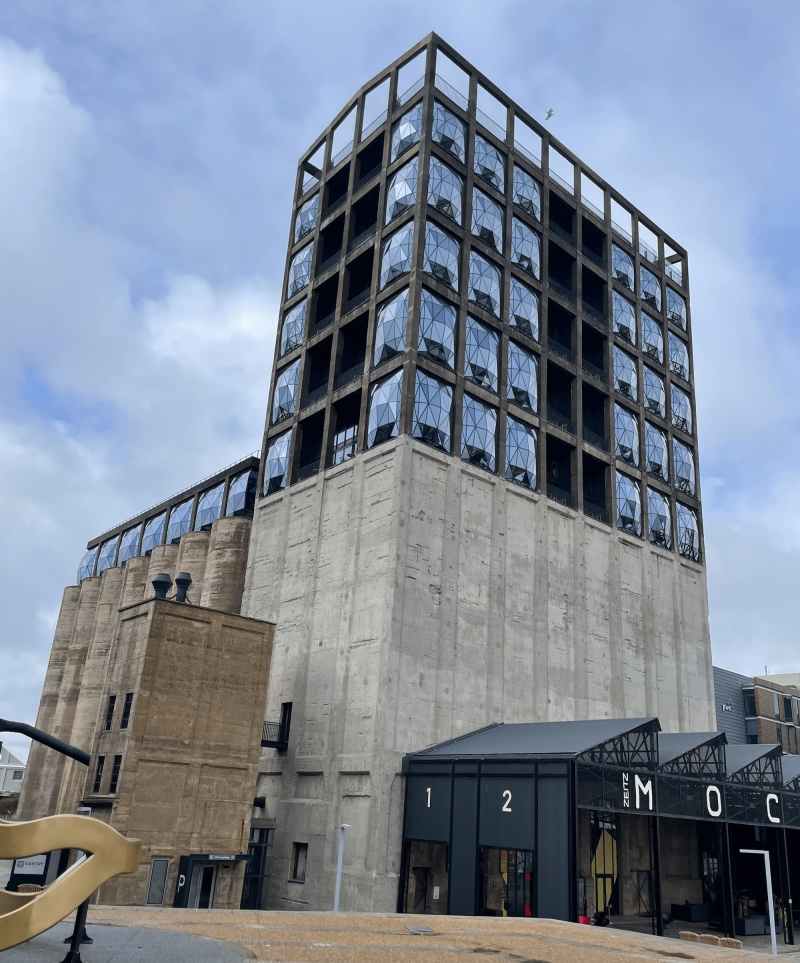
A case in point is the Zeitz Museum of Contemporary Art in Cape Town, South Africa, which I was able to visit through the generosity of the local firm SAOTA. A former grain silo carved out to create one of the most awe-inspiring spaces I have seen in a long time is topped with a stack of six stories of Heatherwick’s signature barrels that turn what was once a specimen of heroic industrial-agricultural architecture into the podium for the Silo Hotel, a luxury boutique inn.
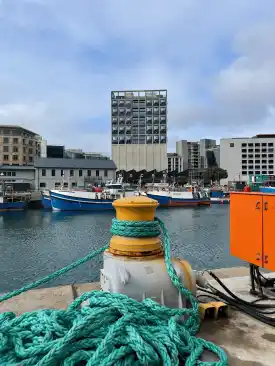
In that combination, the building condenses the conditions in which it sits. Cape Town’s harbor has become the site, as is the case in almost all urban waterfront situations, for redevelopment that has turned the piers and docks into a species of shopping mall opening and prettying up old warehouses, all connected by equally scrubbed and pedestrianized streets that show off their cobblestones.
The difference here is that the site is, for now, very much a working harbor. The cranes still hoist containers off and onto ships right next to the browsing and noshing tourists.
In the middle of all that sits this big monument. Heatherwick encased the 2017 hotel addition in a black grid of tinted concrete that at least continues the material of the silos, though I wonder why he did not leave well enough alone and match the original’s color, so that the silos would seem to rise and open, rather than being oppressed by the glass bay windows bulging out of their ebon frame.
Then again, that would be too delicate for this architect. At least he left the top open as a terrace. Between the addition on top and a fake industrial, saw-toothed entrance pavilion, though, it is hard to find the original block from most angles.
The Astonishing Void at the Heart of the Building
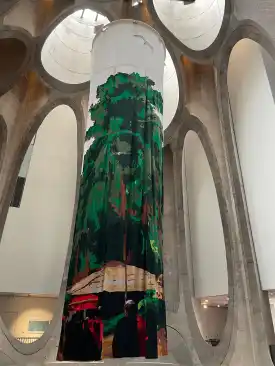
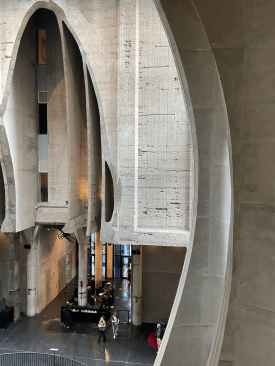
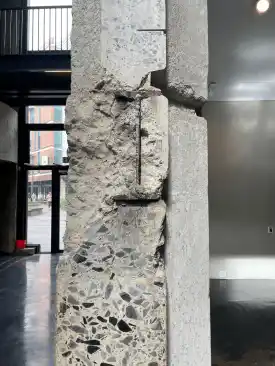
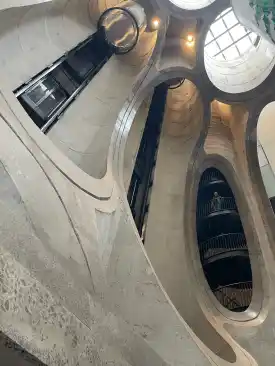
Go inside, though, and none of that (almost) matters. You are now inside what was once South Africa’s tallest building when it was completed in 1924. Walk through the lobby and the space explodes into a negative bomb shape that turns the original concrete structure into a container of space ribbed with soaring fins rising from a shared round space and coming to a Gothic conclusion above your head. The slicing creates a rhythm of stretched ovoid spaces, circles, and carved arches that dance around you in a play of miraculously vaulting concrete that makes it hard to find the beginning or end of either structure or space.
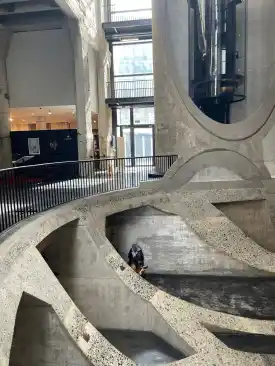
Heatherwick claims the void’s form evokes a grain seed, nodding to what used to be stored here, but the beauty of the space is exactly that it is difficult to find any fixed image in this leaping, arching, and undulating container.
The moments where the remnants of the cluster of silos that made up this facility are still visible, but then lose part of their bottom or top, or where the structure in-between turns into ribs rising out of the remnants of their support before joining again at the top, were some of my favorites.
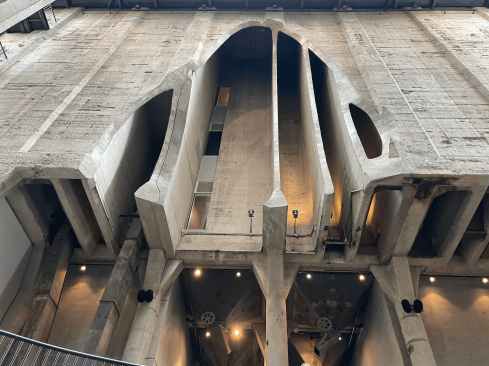
The seemingly haphazard cut and thrust of void and solid, supposedly governed by Heatherwick’s bomb or seed shape, create those patterns at a scale that draws your eye up, around, down, and then back up to the top without ever finding a resting point.
A Museum Shaped by Koyo Kouoh’s Vision
The building does have a function, of course, and that is a museum dedicated to contemporary African art. Jochen Zeitz, the former Puma and now Harley-Davidson CEO who founded the museum in 2015, had the means and will to put together the venture, but he was lucky enough to be able to work with Koyo Kouoh, a brilliant curator and director who died suddenly last year.
Her legacy is still evident in art that explores almost every aspect of the continent’s encounter not only with its own roots, material legacy, and cultural transformation, but also with the forms, images, and especially materials recycled from the rest of the world. The sheer exuberance and quality of the work, much of which was new to my Western eyes, along with the embodied pain of Africa’s long colonial oppression and especially apartheid in South Africa that you can find in the paintings, sculptures, installations, and videos, make a journey through what are nondescript, but very serviceable boxes surrounding the atrium well worth the visit.
Where the Architecture Finally Disappears
At the top of the museum is, of course, a restaurant with a view over the harbor and Cape Town. There, the mixture of old and new, industry and commerce, but also the drama of the city’s setting between the ridges of Table Mountain, Lion’s Head, and Devil’s Peak, are spread out for your consumption. It is a gift that Heatherwick’s architecture finally, as in the galleries, disappears.
Does the grandeur of that atrium make it all worth it? Certainly not for the people who have to live with just the outside of the building, although after the experience of the inside, the plunk of the new on top of the old and even its awkwardness seem perhaps fitting: the new in all its awkward muscle flexing placed on top of the old that reached its effect through its sheer scale and simplicity.
The sense of this being a giant assemblage and even the reversal of importance of base and top, which is so beautifully inverted inside, where the hotel is not visible, also almost makes sense.
A Powerful Symbol, Despite Its Excesses
As an example of museum architecture, the building does not have much new to say. As a symbol of a new South Africa, the Zeitz is strong: an exuberant, not exactly slick new reality overcoming and carving out the old that now looks almost puny.
Above all else, just to walk into that atrium and have your mouth drop open is completely worth the trip to Cape Town.
The views and conclusions from this author are not necessarily those of ARCHITECT magazine.
Read more: The latest from columnist Aaron Betsky includes reviews of: The Fagan House |The Dries Van Noten Foundation | The Revenge of the Arch | Out There | The Shakers | The V&A Storehouse | Fins on Buildings | New Museum & The Studio Museum in Harlem | The Modern Museum | Monuments | Infrastructure | Interior Design | Viollet-le-Duc | Malibu High School | Architecture without Architects | Louis Kahn’s Fisher House | Meow Wolf | Generative AI | Frank Gerhy | Robert A.M. Stern | Lars Lerup | Princeton Art Museum | Victor Legorreta | Mexico City Underwater | On Vitruvius | On Olive Development | Calder Gardens | White House and Classical Architecture | Louis Kahn’s Esherick House | Ma Yansong’s Fenix Museum | The Cult of Emptiness | An Icon in Waiting | Osaka Expo | Teamlab | the Venice Biennale of Architecture | On Michael Graves | On Censorship or Caution? | Uniformity in Architecture | Book on Frank Israel | Legacy of Ric Scofidio| Fredrik Jonsson and Liam Young | DSR’s New Book | the Stupinigi Palace | Living in a Diagram | Bruce Goff | Biopartners 5 |Handshake Urbanism | the MONA | Elon Musk’s Space X | AMAA | DIGSAU | Art Biennales | B+ | William Morris’s Red House | Dhaka | Marlon Blackwell’s new mixed-use development | Eric Höweler’s social media posts,| Peter Braithwaite’s architecture in Nova Scotia,| Powerhouse Arts, | the Mercer Museum, | and MoMA’s Ed Ruscha exhibition.
Keep the conversation going—sign up to our newsletter for exclusive content and updates. Sign up for free.