In Sacramento, where suburban sprawl typically meets the edge of fragile river ecologies with indifference, a new housing project is attempting something far more ambitious: to prove that affordable housing can be both environmentally regenerative and socially transformative—without sacrificing architectural ambition.
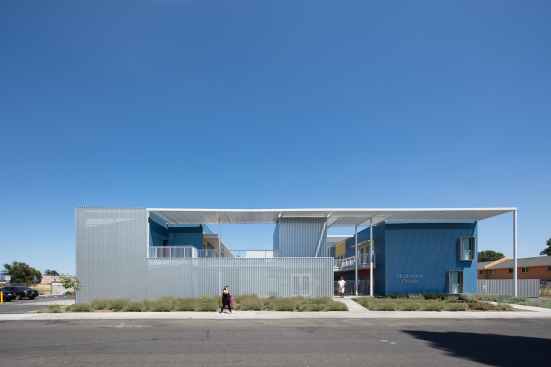
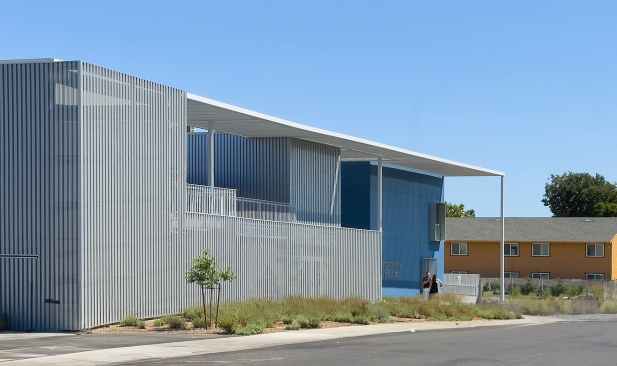
Completed by Brooks Scarpa Huber, the 67-unit Northview Pointe Apartments sit on a modest 1.23-acre site near the confluence of the American and Sacramento Rivers, one of the most ecologically sensitive riparian zones in the San Francisco Bay watershed. The premise is deceptively simple: build housing for some of the city’s most vulnerable residents while repairing the land it occupies. The execution is anything but.
Developed by Excelerate Housing Group in partnership with Hope Cooperative and delivered through the Sacramento Housing and Redevelopment Agency, the project is part of a broader push to house individuals emerging from homelessness. But rather than retreat into the defensive architecture that has long defined affordable housing—fences, blank walls, inward-facing corridors—Northview Pointe rejects that model outright.
Instead, it opens itself up.
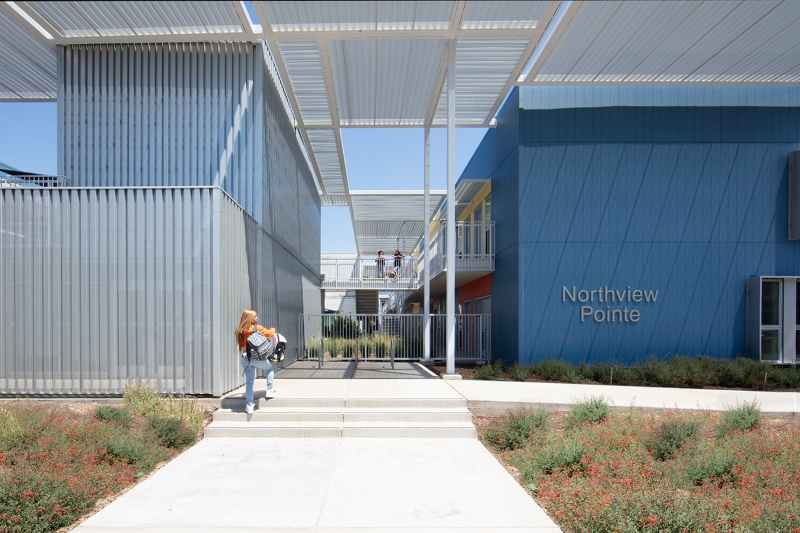
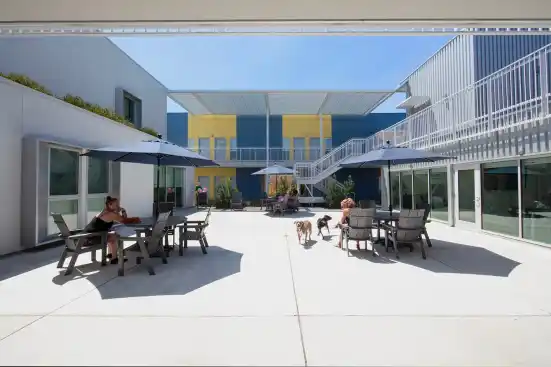
At the center of the project is a carved-out courtyard that functions less like an amenity and more like a social condenser. The buildings wrap the perimeter, their two-story forms framing a shared landscape that is both visually and physically accessible from nearly every unit. Windows, circulation paths, and breezeways are carefully aligned to create a constant awareness of others—a subtle but powerful architectural strategy that shifts the emphasis from private isolation to collective presence.
The effect is deliberate. “The project celebrates social space by de-emphasizing private space,” the architects note in their project description.
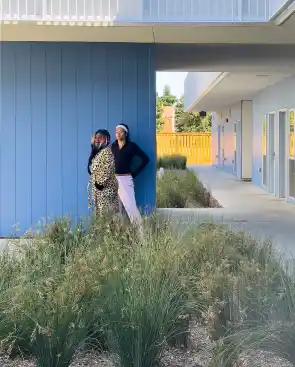
That philosophy extends to the way the buildings breathe. Cross-ventilation is not a technical afterthought but a primary design driver. Exterior circulation corridors double as environmental infrastructure, pulling air through the site while connecting residents to gardens, parking areas, and communal spaces. Breezeways slice through the massing, acting as both shortcuts and climate moderators.
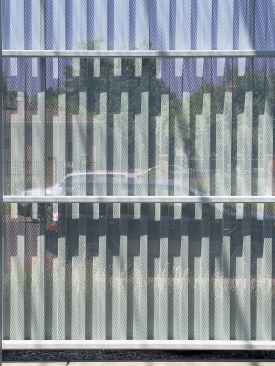
At the center, a community room anchors the project—its large sliding glass doors dissolving the boundary between inside and outside. When open, the space becomes an extension of the courtyard; when closed, it remains visually porous. Above it, a two-story trellis filters sunlight into shifting patterns, creating a microclimate that is both shaded and luminous.
This is architecture doing multiple jobs at once: social, environmental, and spatial.
But the project’s most radical move may be invisible at first glance. Northview Pointe is designed as a fully electric, net-zero development—an increasingly urgent benchmark in California’s push toward decarbonization. Passive strategies, material choices, and landscape design all work in tandem to reduce energy demand while supporting long-term resilience.
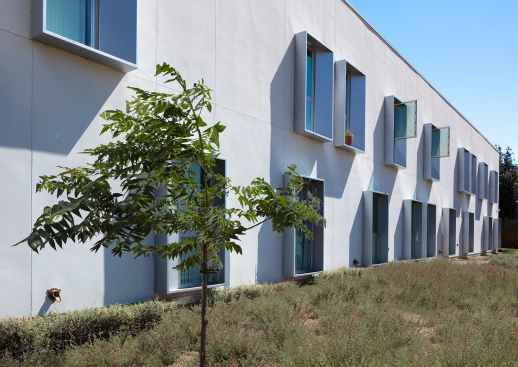
The landscape, in particular, is doing heavy lifting. Rather than treating the site as a neutral ground plane, the design reintroduces ecological processes that suburban development typically erases. Native and drought-tolerant plantings replace turf lawns. Impervious surfaces are minimized to allow water to filter naturally into the soil, reducing runoff and protecting nearby waterways. The site becomes part of a larger ecological network, supporting pollination, seed dispersal, and species migration.
In other words, the project doesn’t just sit near a sensitive ecosystem—it participates in it.
This integration of social housing and ecological infrastructure reflects a broader shift in how architects are beginning to think about resilience. It’s no longer enough for buildings to withstand climate impacts; they are increasingly expected to mitigate them. Northview Pointe attempts to do both, embedding climate adaptation into the everyday experience of residents.
The numbers are modest—31,100 square feet, $28.4 million in construction costs—but the implications are not. At 37 units per acre, the project achieves a level of density that challenges suburban norms while maintaining a sense of openness and permeability. It suggests that density, when designed thoughtfully, can enhance rather than diminish quality of life.
And perhaps most importantly, it reframes what affordable housing can look and feel like.
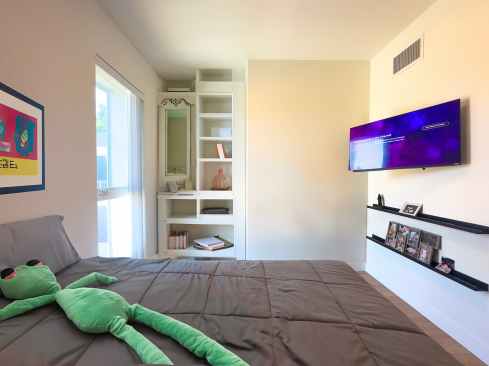
Too often, social housing is treated as a problem to be solved as cheaply and efficiently as possible. Here, it is treated as an opportunity—to experiment with new models of living, to test environmental strategies, and to create spaces that foster dignity and connection.
Fully occupied since opening, Northview Pointe is already functioning as more than a building. It is a prototype—one that asks whether the future of housing might be less about units and more about systems: social systems, ecological systems, and the architectural frameworks that bind them together.
If that’s the case, then projects like this aren’t just solving a housing crisis.
They’re redefining what housing is.
NORTHVIEW APARTMENTS
Project Details
Project’s Formal Name: Northview Apartments
Location of Project: 2314 Northview Drive, Sacramento, CA 95833
Client/Owner: Excelerate Housing Group
Total Square Footage: 31,100 SF
Lot Size: 23,750 (1.23 acres) 67 units = 37 units/acre
Total Cost: $28.4 mil
Completed: 2023
Architects: Brooks Scarpa Huber
Project Team: Brooks Scarpa Huber
Lawrence Scarpa, FAIA – Lead Designer, Angela Brooks, FAIA – Principal In Charge, Eleftheria Stavridi – Project Architect, Flavia Christi, Carlos Garcia, AIA -Project Architect, Jeffrey Huber, Dionicio Ichillumpa, FAIA, Iliya Muzychuk, Yeawon Min, Eric Mosher, Yimin Wu, Juan Villareal, – Project Design Team
Landscape: Brooks Scarpa Huber with PLAN(t) Landscape Studio
Engineering: Labib Funk – Structural and Civil Engineering
IDiaz Design – Electrical, Mechanical and Plumbing
Homage Design (Shellie Collier) – LEED Consultant
Southern California Geotechnical –Geotechnical Engineering
Wayfinding: Brooks Scarpa Huber
Contractor: Snyder Langston
Photography: Tara Wujcik