For a discipline that often measures itself in decades—if not centuries—architecture has been moving unusually fast. Climate pressures, shifting demographics, and the destabilizing effects of technology have compressed the timeline of urban change into something closer to real time. And increasingly, the most important conversations about cities aren’t happening in master plans or municipal offices—they’re happening in festivals.
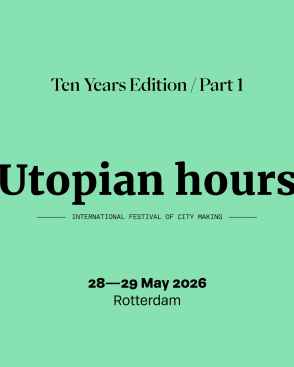
This spring, that conversation arrives with particular urgency in Rotterdam, where the international city-making festival Utopian Hours will stage the first half of its tenth-anniversary edition. Across two days—May 28 and 29—the festival will transform the cavernous halls of the Groot Handelsgebouw into a dense, multidisciplinary forum for rethinking how cities are conceived, governed, and lived.
Founded by the Turin-based organization Stratosferica, Utopian Hours has spent the past decade building a reputation as one of the more agile platforms for urban discourse—less academic conference, more intellectual collision. Its expansion beyond Italy signals something larger: a recognition that the future of cities is no longer a local question. It’s a networked one.
A City That Already Lives in the Future
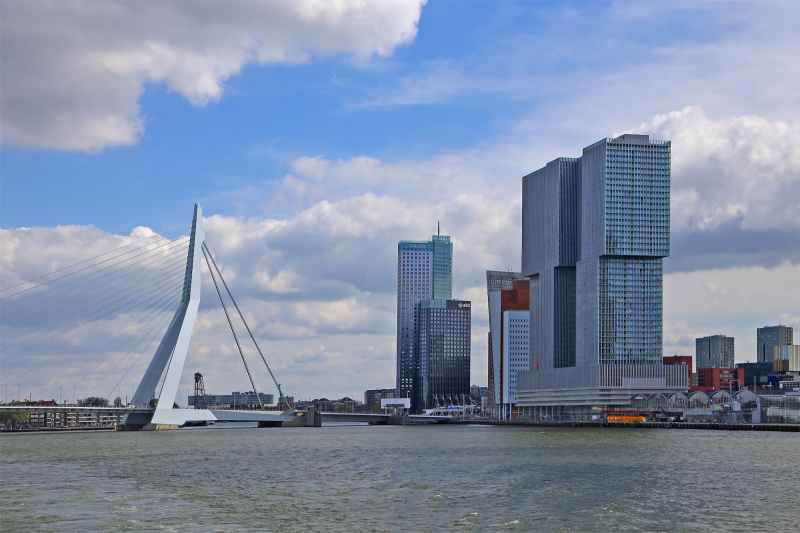
Rotterdam is not a neutral backdrop. Rebuilt after World War II into one of Europe’s most experimental urban laboratories, the city has long positioned itself at the forefront of architectural risk-taking and climate adaptation. That identity makes it a natural host for a festival that thrives on speculative thinking grounded in real-world urgency.
The choice is also strategic. The Netherlands has become a proving ground for ideas around water management, density, and post-carbon urbanism—topics that now dominate global conversations. The festival’s organizers see Rotterdam not just as a venue, but as an active participant in the dialogue.
“Rotterdam’s experimental spirit makes it the ideal place to expand the festival and engage a broader international audience,” note founders Luca Ballarini and Giacomo Biraghi.
From Big Names to New Frameworks
If architecture festivals once revolved around star architects presenting finished work, Utopian Hours operates differently. Its speaker list reads less like a roster of designers and more like a cross-section of urban thinkers—filmmakers, policy experts, activists, and researchers—each addressing a specific dimension of city-making.
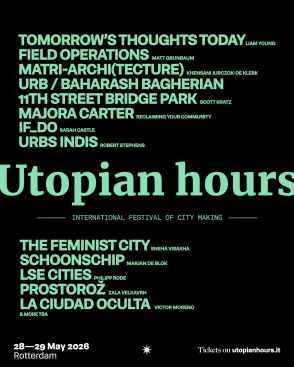
Participants include speculative architect Liam Young, urban strategist Majora Carter, and Baharash Bagherian, whose work explores large-scale sustainable urbanism. Landscape architect Matt Grünbaum brings a perspective shaped by projects like New York’s High Line, while Philipp Rode offers a research-driven lens on urban governance and policy.
What binds these voices is not a shared aesthetic, but a shared premise: that the most urgent architectural questions are no longer about form, but about systems.
The End of the Single-Issue City
That shift is reflected in the festival’s thematic structure. Rather than siloing topics, Utopian Hours organizes its programming around overlapping challenges—“Green Water City,” “Carbon City,” “Gender-Inclusive Public Space,” “Third Spaces,” and “Just Green.”
Each theme points to a growing realization within the discipline: that urban problems no longer arrive one at a time. Climate adaptation is inseparable from social equity. Public space design is entangled with questions of gender and access. Even something as seemingly straightforward as decarbonization now demands cultural, economic, and political negotiation.
In this context, the festival’s format—keynotes, roundtables, tours, and film screenings—feels less like programming and more like an attempt to model a new kind of urban discourse: interdisciplinary, iterative, and open-ended.
Beyond the Stage
What happens outside the lecture hall may be just as important. The festival extends into the city itself through curated tours—exploring waterfronts as public space, green infrastructure, and emerging “third places” that blur the line between work, leisure, and civic life.
There is also a deliberate effort to engage with Rotterdam’s cultural ecosystem. Collaborations with the Architecture Film Festival Rotterdam and Rotterdam Rooftop Days position Utopian Hours within a broader network of events that collectively frame the city as a living laboratory.
Even the opening reception—held at the new Fenix Museum—underscores a thematic throughline: migration, movement, and the fluid identities that increasingly define urban life.
A Festival at a Turning Point
The Rotterdam edition is only the first half of a two-part anniversary celebration, with the second installment returning to Turin in October. But the split format also signals a deeper evolution. What began as a local initiative is now positioning itself as a distributed platform—one that moves between cities, absorbing and reflecting their specific conditions.
That mobility mirrors the very phenomena the festival seeks to address. Cities today are less isolated entities than nodes in a global system, shaped as much by external forces as by internal decisions.
The Real Question
The word “utopian” has long carried a whiff of impracticality—an association with idealized visions detached from reality. Utopian Hours seems intent on reclaiming the term, grounding it in the messy, contradictory work of actually making cities.
The real provocation isn’t the idea of a perfect city. It’s the suggestion that we may already have the tools to build better ones—and that what’s missing is not imagination, but coordination.
For two days in Rotterdam, at least, that coordination will be on display: a dense convergence of ideas, arguments, and experiments that together sketch a new kind of urban future—one that is less about singular visions and more about collective intelligence.