A dense rainforest surrounds an island retreat in the Dominican Republic, where a narrow trail leads to the house, emerging from the tree canopy and opening to a central courtyard before revealing a view to the Atlantic Ocean.
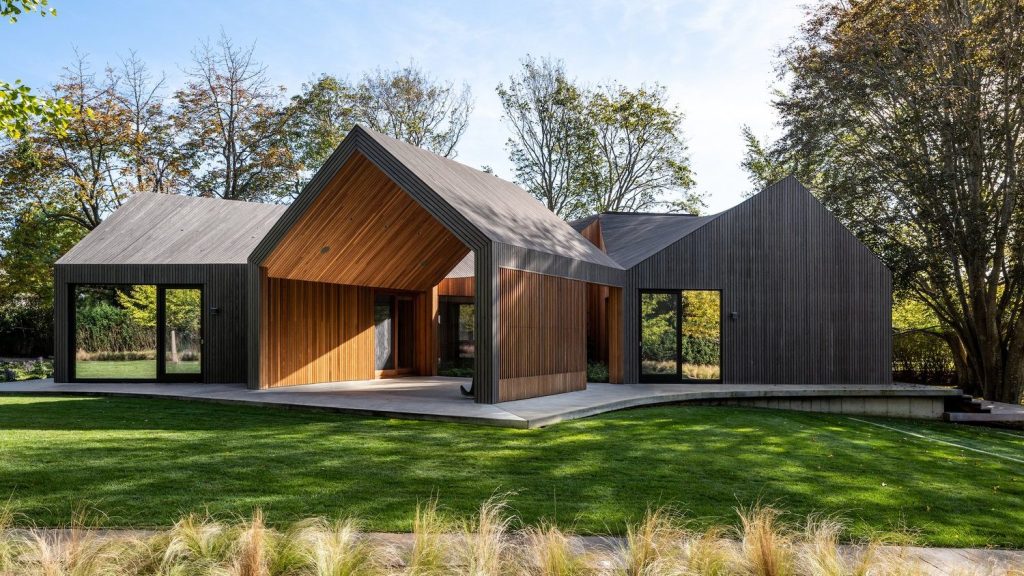
Far to the north, at a historic Hamptons homestead in New York, six barn-vernacular volumes form a courtyard with no obvious front entry. Instead, the house is experienced through the spaces between them rather than from a single point of arrival.
Though separated by climate, context, and geography, both projects share a similar ambition. Designed by architect Bryan Young, founder of New York-based Young Projects, they have a seamless continuity between exterior and interior “that radicalizes what a domestic project could be,” he says.
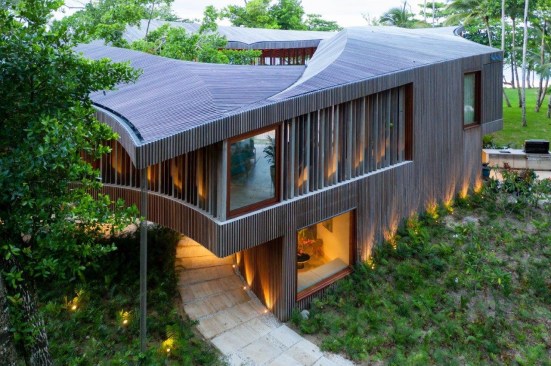
Retreat House in the Dominican Republic, by Young Projects. Photo by Iwan Baan.
That relationship is not predetermined. “I am suspicious of the stereotype of an architect reading a landscape and the airflow and having the ‘aha moment’ about what the project should be,” Young says. “You do think about solar orientation, natural ventilation, and topography, but I also think architects can bring something to a project that might be foreign. Then, through the design process, you’re merging [that idea] with the actual site.”
Designing with Place
Rather than imposing a fixed aesthetic, architects working across geographies translate core design philosophies that shift, recalibrate, and reassemble in response to place. For architect Veronica Schreibeis Smith, founding principal of Jackson Hole, Wyo.-based Vera Iconica Architecture, the process begins with capturing, through sketches and photographs, not only the landscape, but also the culture and people to develop a deeper sense of place. “Our design approach is really about finding the essential qualities of the place, the culture, the site, the climate, and then the people we’re designing for,” she says.
In designing a home in Cusco, Peru, for a philosopher, Schreibeis Smith partnered with architect Luis Longhi to configure the house so that private rooms are tucked into the hill, whereas the more public spaces emerge from the landscape—some in an exposed glass cube.
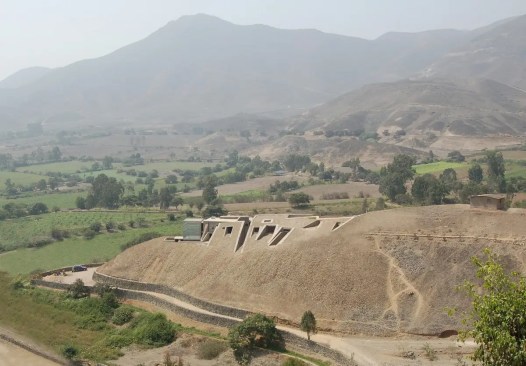
Pachacamac in Cusco, Peru, by Vera Iconica.
“The home was built into a hill as a sign of respect for the earth,” she says. “We talked about finding the essential qualities of self and place so that the design was truly conceived out of the DNA of the client and of that setting,” she says.
For Schreibeis Smith, the essence of place is holistic—shaped by a close reading of landscape, culture, and human experience, and reflected in every home she designs, regardless of location.
“You never start the design process knowing what you’re going to design,” she says. “It’s a discovery. It’s the sights and sounds and the smell and the laughter and the quality of the conversation and connection to the landscape; that is the beauty of the whole experience.”
Designing across climates—from Minnesota’s winters to the dry desert conditions of Baja California in Mexico—requires balancing performance with a strong connection to the landscape. Kristine Anderson, principal of Minneapolis-based PKA Architecture, says that experience with extreme conditions informs the firm’s work elsewhere.
“Our process is about understanding those relationships between the people, the climate, and how the buildings and the landscape work harmoniously to create architectural context,” she says.
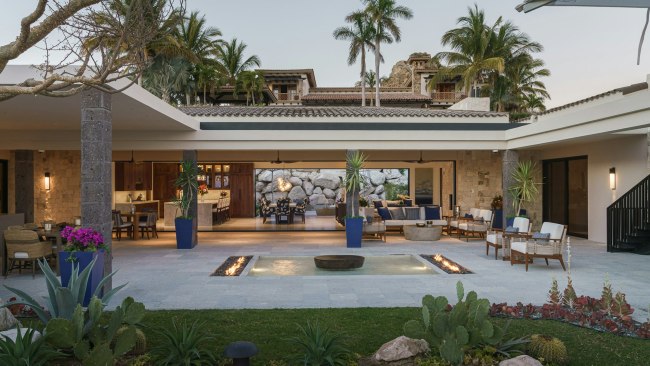
Casa Hacienda Moderna in San José del Cabo, Mexico, by PKA Architecture. Photo by Kory Kevin Studio.
Creating outdoor connections that integrate seamlessly with the indoors is central to the firm’s work, yet each project responds to its setting. At a retreat in San José del Cabo designed by PKA Architecture, the wings of the house cradle outdoor living areas, with two private courtyards facing the ocean. Generous overhangs provide shade, while sliding and pocket doors allow breezes to move freely through the house.
In Minnesota, that approach takes a different form. A PKA Architecture home embedded in a sloping lakeside landscape near the Twin Cities pairs expansive waterfront views through 10-foot-tall floor-to-ceiling windows with a sunken central garden courtyard that creates multiple opportunities to look through the house toward the surrounding landscape.
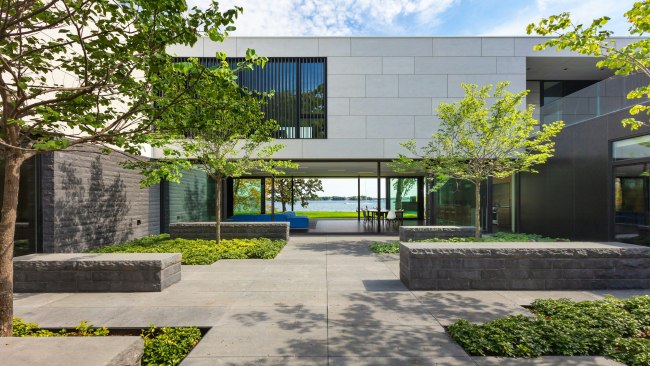
Bayside Residence in Minnesota, by PKA Architecture. Photo by Paul Crosby.
“The way these houses create a private experience to see the ocean and beyond or a private oasis where every guest can step out into a courtyard is pure joy. Everyone needs their own private universe—what I call their Xanadu moments,” Anderson says.
Working with Materials
For Young, the unifying thread across his firm’s global projects is the dynamic relationship between scale, building type, and materials. A loft in Tribeca clad in pulled plaster panels—created with a serrated blade to give the plaster its movement—translated to the Dominican Republic house, where carpenters used palm fronds to texture concrete walls. In both cases, the designs emerged through collaboration between the architect and the material makers. “The manner in which artisans are manipulating materials will have an effect on the aesthetics of a project,” he says.
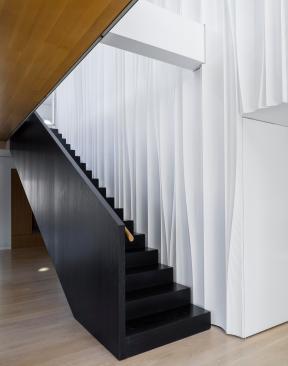
Pulled Plaster House in New York City, by Young Projects. Photo by Naho Kubota.
Another house on the Dominican Republic property played with the graphic interplay of light and shadow through the placement of handmade encaustic cement tiles. The effect makes the structure seem to vibrate in the jungle setting.
“We developed this technique in tandem with the [local] builders, and while we would never have designed a house like that in, say, the Hamptons or Long Island, what emerged was very powerful in terms of a body of work,” Young says. “Each one of these experiments informs something else, so we have this way of working with concrete block that was born in the Dominican Republic but can travel across borders.”
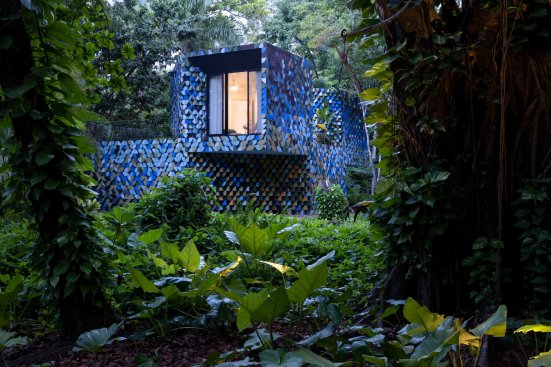
Glitch House in the Dominican Republic, by Young Projects. Photo by Iwan Baan.
At a new home in Teton County, Wyoming, designed by Schreibeis Smith, rugged steel and heavy stone are balanced by a pared-back, calming atmosphere, shaping an elevation that frames views of the meadow and mountains beyond. “When you look out the window, it feels like you could step off the edge and just float across the grass or the snow,” she says.
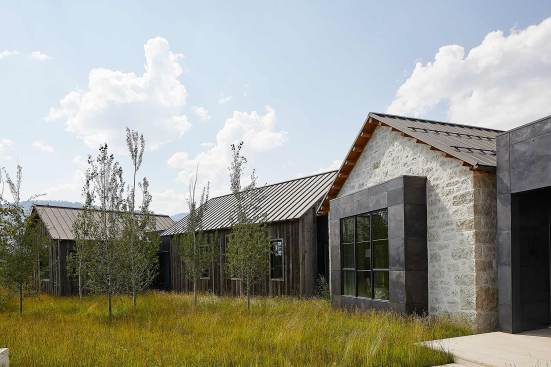
Snowstone Residence in Teton County, Wyo., by Vera Iconica. Photo by William Abroniwicz.
Natural daylight further strengthens the sense of grounding. “One of the main jobs of glazing is so you can connect to the real thing—you know if it’s a cloudy or sunny day because you have the real quality of light,” Schreibeis Smith says. “That’s important because we are seasonal creatures. When our homes are living, they can help us respond and live in sync with our environment.”
Experience and Well-being
Material continuity also reinforces the link between a house, its setting, and its inhabitants. At the Mexican retreat designed by Anderson’s firm, locally sourced stone and travertine flooring extend from exterior terraces into interior spaces, dissolving boundaries and anchoring the house to the site. The tactile qualities of these materials—their imperfections and textures—become part of the sensory experience. “It feels human,” Anderson says. “It lets you relax.”
Sensory engagement between the built environment and its inhabitants fosters deeper connection and a sense of well-being, she says.
“You walk down a hallway and there’s a window with a perfectly framed view or a tree or the sky—that’s an intentional move because it stops you. These primal elements create wellness moments that help give us pause and let people reflect.”
Even small material gestures, such as an iron handrail, can hold meaning. When Evan Mack, creative brand director at Vera Iconica, was building her house, Schreibeis Smith suggested she visit the blacksmith’s studio to watch her staircase railing being made. “I will always remember, when I touch or see that railing, the creation story behind it,” Mack says.
Creating that kind of experience—connecting to a place through the built and natural environment across geographies—is an inherent part of wellness design. “We’ve got a tool bag full of scientific and evidence-based design to understand the physiological and cognitive performance of our homes and how they are shaped,” Schreibeis Smith says. “We can create spaces that will help relax or energize you or get you into your flow state. This is measurable. When you go into a space and it feels good to you, there are reasons why.”