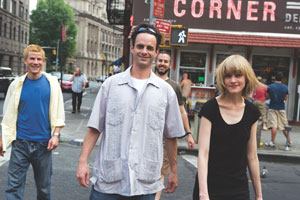
The ranks of small, independently published magazines that enlivened architectural discourse in the 1960s and 1970s have left few direct off spring in print. Instead, that culture of intrepid architectural commentary has reemerged online, in the form of blogs.
“Blogging has become an incredibly important part of how architecture is discussed,” says Joseph Grima, director of the Storefront for Art and Architecture, a nonprofit Manhattan gallery. To underscore this point, last spring Grima tapped four architectureoriented bloggers—Geoff Manaugh of BLDGBLOG, Jill Fehrenbacher of Inhabitat, Bryan Finoki of Subtopia, and Dan Hill of City of Sound—to orchestrate Postopolis!, the first conference about blogs and the built environment.
For five humid days in Storefront's snug Manhattan gallery, the host bloggers and their invited guests discussed architecture, the web, and related subjects. Acknowledging the passion and mischief in the air, Grima compared the well-attended marathon to Woodstock.
Although the most thorough research and criticism of buildings is still done by scholars and professional journalists, bloggers are transforming the forum of architectural discourse through topical creativity as well as the sheer speed and accessibility of their medium. Blogs have reinvented the concept of “breaking news” in a notoriously slow-paced profession. New renderings and photos may traverse the web months before mainstream design journals print an editorial. On the other hand, some bloggers shun the journalistic “scoop,” preferring to venture deep into the realms of theory, commentary, and fantasy.

New voices are flourishing amid the crossfire of hyperlinked articles, images, and videos. Some of these authors have a direct connection to the world of architecture, while others are pure enthusiasts. Most of them defy simple categorization, reveling in combining the subject of design with tangentially related interests, from social policy to planetary acoustics. “I much prefer the outsider perspective,” says Finoki, whose background includes as much literature and psychology as architecture. Ryan McClain, an intern architect, describes the informal tone of his blog, Architecture My Ninja Please, as “reminiscent of a buddy approaching you.”
At this stage in the history of architectural blogging, the endeavors range in scale from part-time web diaries of practicing architects and graduate students to a handful of more-prolific blogs with dedicated editorial staff. Australian architect Marcus Trimble, creator of the blogs Gravestmor and Super Colossal, has begun deliberately to cross-pollinate his blog with his day job. Lockhart Steele's blog, Curbed, recently became his day job. And the avid research and originality of BLDGBLOG is presumably one of the reasons the print magazine Dwell recently hired Manaugh as a senior editor.
Like Curbed, the green-themed blog Inhabitat has organized a business structure with advertising revenue to support professional staff and equipment. “We currently occupy an interesting and challenging middle ground between labor of love and commerce,” says Fehrenbacher, who founded Inhabitat in 2005. The blog's dozen or so contributors earn a nominal fee for their work, but less than a professional freelance rate. The full-time managing editor earns a salary. “Obviously, ad revenue is very important to us,” adds Fehrenbacher, “though we are very sensitive to trying to keep all of our advertisers high-quality and in line with the values of our site.”
Blogs may represent the first indigenous web publications, formatted as continuous digital scrolls rather than adapted from print journalism. Along with the excitement of autonomous publishing, though, come a few pitfalls. Chief among them may be what Bill Millard—a frequent contributor to the print magazines Oculus and Icon—described in a conversation at Postopolis! as “the enormous temptation for everyone's inner windbag to come out.” In addition, bloggers must accept the ephemerality that the internet imposes upon their work. “If I stopped posting to my blog,” Manaugh muses, “nobody would refer to it in a year.”
Gideon Fink Shapiro is a freelance writer based in New York City and a contributor for the blog gothamist.com.
Architecture My Ninja Please

Credit: Paul Wearing
architecture.myninjaplease.com
Ryan McClain (left), 24, Boston
Kiye Apreala (right), 24, New York
First post: December 2006
Total posts as of June 30, 2007: 380
Unique visitors in May 2007: 22,000
Architecture My Ninja Please combines the language of design and youthful slang to describe architecture. It's fun, hip, and occasionally silly. “Not only is the massing interesting,” writes Ryan McClain about a house designed by Santa Monica, Calif.–based MINARC, “but the details inside are siiick.” This popular new blog—created by Kiye Apreala as a microsite within his myninjaplease.com (MNP) family of blogs—features splashy projects that catch your attention, even if you know nothing about design. McClain's fresh zeal for the work of starchitects and students alike makes you want to pardon the endless repetition of the word “ninja,” the epithet used throughout MNP to refer to readers and anyone the MNP bloggers favor. McClain, who holds a B.Arch. degree from Roger Williams University, works at a large Boston firm he declines to name for fear of implying a connection with the blog. The Spanish version of Architecture MNP, translated by César Cotta, was launched in July as a response to the discovery that a surprising portion of the blog's readership is located in Spanish-speaking countries.

BLDGBLOG

Credit: Paul Wearing
bldgblog.blogspot.com
Geoff Manaugh, 31, San Francisco
First post: July 2004
Total posts as of June 30, 2007: 800
Unique visitors in May 2007: 150,000
Geoff Manaugh's posts on “architectural conjecture,” “urban speculation,” and “landscape futures” (as he describes the content) have catapulted BLDGBLOG to the center of the architectural blogging universe. BLDGBLOG was born in Los Angeles, which might help explain Manaugh's preoccupation with film and geology. “Plate tectonics,” he says, “outdoes any landscape design studio with its sheer impact and scale.” Manaugh has also written about the architecture of science fiction movies and biologically cloned building materials. In 2009, Chronicle Books will publish a print version of the blog. Meanwhile, Manaugh—whose multidisciplinary background includes art history, cultural studies, a summer architecture studio at the Rhode Island School of Design, and a brief stint at Foster + Partners—begins working this month as a senior editor at Dwell, which has necessitated a move to San Francisco.
City Of Sound

Credit: Paul Wearing
www.cityofsound.com
Dan Hill, 37, London
First post: January 2002
Total posts as of June 30, 2007: 1,000
Unique visitors in May 2007: 30,000
Does a diagram of a soccer match have architectural properties? What about the underwater mesh caverns created during a traditional Sicilian fishing ritual? Or the structural narrative of a work of music? Dan Hill's City of Sound explores buildings and cities through a kaleidoscope of images, memories, sounds, rituals, and engineering. Although Hill has no architectural training, he cites the “deliberately unfocused peripheral vision” espoused by Finnish architect Juhani Pallasmaa as grounds for his own creative digressions. Throughout Hill's work as the head of interactive technology and design for BBC Radio & Music/Future Media & Technology and now as the director of web and broadcast for the recently launched magazine Monocle, City of Sound has served as sketchbook, sounding board, and laboratory for honing new ideas. His extrapolations from Google Earth include an interactive “timeslider” of Barcelona that incorporates historic maps and audio recordings.
CURBED

Credit: Paul Wearing
www.curbed.com
Lockhart Steele, 33, New York
First post: May 2004
Total posts as of June 30, 2007: “No idea—way too many!”
Unique visitors in May 2007: 1 million
Lightning fast and irreverent through and through, Curbed keeps the pulse of development in New York, Los Angeles, and San Francisco—with coverage of additional cities coming soon. Lockhart Steele and his invisible army of “tipsters” have built Curbed into a churning clearinghouse of news and hearsay. Its roots run to Steele's personal blog, lockhartsteele.com, from which he learned that “people liked to track the minutiae of neighborhoods as much as I did.” Steele says his nonarchitectural background gives Curbed certain advantages: “For instance, I don't tend to lapse into archibabble. … If something's ugly, we say it's ugly.” The site's posts, which are as concise as they are abundant, make generous use of signature vocabulary such as “floorplan porn” and “advertecture.” Steele recently left web publishing company Gawker Media, where he was managing editor, to concentrate full time on running the Curbed network.
A Daily Dose of Architecture

Credit: Paul Wearing
archidose.blogspot.com
John Hill, 34, New York
First post: February 2004
Total posts as of June 30, 2007: 2,010
Unique visitors in May 2007: 15,000–30,000
Dished out in illustrated spoonfuls, architecture glides right down the hatch. John Hill's Daily Dose of Architecture, an offshoot of his earlier Weekly Dose of Architecture, comprises a revolving gallery of hand-selected design artifacts, where photos of gorgeous structural details complement architectural field trips and choice literary excerpts. Free of hyperbole and cheap sarcasm, the site functions as a soothingly minimal vessel for a sip of content. Hill is a registered architect with a decade of experience at DeStefano and Partners in Chicago. Having just completed the graduate program in urban design at the City College of New York, he is currently mapping his next move. “Even though I don't take everything on my page seriously,” he says, “I take architecture, urbanism, and design in general very seriously.”
Inhabitat

Credit: Paul Wearing
www.inhabitat.com
Jill Fehrenbacher, 30, New York
First post: March 2005
Total posts as of June 30, 2007: 1,500
Unique visitors in May 2007: 350,000
Inhabitat aims to bridge the gap between green design and good design. Founder and editor Jill Fehrenbacher spent seven years as a commercial graphic and web designer before refocusing on something she found more inspiring: “design that makes a difference in the world.” With a large audience and an upbeat tone, the blog is well positioned to perform the role of educator and promoter of enlightened innovations such as green-roof tiles, wind microturbines, and prefab homes. The prolific site, which has a dozen modestly paid freelance contributors, is equally adept at explaining San Francisco's ban on plastic bags, identifying the most stylish LED light fixtures, and pointing you to a Barcelona nightclub made of recycled industrial tanks. Fehrenbacher is currently completing the M.Arch program at Columbia's Graduate School of Architecture, Planning, and Preservation.
Life Without Buildings

Credit: Paul Wearing
lifewithoutbuildings.net
Jimmy Stamp, 26, San Francisco
First post: July 2004
Total posts as of June 30, 2007: 380
Unique visitors in May 2007: 5,000
Resisting the possible onset of intellectual hunger following his 2004 graduation from the School of Architecture at Tulane University, Jimmy Stamp created his blog to extend the academic spirit of inquiry and discourse. Life Without Buildings offers a worldwide sweep of captivating projects and media, from a 258-truck concrete pour in San Diego to North Korea's monumental urban spaces. Stamp will post on any topic he digs, but he admits, “I have a definite bias toward anything that involves gigantic statuary.” He is employed by the San Francisco studio Mark Horton/Architecture and currently finds inspiration in the work of British architects David Adjaye and FAT (Fashion, Architecture, Taste).
Miss Representation

Credit: Paul Wearing
www.missrepresentation.com
Anonymous, 38, New York
First post: March 2004
Total posts as of June 30, 2007: 500
Unique visitors in May 2007: 4,000
Miss Representation offers some of the web's most biting architectural commentary. While architects are not unique in having a responsibility to improve society, says the blogger, “their failings are simply far more evident than most.” The blogger who writes as Miss Representation prefers to remain unidentified, noting in an e-mail that “my words (in [the blog's] context, at least) aren't ‘mine.' ” Anonymity, says the blogger, gives the persona of Miss Representation the freedom to embody a critical voice that “people can both celebrate and attack, or even appropriate and evolve.” Questioning the willy-nilly transformation of Lower Manhattan, the blog's home turf, Miss Representation challenges the agendas of developers, preservationists, and hipsters. Before becoming an architectural and graphic/branding consultant, the blogger studied architecture at the Savannah College of Art and Design and worked as a junior architect at a Savannah firm—“the best work experience I've had”—for two years.
Subtopia

Credit: Paul Wearing
subtopia.blogspot.com
Bryan Finoki, age withheld, San Francisco
First post: December 2005
Total posts as of June 30, 2007: 250
Unique visitors in May 2007: 10,000
If enclosure, warfare, and surveillance form an all-too-real netherworld of contemporary architecture, Subtopia is its unflinching scribe. Dispatches from fortified borders, data bunkers, and floating prisons scrutinize the social conditions that fuel the proliferation of militarized space. Although Bryan Finoki once thought he would become an architect, “My urge to write was as strong as the urge to draw.” He is currently earning a master's degree in psychology, but created the blog to overlay his converging cultural and political interests with the notion of “architecture as a spatial dimension of power.” (As for why he refuses to give his age or the name of his school, Finoki says, “I would rather just play with the whole mystique around bloggers and their culture of anonymity, and keep the audience curious on some level.”) Subtopia underscores Finoki's belief that architecture has daily political relevance in an age of gated communities, armored skyscrapers, and a worldwide “border fence– building boom.”
Super Colossal

Credit: Paul Wearing
supercolossal.ch
Marcus Trimble, 29, Sydney
First post: May 2004 (Gravestmor)/ July 2007 (Super Colossal)
Total posts as of June 30, 2007: 450
Unique visitors in May 2007: 16,000
Super Colossal is the new website by veteran blogger Marcus Trimble that fuses the DNA of blog, portfolio, and research tool. It inherits a large readership from Trimble's previous site, the cheeky Gravestmor. Conceived as a satirical comic strip to mock architectural clichés, Gravestmor emerged as a well-rounded design blog with a distinctly Australian twist. Trimble recently quit his job at the large Australian architecture firm BVN to launch his own practice, and he decided to merge his blogging and professional activities. Super Colossal features an openly accessible online product library and links to other Australian architects. Trimble has also been a leading proponent of Pecha Kucha (www.pecha-kucha.org), a rapid-fire design-presentation format devised in 2003 by Tokyo-based Klein Dytham Architecture that–has since caught on the world over.
In early June, as the editors considered a feature on architecture-related blogs and websites, we ran an online poll to help inform our decision. Here are the questions and results.
(1) Which of the following blogs/websites do you read on a regular basis? (1,064 responses; multiple responses permitted)

(1) Which of the following blogs/websites do you read on a regular basis? (1,064 responses; multiple responses permitted)
(2) Do you think blogs are:

(2) Do you think blogs are:
A good forum for information and discussion
A worthwhile diversion
A waste of time