In American architecture, new housing is often treated as a numbers game.
Cities debate shortages. Developers count units. Architects focus on density, sustainability, and cost. Yet in Africatown, Alabama, a neighborhood founded by the survivors of the last known slave ship to reach the United States, housing carries a different burden.
Here, every building sits within a landscape shaped by one of the most extraordinary stories in American history.
Founded by the survivors of the Clotilda—the schooner that illegally transported 110 captive Africans to Alabama in 1860, more than fifty years after the transatlantic slave trade had been outlawed—Africatown is not simply a historic neighborhood. It is a living testament to resilience, self-determination, and cultural survival.
Now, a new housing initiative designed by Tall Architects seeks to write the next chapter of that story.
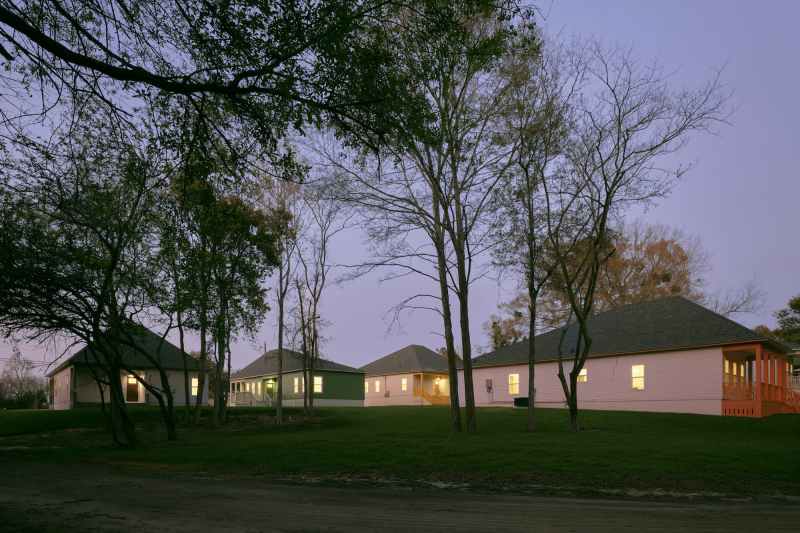
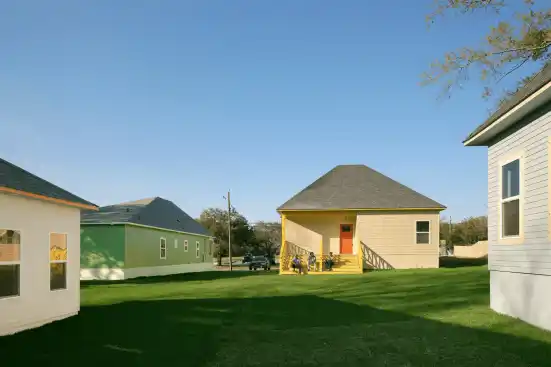
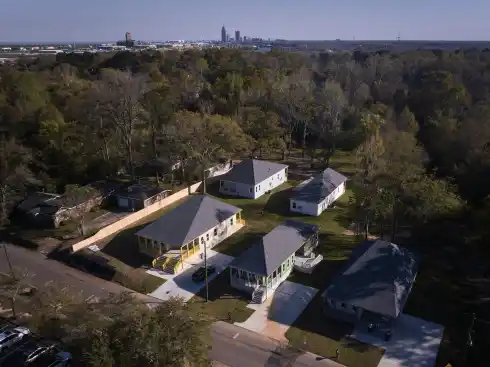
Located on scattered vacant lots throughout the community, the first six of eleven planned homes have been completed for the Africatown Redevelopment Corporation. Rather than treating the project as an exercise in historic preservation or architectural spectacle, the Mobile-based firm pursued a quieter ambition: creating contemporary houses that feel as though they belong to Africatown without pretending they were always there.
The challenge reflects a broader question facing communities across the United States. How can neighborhoods accommodate new development without losing the cultural identity that makes them unique in the first place?
For Africatown, that question carries particular urgency.
Building in a Place Unlike Any Other
Africatown occupies a singular position in American history.
After emancipation, survivors of the Clotilda established their own community north of Mobile, creating institutions, churches, schools, and social networks that preserved aspects of their cultural heritage while forging a distinctly American identity. Over generations, the neighborhood developed its own architectural language, shaped by local traditions, Southern building practices, economic realities, and community values.
The result was neither purely African nor conventionally Southern. It became something uniquely Africatown.
For architects entering such a place, the temptation can be to freeze history in time—to reproduce historic forms as a form of homage. Yet that approach often risks reducing living communities to museums.
Tall Architects understood that challenge from the outset.
Founded by principals Madison Talley and Mark Talley, the Ocean Springs Mississippi-based practice has built a reputation for work that is deeply rooted in the history, culture, and environmental realities of the Gulf Coast. Across civic, educational, residential, and community-focused projects, the firm has consistently looked to local building traditions and regional patterns as sources of inspiration rather than constraints.
That philosophy made the firm a natural fit for Africatown.
Instead of approaching the neighborhood primarily as a historic site, the architects treated it as a living community whose character continues to evolve.
Principal Madison Talley says the firm’s first task was understanding the neighborhood as it exists today rather than as an abstract historical narrative.
“We focused on the physical history of the place that was created by the original survivors of the Clotilda and the successive generations that have lived there,” Talley said. “From our perspective, the neighborhood was built with fundamentals that were carried over from other parts of the world, but over time, the neighborhood had taken on a personality of its own.”
That understanding emerged through extensive conversations with residents and community organizations before any design work began.
“We initially worked with the community members and local organizations to understand that personality and the functional and cultural aspirations for the homes before designing anything,” Talley said. “With that robust knowledge base, we were able to focus on two home-design concepts that were rooted in historic typologies.”
Looking to the Neighborhood Instead of Reinventing It
The houses draw from two architectural forms that have long shaped the community.
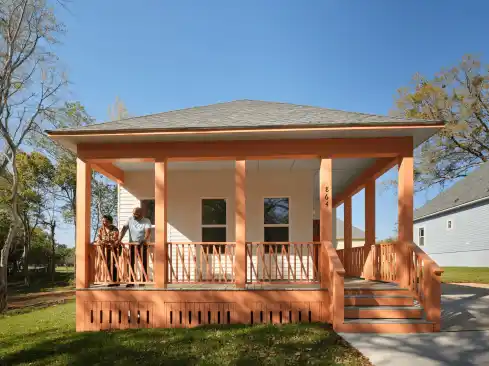
One is the Shotgun house, the narrow, linear housing type found throughout the American South and often associated with African diasporic building traditions. The other is the Wide House, a residential form that evolved within Africatown itself.
Rather than reproducing these typologies verbatim, Tall Architects treated them as frameworks rather than templates.
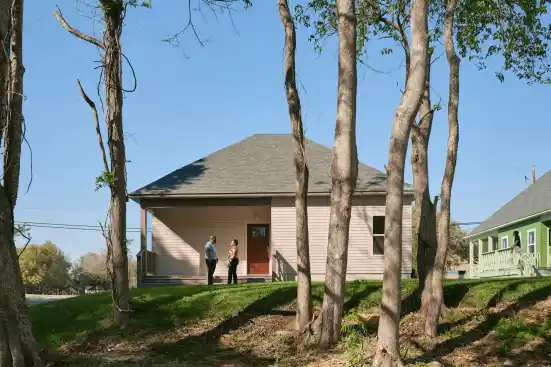
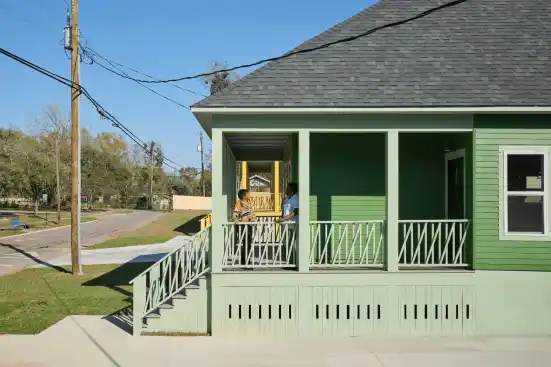
Each house references historic precedents while introducing subtle contemporary modifications. Rooflines shift slightly. Porch configurations are adjusted. Proportions evolve. Hipped roofs are reinterpreted. Architectural details draw inspiration from nearby buildings and the historic architecture of Mobile.
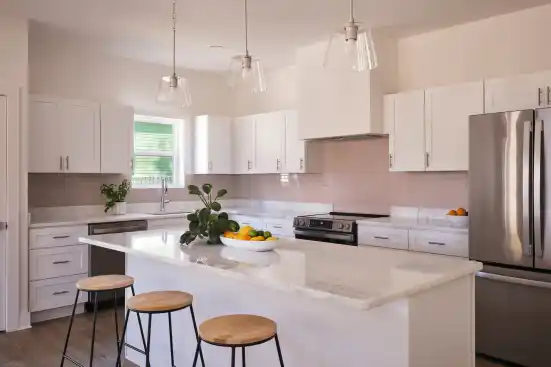
The result is architecture that feels familiar without feeling nostalgic.
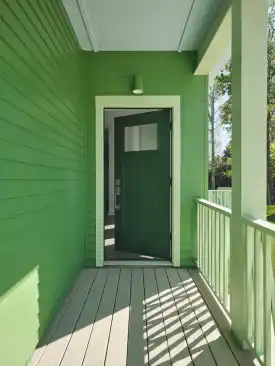
Color accents and wood detailing add further layers of connection to place. Rather than relying on overt symbolism, the architects embedded references to Africatown’s legacy through material choices, craftsmanship, and spatial relationships.
The goal was not to recreate the past.
The goal was to extend it.
The Challenge of Building Without Erasing
The questions facing Africatown are hardly unique.
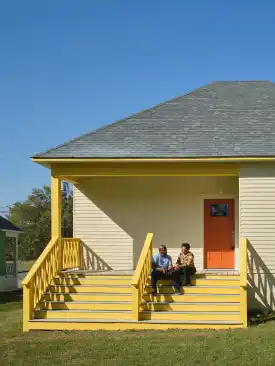
Across the United States, historic neighborhoods are struggling to accommodate new housing while preserving the cultural identity that defines them. Too often, development arrives as an external force, introducing buildings that could exist anywhere and belong nowhere.
Talley believes architects can learn important lessons from Africatown.
“We approached this exact issue in three distinct ways: 1 – We worked intimately with community members and local stakeholders to understand the cultural goals for the project, 2 – We carefully researched the existing neighborhood for important attributes that could and should be recreated, and then we chose certain elements to incorporate into the new designs, and 3 – We studied the best local construction techniques,” she said.
Perhaps most importantly, the architects resisted the temptation to impose a new architectural vision onto the community.
“Instead of trying to create a whole new architectural language, we relied on the existing neighborhood to guide the process,” Talley said.
That philosophy may sound obvious. In practice, it is surprisingly rare.
Contemporary architecture often celebrates originality. Developers frequently seek buildings that stand out. Yet in places like Africatown, success may depend less on creating something entirely new than on understanding what already exists.
The project reflects a growing recognition among architects and preservationists that communities remain healthy not by freezing themselves in time but by evolving thoughtfully. Cultural continuity emerges through adaptation rather than replication.
In Africatown, that continuity is particularly meaningful.
The community itself was born from adaptation. The survivors of the Clotilda carried memories, traditions, and knowledge from West Africa and transformed them into a new place under extraordinary circumstances. Their descendants continued that process over generations, shaping a neighborhood with its own identity and architectural character.
The new houses participate in that same evolution.
Filling the Empty Spaces
The project’s impact extends beyond the individual homes.
Like many historic Black communities, Africatown has faced decades of economic challenges, population decline, industrial encroachment, and disinvestment. Vacant lots have interrupted neighborhood streetscapes and weakened physical connections between residents.
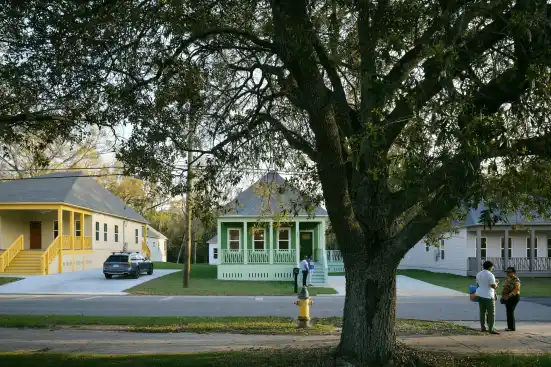
The new homes are strategically distributed throughout the community, occupying empty parcels and helping repair the urban fabric.
Rather than introducing a large development that could overwhelm the neighborhood, the architects pursued a form of targeted infill. Each house contributes to the rhythm of the street while reinforcing relationships among neighboring properties.
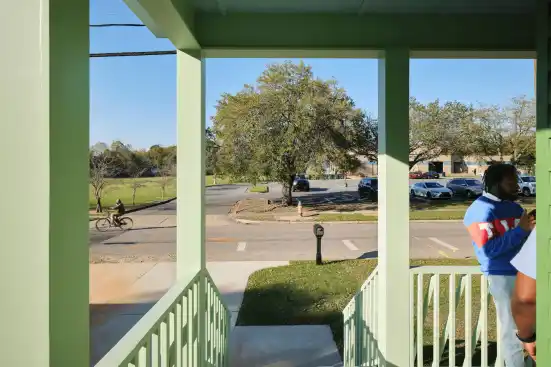
Front porches create opportunities for interaction. Building placement encourages visual connections. Together, the homes help strengthen the sense of community that has long defined Africatown.
The strategy recognizes that neighborhoods are not simply collections of buildings. They are social networks embedded within physical environments.
Good housing can reinforce those networks.
Bad housing can erode them.
A Different Model for Preservation
The significance of the project lies not simply in its architecture but in what it suggests about the future of preservation itself.
For decades, preservation has often focused on protecting existing buildings. Yet many historic communities face a different challenge: how to remain vibrant and relevant while accommodating new residents, new housing, and changing needs.
Africatown suggests another path.
The project demonstrates that preservation and development need not be opposing forces. New construction can reinforce cultural identity rather than erase it. Contemporary architecture can honor history without becoming trapped by it.
The homes do not mimic historic structures. They do not turn Africatown into a heritage attraction.
Instead, they acknowledge that the community’s greatest achievement was never the buildings themselves. It was the creation of a place where people could build lives, families, institutions, and a future.
That lesson may prove especially relevant as communities across the country grapple with how to grow while maintaining the qualities that make them distinctive.
For Tall Architects, the answer was not to invent something entirely new.
It was to listen.
The firm’s process relied on community engagement, historical research, and careful observation rather than architectural bravado. The resulting homes are modest in scale but ambitious in what they attempt to achieve.
They do not ask to become landmarks.
They ask to belong.
Building the Next Chapter
The survivors of the Clotilda did not establish Africatown as a memorial to tragedy. They built it as a functioning community—a place where families could prosper, traditions could survive, and future generations could flourish.
More than 160 years later, that work continues.
These houses occupy vacant lots, but they are really filling something larger: the space between memory and possibility.
In an era when so much new housing looks interchangeable from one city to the next, Africatown offers a reminder that architecture can still emerge from the specific histories, cultures, and aspirations of a particular place.
The first six homes may be modest in scale, but their ambition is profound.
They suggest that the future of historic communities may not depend on preserving the past exactly as it was.
It may depend on building carefully enough that the next chapter feels like it belongs to the same story.