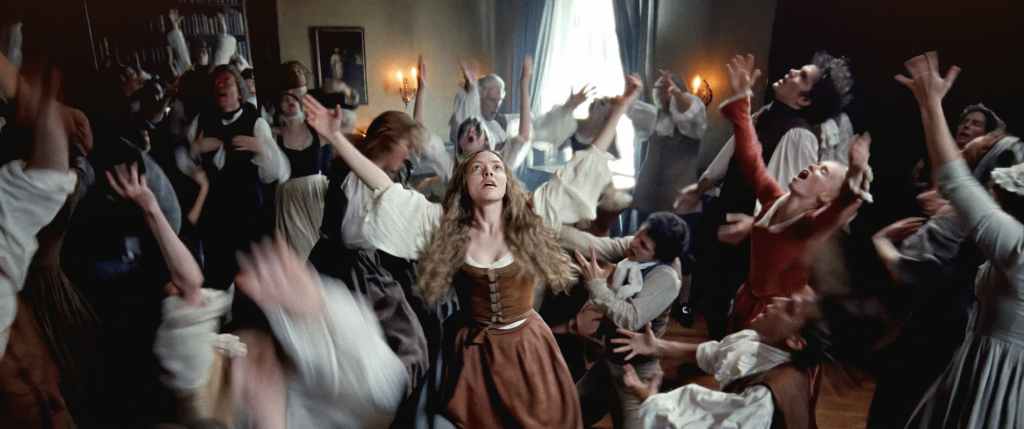
The Shakers are having a moment. The Testament of Ann Lee, a visually scrumptious film, directed by Mona Fastvold and starring Amanda Seyfried, has just ended its theatrical run and is now available for streaming.
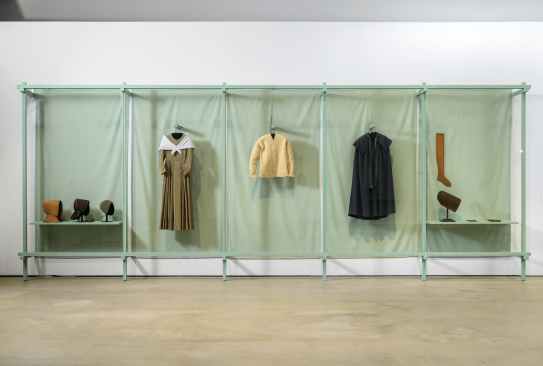
Installation view of A World in the Making: The Shakers at the Institute of Contemporary Art Philadelphia. Photo by Constance Mensch.
An exhibition, accompanied by a thorough and beautifully produced catalog (full disclosure: I wrote one of the essays) is now on display at the Institute of Contemporary Art in Philadelphia (through August 9) and will then travel to the Milwaukee Art Museum.
Keying into our renewed interest IRL and how we can heighten our experiences through both craft and spirituality, the focus on this sect of Christian believers, of which only two practitioners remain, opens our eyes –and in the movie our ears—to their ability to make the world around us awesome.
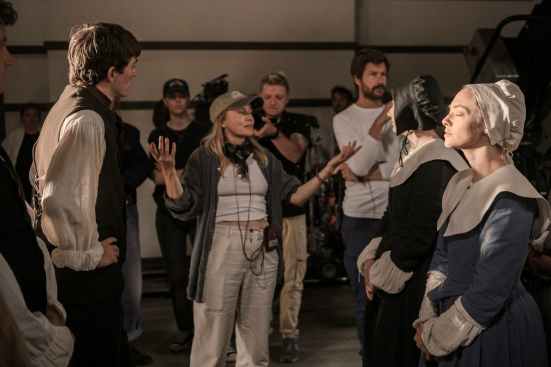
Director Mona Fastvold with cast and crew on the set of THE TESTAMENT OF ANN LEE. Photo courtesy of Searchlight Pictures. © 2025 Searchlight Pictures All Rights Reserved.
For me, and I am sure for most readers here, the designation “Shaker” has long been synonymous with simplicity. That is due in no small measure to the popularity of the hymn commonly known as “’T’is a Gift to Be Simple,” whose beguiling melody and message were popularized by Aaron Copeland (the film uses many Shaker hymns to great effect on its soundtrack, but not that one).
To hear it performed a capella in the meeting house at the former Shaker settlement in Pleasant Hill, Kentucky was for me one of the greatest revelations of how sound, space, and materiality can come together to open your senses to your environment. All complexity and conflict fell away, and I felt in the place. To walk into any of the half dozen Shaker settlements that have been preserved and are accessible today is open yourself to that possibility.
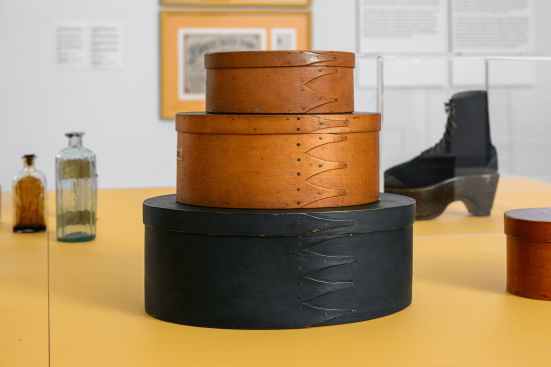
Installation view of A World in the Making: The Shakers at the Institute of Contemporary Art Philadelphia. Photo by Constance Mensch.
The other reason many of us still admire the Shakers is their craft. The Shaker boxes, whose thin wood skins warp around themselves like hands in a glove, the chairs reduced to their essence of sitting, the system of pegs and complex storage systems that present themselves as emblems of clarity, and the objects made for and expressing specific purposes, such as sewing or wood working, have become staples of the tchotchke stores that themselves have extended our midcentury modern fascination with functional and clean-lined design to the everyday world of affordable clutter.

Installation view of A World in the Making: The Shakers at the Institute of Contemporary Art Philadelphia. Photo by Constance Mensch.
The film implies that the Shakers learned some of their techniques from Native Americans. That might be true for some of their basketry techniques, but it is more likely that the same culture of experimentation and invention that turned the area from which they emerged around Manchester, England, into the birthplace of the Industrial Revolution at the same time as their founder Ann Lee, began articulating her positions, had more to do with development.
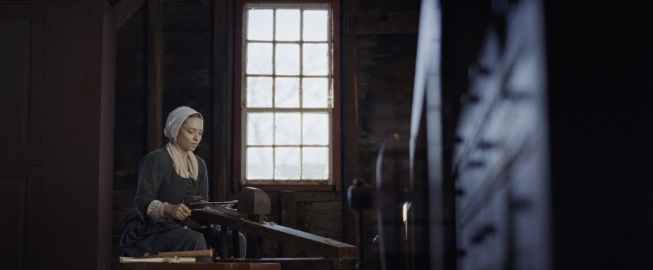
Amanda Seyfried in THE TESTAMENT OF ANN LEE. Photo courtesy of Searchlight Pictures. © 2025 Searchlight Pictures All Rights Reserved.
That sense of extending craft and simplifying objects and spaces to fit the task at hand extended in the New World, where resources were plentiful, but people and biases few.
Shaker design was, as the catalog more than any of the other elements of this revival points out, both a clarification and expressive turn to already existing craft, architecture, art, music, and dance in the same way that the “Shaking Quakers,” as they were called when they emerged out of the religious and social ferment that marked England in the second half of the 18th century, focused and heightened the religious experience already tuned up by sects such as the Methodists and Quakers.
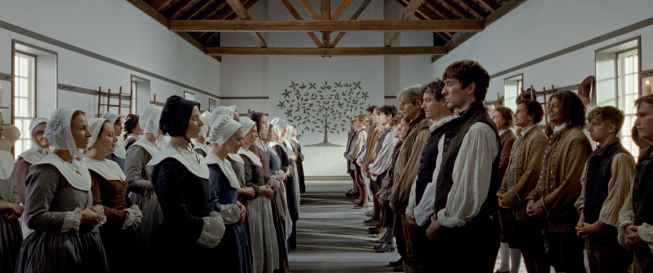
Ensemble in THE TESTAMENT OF ANN LEE. Photo courtesy of Searchlight Pictures. © 2025 Searchlight Pictures All Rights Reserved.
To that process the Shakers added some of their own signs, symbols, or just quirks. The most famous of these is the doubling that shows up in the architecture because of Ann Lee’s insistence on the separation of the sexes and celibacy. That replication and mirroring create echoes and splits in what are buildings and spaces that are otherwise simple house shapes. In addition, communal living meant that what look like houses at first glance are much bigger to accommodate the living quarters and activities of groups that in some locations reached up to six hundred members.
Though Lee railed against ornament, visual elements from the revelations she had received made their way into especially the woven parts of the Shaker’s art. The “tree of life” in particular blossoms across blankets and drawings. It brings the nature the congregants were so keen on husbanding to produce what they saw as an analogy of the sinless Garden of Eden into the daily lives of the buildings.
The exhibition gives us the objects, and the film evokes the life that produced them. While the Vitra Museum, which organized the presentation, has worked hard to provide the objects they have assembled from both their own collections and Shaker sites with a context, in one case by showing some of the choreography adapted for the film, the latter gives you the Shakers’ life but little of the frame they produced, inhabited, and used.
The film also goes overboard, in my opinion, in amping up the singing and dancing, layering it with lush orchestrations and gyrating camera moves that to me recall Bob Dylan turning on his electric guitar at the Newport Folk Festival.
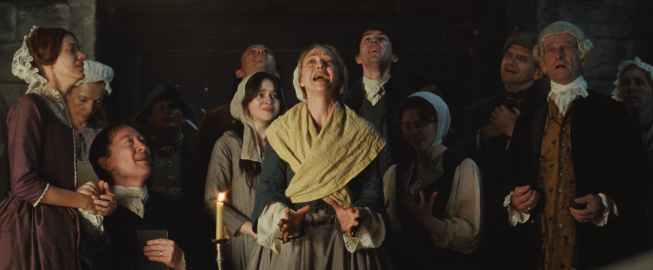
Amanda Seyfried in THE TESTAMENT OF ANN LEE. Photo courtesy of Searchlight Pictures. © 2025 Searchlight Pictures All Rights Reserved.
The aching desire and awe, but also the hypnotic simplicity of rhythm and form dissolve into aural and visual systems that to me seemed overly decorative. Then again, maybe my biases for the myth of simplicity are showing here.
On the other hand, what I had hoped Fastvold would provide, which was the grit out of which the Shakers emerged in England and that they encountered in America, is sanitized. Lee’s proclamation of celibacy as the only way back to God is laid, in typical Hollywood fashion, on her personal experience with childbirth and a sadomasochistic husband (who in the movie actually reads her de Sade), rather than on the sensuality, filth, violence, and mass social upheaval out of which she emerged.
The discovery of the land they made their own in upstate New York is rendered quite literally as a walk in the park, including on paths that appear in the middle of what is meant to be (pace those that already lived there) virgin territory.
For all that, these events, along with our turn towards spirituality that we can achieve through focusing on the real and craft (ASMR, Marie Kondo’s drive to decluttering, raves and art festivals in the middle of the desert, the craze for the fetishistic architecture of luxe minimalist such as Tadao Ando, David Chipperfield, and John Pawson) serve to show that it is indeed a gift to be simple and pure, or to find ways to open yourself up the world around you, and that good design can get us at least part of the way towards that newfound Eden.
Read more: The latest from columnist Aaron Betsky includes reviews of: The V&A Storehouse | Fins on Buildings | New Museum & The Studio Museum in Harlem | The Modern Museum | Monuments | Infrastructure | Interior Design | Viollet-le-Duc | Malibu High School | Architecture without Architects | Louis Kahn’s Fisher House | Meow Wolf | Generative AI | Frank Gerhy | Robert A.M. Stern | Lars Lerup | Princeton Art Museum | Victor Legorreta | Mexico City Underwater | On Vitruvius | On Olive Development | Calder Gardens | White House and Classical Architecture | Louis Kahn’s Esherick House | Ma Yansong’s Fenix Museum | The Cult of Emptiness | An Icon in Waiting | Osaka Expo | Teamlab | the Venice Biennale of Architecture | On Michael Graves | On Censorship or Caution? | Uniformity in Architecture | Book on Frank Israel | Legacy of Ric Scofidio| Fredrik Jonsson and Liam Young | DSR’s New Book | the Stupinigi Palace | Living in a Diagram | Bruce Goff | Biopartners 5 |Handshake Urbanism | the MONA | Elon Musk’s Space X | AMAA | DIGSAU | Art Biennales | B+ | William Morris’s Red House | Dhaka | Marlon Blackwell’s new mixed-use development | Eric Höweler’s social media posts,| Peter Braithwaite’s architecture in Nova Scotia,| Powerhouse Arts, | the Mercer Museum, | and MoMA’s Ed Ruscha exhibition.
Keep the conversation going—sign up to our newsletter for exclusive content and updates. Sign up for free.