For architecture firms waiting for the long-promised recovery, July delivered another reason to keep waiting.
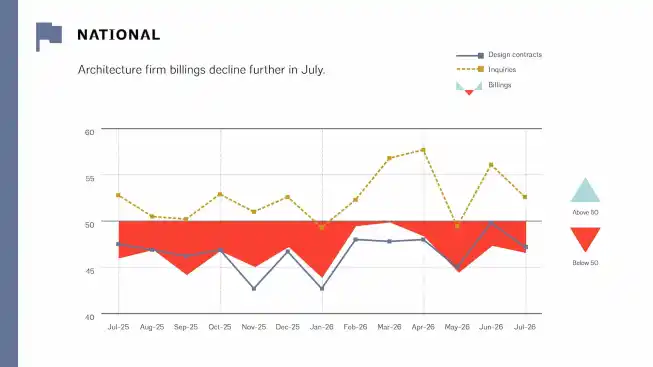
The AIA/Deltek Architecture Billings Index (ABI) fell to 46.6 in July, down modestly from June and extending what has become the longest period of soft business conditions in the index’s history: nearly three and a half years.
The latest numbers, released Aug. 19 by the American Institute of Architects, reveal an industry caught in a stubborn holding pattern. Clients are still considering projects, but that interest is increasingly failing to translate into signed contracts and stronger billings.
The project inquiries index remained in positive territory at 52.6, although inquiries grew more slowly than in June. More troubling, the design contracts index fell to 47.2 after coming close to growth the previous month.
An ABI score above 50 indicates increasing billings; a score below 50 signals a decline.
The widening gap between inquiries and contracts suggests that demand has not disappeared. Instead, projects appear to be struggling to cross the financial threshold from consideration to commission.
“Macroeconomic uncertainty continues to weigh on the built environment,” said AIA Chief Economist Richard Branch. “High oil prices are putting upward pressure on inflation and may lead to even higher rates in the back half of the year. This will put additional pressure on developers and may lead to a further weakening in billings.”
An Unprecedented Downturn
The ABI is closely watched because architects typically become involved early in the development process, making firm billings a potential leading indicator of future construction activity.
What distinguishes the current downturn is its duration. Rather than a sharp collapse followed by a rebound, firms have endured nearly three and a half years of persistently weak conditions.
For architecture practices, duration matters. Firms can often navigate a brief contraction by relying on existing backlogs and projects already under contract. A multiyear slowdown is different, bringing delayed starts, slower client decisions, staffing uncertainty, pressure on fees, and repeated questions about whether projects still make financial sense.
The July numbers offer little evidence of an imminent reversal.
Plenty of Interest, Not Enough Contracts
The disparity between project inquiries and signed contracts may be the clearest expression of the industry’s current predicament.
With inquiries at 52.6, prospective work continues to enter the pipeline. But design contracts at 47.2 indicate that too little of that activity is converting into actual commissions.
Financing provides at least part of the explanation. Developers may be exploring projects while struggling with borrowing costs. Institutional clients may be considering capital investments but hesitating over budgets. Companies may be evaluating new facilities while waiting for greater economic certainty.
For architects, that can mean spending substantial time on proposals, meetings, feasibility studies, and early-stage discussions for projects that are ultimately delayed, reduced in scope, or abandoned.
The drop in design contracts is particularly notable because the index had approached growth in June. Instead of crossing the 50 threshold in July, it moved further into contraction.
Weakness From Coast to Coast
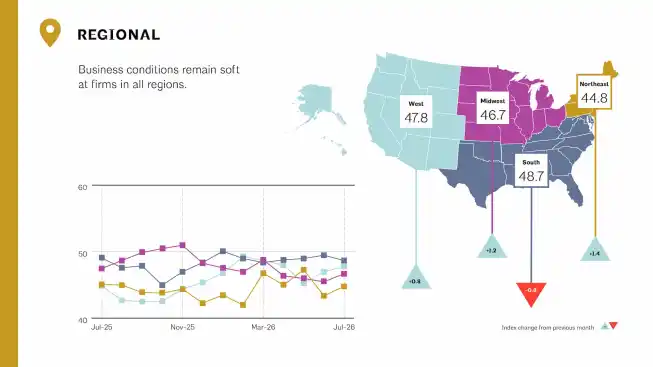
No region escaped the slowdown.
The South, at 48.7, posted the strongest regional score, followed by the West at 47.8 and the Midwest at 46.7. Although all three remained below 50, their rates of decline eased slightly.
The Northeast, however, continued to lag, registering 44.8 and reporting the weakest business conditions for the second consecutive month.
Because the regional figures are calculated as three-month moving averages, the across-the-board contraction points to a broad national slowdown rather than weakness concentrated in a few markets.
Every Major Sector Is Contracting
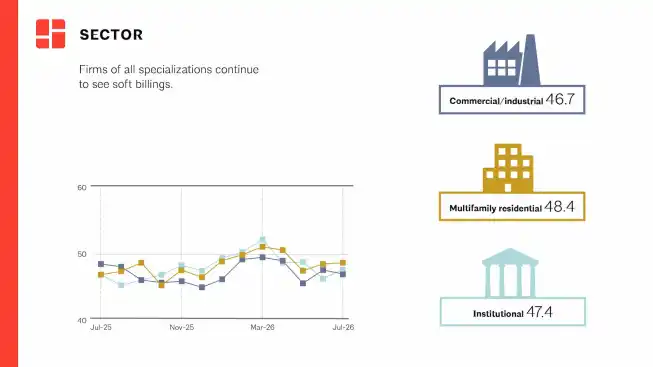
There was equally little refuge among building sectors.
Multifamily residential firms posted the strongest score at 48.4, followed by institutional practices at 47.4 and commercial and industrial firms at 46.7. Mixed-practice firms recorded the weakest conditions at 43.2.
The reversal in multifamily and institutional work is particularly notable. Both sectors recorded slight growth earlier this year before slipping back into contraction.
Commercial and industrial practices face a much longer drought: Firms specializing in the sector have not reported an increase in billings since July four years ago.
That prolonged weakness underscores the challenges facing commercial real estate, from expensive financing and uncertain office demand to changing workplace patterns and cautious corporate investment.
Multifamily housing presents a different paradox. Many cities desperately need additional housing, yet high borrowing costs and construction expenses can prevent projects from moving forward even where demand is substantial.
The result is a larger problem confronting the building industry: The need for buildings and the ability to finance them are increasingly two different things.
The Interest-Rate Problem Isn’t Over
For much of the current downturn, lower interest rates have been viewed as a potential catalyst for recovery. Branch’s warning complicates that scenario.
High oil prices could add to inflationary pressure and potentially push rates higher in the second half of the year. For developers already struggling to make projects pencil out, another increase in borrowing costs could make an already difficult environment worse.
Architecture firms are particularly exposed because their work sits near the beginning of the development cycle. A project does not have to be canceled to affect an architect’s business. It can simply be postponed.
That helps explain the unusual contradiction in July’s numbers: Clients continue to inquire about projects even as signed contracts and billings decline.
The pipeline, in other words, has not disappeared. It has become harder to move through.
After nearly three and a half years, that distinction is becoming increasingly important. Architecture firms are not necessarily confronting a world without projects; they are confronting one in which too many projects remain prospective for too long.
For an industry that has spent years anticipating the next recovery, July’s ABI delivers an unsettling message: There are still projects people want to build. The problem is an economy that keeps making them harder to build.