With 3-d modeling, scholars bring an ancient city back to life.
7 MIN READ
Michael Warren
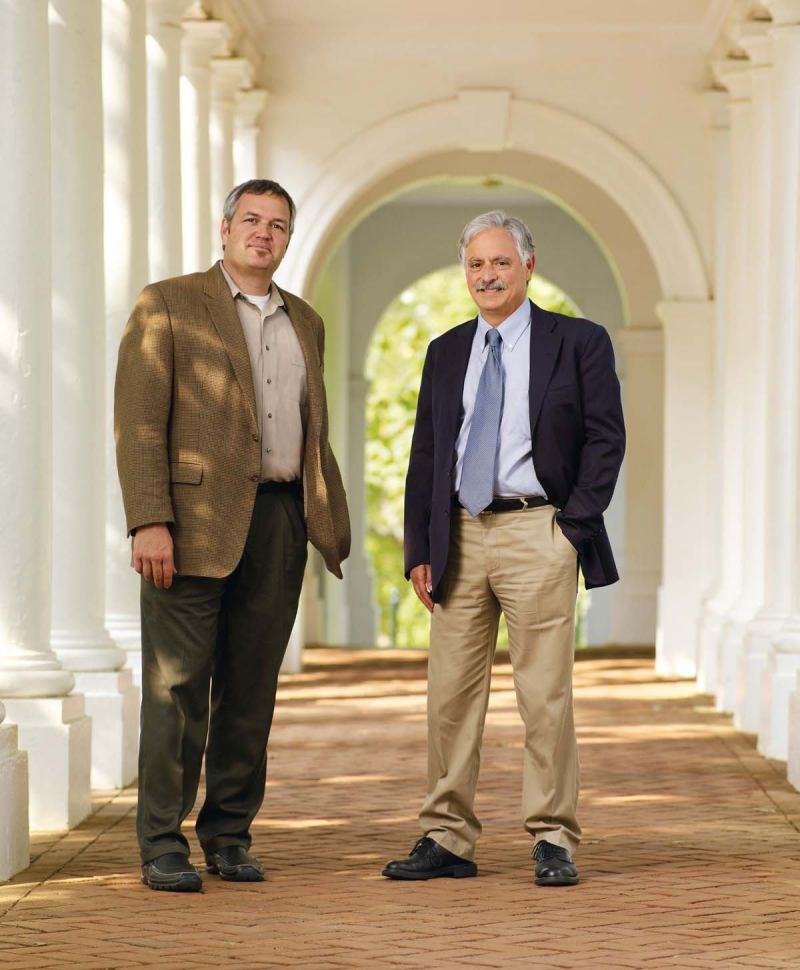
Pictured on the suitably neoclassical campus of the University of Virginia, faculty members Dean Abernathy (far left) of the School of Architecture and Bernard Frischer of the Department of Classics have helped create a digital model of the city of Rome in A.D. 320. Their collaborator on the project is University of California, Los Angeles, classicist Diane Favro, who is currently abroad.
Built at a scale of 1:250 and measuring more than 250 square fee…
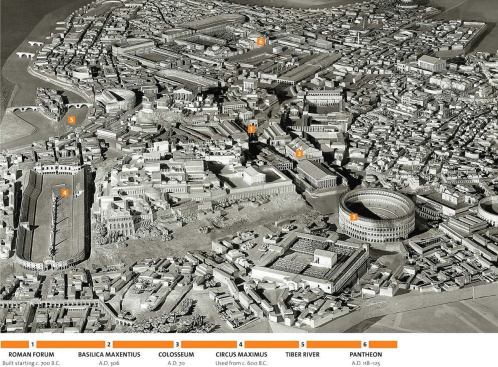
Built at a scale of 1:250 and measuring more than 250 square feet, the Plastico di Roma Antica is a plaster model of the ancient city of Rome housed in the Museum of Roman Civilization. It depicts the city in the early fourth century, when its population was about 1 million.
IATH/University of Virginia
A still from the digital model shows the western end of the Foru…
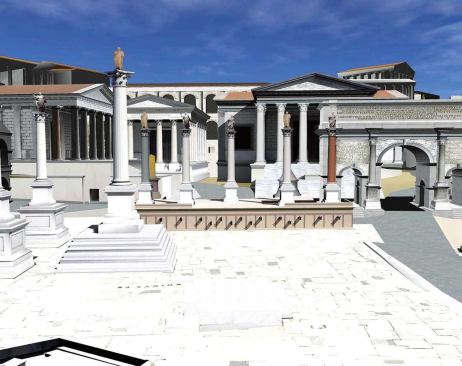
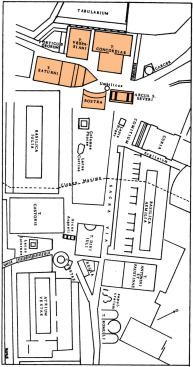
A still from the digital model shows the western end of the Forum, with the Arch of Septimius Severus at right, three temples behind it (see plan, below left), and the Rostra, or speakers' platform, in front. Th
The Rostra (which means "prows" in Latin) was so called on accou…
The Rostra (which means "prows" in Latin) was so called on account of the bronze prows of enemy warships that were mounted on it as trophies.
Corbis
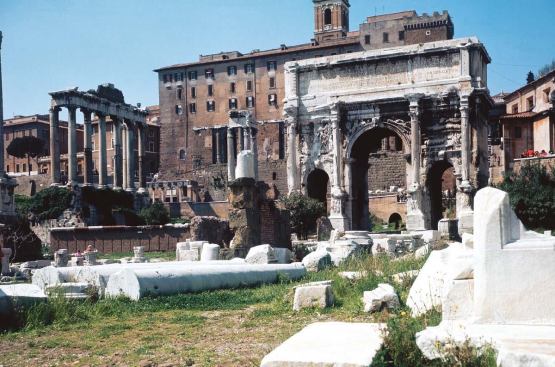
Unlike the fragmentary site today, the Roman Forum in A.D. 320 w…
Unlike the fragmentary site today, the Roman Forum in A.D. 320 was imposing, dense with richly decorated temples and monuments.
REGENTS OF THE UNIVERSITY OF CALIFORNIA
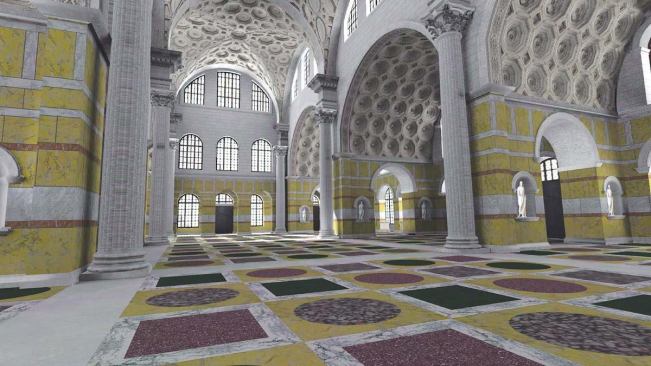
Paved in yellow, red, green, and purple marbles in a pattern of …
Paved in yellow, red, green, and purple marbles in a pattern of circles and squares, the floor of the Basilica Maxentius recaptures its original splendor in the Rome Reborn model.
Corbis
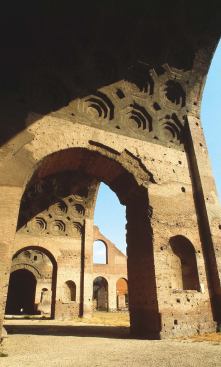
The grandeur of the structure, however, is still clear from the …
The grandeur of the structure, however, is still clear from the physical remains: coffered barrel vaults stand 80 feet high.
Corbis
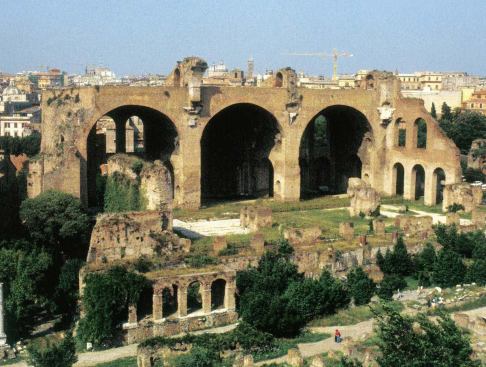
The three arches stretched alongside the nave indicate the basil…
The three arches stretched alongside the nave indicate the basilica's immense size before the rest likely collapsed in an earthquake in A.D. 847.
Corbis
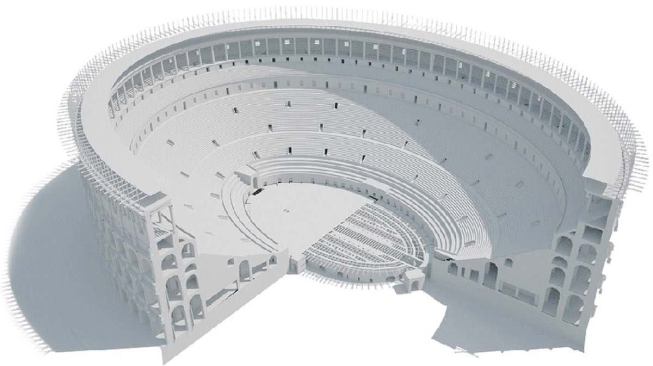
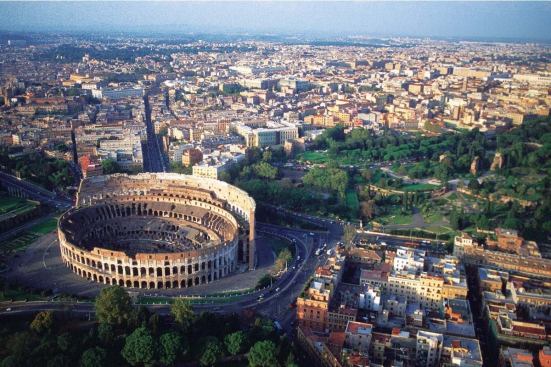
Social stratification: The Colosseum's four tiers of spectator s…
Social stratification: The Colosseum's four tiers of spectator seating inverted the class structure of Roman society, with top-ranking senators getting the lowest, closest tier; knights occupying the secondlowest; ordinary citizens above them; and the poor and slaves at the top.
Colosseum Model: Regents of the University of California
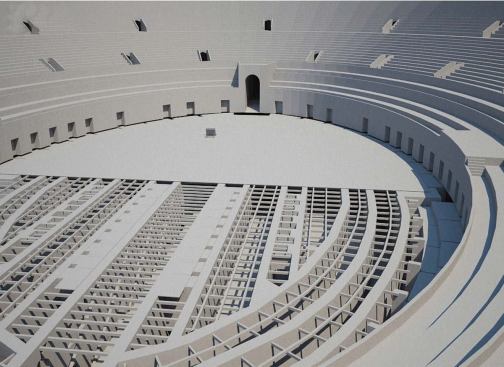
Under the wooden floor of the arena is a warren of holding cells…
Under the wooden floor of the arena is a warren of holding cells for men and animals.
CD-Rome: Technology that inspired the model
From the 1970s onward, Bernard Frischer experimented with different technologies in his quest to simulate the ancient city of Rome. While a fellow at the American Academy in Rome in 1975, Frischer met urban designer Donald Appleyard of the University of California, Berkeley. Appleyard had developed a system of video editing that presented models of new architectural projects within the context of the surrounding neighborhood and city. Appleyard died in 1982, but his work gave Frischer the idea to translate the plaster-of-paris model of ancient Rome into video form.
From 1978 to 1980, a research team from the Massachusetts Institute of Technology created the Aspen Movie Map, a navigable, touchscreen tour of Aspen, Colo., that was a breakthrough in interactive media. The team mounted four 16mm film cameras on top of a car and drove down the center of every street in Aspen, capturing front, back, and side views. The scenes were transferred to laserdisc and linked to a street plan of Aspen. “My idea was to use the same approach, with miniature cameras going up and down the streets of the [Rome] model,” says Frischer. So he did some test shots of the plaster model to see if it would support a close-up view. It didn’t. “Eighty percent of the surfaces of buildings in that model have no detail at all,” Frischer says. “So the idea of a videodisc didn’t fly. But the vision of simulating ancient Rome stuck with me.”
The advent of 3-D modeling software proved more auspicious. The buildings and terrain that constitute the urban fabric in Rome Reborn 1.0, based on a laser scan of the Plastico, were modeled with Maya software, textured with Google SketchUp, and then imported into MultiGen Creator. Finally, says Kim Dylla, a systems operator who works with Frischer, the Creator model of the whole city was converted to an OpenSceneGraph binary format for real-time viewing. —Amanda Kolson Hurley